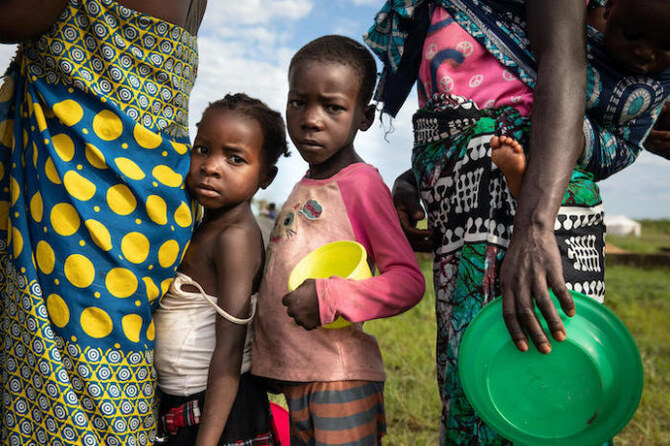
UNITED NATIONS, United States: Demographic shifts, worsening climate change and rapid technological transformation risk creating a bleak future for youth in the mid-21st century, the United Nations agency for children warned Tuesday in an annual report.
“Children are experiencing a myriad of crises, from climate shocks to online dangers, and these are set to intensify in the years to come,” Catherine Russell, executive director of UNICEF, wrote in a statement marking the release of the agency’s annual report.
“Decades of progress, particularly for girls, are under threat.”
This year, UNICEF uses its report to project forward to 2050 identifying three “major trends” that in addition to unpredictable conflicts pose threats to children unless policymakers make changes.
The first risk is demographic change, with the number of children expected to remain similar to current figures of 2.3 billion, but they will represent a smaller share of the larger and aging global population of around 10 billion.
While the proportion of children will decline across all regions, their numbers will explode in some of the poorest areas, particularly in sub-Saharan Africa.
This offers the potential to boost economic growth, but only if the new young population has access to quality education, health care, and jobs, UNICEF notes.
In some developed countries, children could make up less than 10 percent of the population by 2050, raising concerns about their “visibility” and rights in societies focused on aging populations.
The second threat is climate change.
If current greenhouse gas emission trends continue, by 2050 children could face eight times more heatwaves than in 2000, three times more extreme flooding, and 1.7 times more wildfires, UNICEF projects.
New technology, particularly artificial intelligence, has the potential to power new innovation and progress but could also widen existing inequalities between rich and poor countries.
An estimated 95 percent of people in developed nations have Internet access, compared to just 26 percent in the least developed, often due to a lack of electricity, connectivity, or devices.
“Failure to remove barriers for children in these countries, especially for those living in the poorest households, means letting an already disadvantaged generation fall even further behind,” according to UNICEF.
Being connected also carries risks. The unchecked proliferation of new technologies poses threats to children and their personal data, making them vulnerable to online predators.
“Children of the future face many risks, but what we wanted to demonstrate is that the solutions are in the hands of todays decision-makers,” Cecile Aptel, deputy director of UNICEF’s research division, told AFP.


Children’s wellbeing ‘under threat’ in 2050, warns UNICEF
https://arab.news/m6rye
Children’s wellbeing ‘under threat’ in 2050, warns UNICEF

- The unchecked proliferation of new technologies poses threats to children and their personal data, making them vulnerable to online predators


Fire at Cape Town airport disrupts international flights
- Images shared online showed travelers evacuating South Africa’s second-busiest airport
- The fire occurred just days after the announcement of a major phased infrastructure upgrade project at the airport
CAPE TOWN: A fire broke out at Cape Town International Airport Tuesday, prompting passenger evacuations and disrupting international flights to and from South Africa’s popular tourist city before being brought under control.
Images shared online showed travelers evacuating South Africa’s second-busiest airport with suitcases as smoke filled the terminal and sirens rang to alert passengers of an emergency evacuation.
“Cape Town International Airport confirms that a fire occurred on the landslide of the airport,” Airports Company South Africa (ACSA) said in a statement, adding that the blaze had been “extinguished” with no injuries.
“As a precautionary measure, international departures have been temporarily suspended, and incoming international flights are being diverted,” the statement said, as the fire had affected “network and IT services.”
International flights that had already landed were still being processed, it said.
The fire occurred just days after the announcement of a major phased infrastructure upgrade project at the airport.
According to ACSA statistics, Cape Town airport recorded 11.1 million two-way passengers in 2025, including 3.33 million international travelers.


