French president urges Putin to ‘listen to reason’ on Ukraine

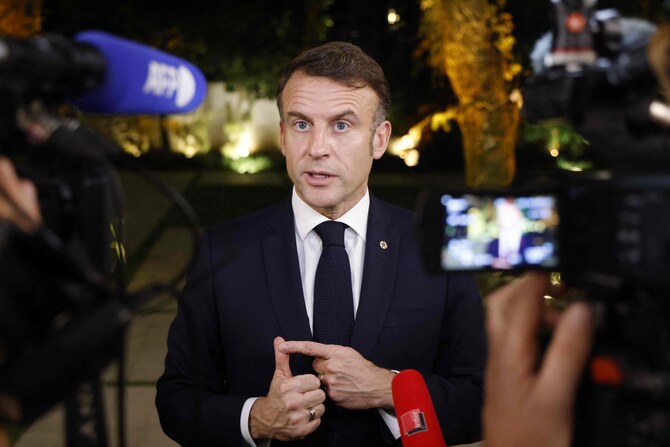
French President Emmanuel Macron makes a statement to the French media during the G20 summit in Rio de Janeiro, Brazil, on Nov. 18, 2024 (AFP)
Short Url
Updated 20 November 2024
Follow

French president urges Putin to ‘listen to reason’ on Ukraine

  • Emmanuel Macron said he had asked Chinese President Xi Jinping to "use all his influence" with Putin to try to achieve a de-escalation.

RIO DE JANEIRO: French President Emmanuel Macron urged his Russian counterpart Vladimir Putin to “listen to reason” on Ukraine, accusing Moscow of becoming “a force of global destabilization” after it loosened its rules on using nuclear arms.
Speaking to journalists after the G20 summit in Rio de Janeiro, the French leader said: “I want truly to call here on Russia to listen to reason. As a permanent member of the United Nations Security Council it has responsibilities.”
He said he had asked Chinese President Xi Jinping during a meeting at the G20 to “use all his influence” with Putin to try to achieve a de-escalation.
Macron said Russia ally China had “the capacity to negotiate with President Putin so that he halts his attacks” on Ukraine.
Macron also cited the alleged involvement of another China ally, North Korea, which has reportedly deployed thousands of troops to fight alongside Russia, as a reason for Beijing to intercede.
Russia has reacted furiously to a decision by US President Joe Biden to change policy on Ukraine and allow Kyiv to use US-supplied long-range missiles to strike Russian territory for the first time.
The tensions spiralled further on Tuesday after Russia said Ukraine used the missiles against a facility in Russia’s Bryansk region.
Russian Foreign Minister Sergei Lavrov, who was at the G20, said the escalation had brought the United States and Russia to “the brink of direct military conflict.”


Japan ruling party approves plans to beef up intelligence

Updated 5 sec ago
Follow

Japan ruling party approves plans to beef up intelligence

TOKYO: Japanese Prime Minister Sanae Takaichi’s ruling party has approved plans to beef up the country’s intelligence capability, a party official said Friday, as the premier pushes ahead with a defense overhaul.
Newly empowered after a landslide victory in snap elections this month, Takaichi has vowed to make Japan “strong and prosperous” through key policy changes including in defense and intelligence.
The plans come as a months-long diplomatic row between Japan and China over comments Takaichi made on Taiwan rumbles on.
The proposal, agreed by the intelligence strategy headquarters of the Liberal Democratic Party (LDP), includes establishing an upgraded intelligence bureau and strengthening “foreign intelligence collection capabilities,” an LDP official told AFP.
It calls for a mandatory registration system for foreign agents — such as individuals and corporations lobbying within Japan on behalf of other governments — as part of counterintelligence measures.
The plan, which also includes a ban on the use of mobile phones in key government buildings, is expected to be submitted to Takaichi next week, the Asahi Shimbun and other local media reported.
“One of the central pillars of the major policy shift (under Takaichi) is a fundamental strengthening of intelligence,” the LDP’s policy chief Takayuki Kobayashi said at the meeting Thursday where plans were approved.
“Simply creating an organization on paper is utterly meaningless; the question is how we can turn it into a truly living, functioning body,” he said.
Separately, the LDP on Wednesday proposed changes to Japan’s stringent rules on exporting military equipment so as to enable exports of lethal weapons, local reports said.
The LDP official could not immediately confirm the proposal.
Takaichi has also said that she plans to revise three key national security policy documents this year to reflect the changing security environment.
The premier, seen as a China hawk before becoming premier in October, suggested in November that Japan could intervene militarily if Beijing sought to take Taiwan by force.
China, which regards the democratic island as part of its territory and has not ruled out force to annex it, was furious.
It summoned Tokyo’s ambassador, warned Chinese citizens against visiting Japan and in December J-15 jets from China’s Liaoning aircraft carrier twice locked radar on Japanese aircraft in international waters near Okinawa, according to Japan.
Takaichi has vowed that Japan will steadfastly protect its territory, territorial waters and airspace.
Beijing’s top diplomat Wang Yi told the Munich Security Conference earlier this month that forces in Japan were seeking to “revive militarism.”
While she has said in parliament she will not change the rules, local media have reported that Takaichi is considering allowing US nuclear weapons into Japanese territory, a revision to the country’s non-nuclear principles of not producing, possessing or permitting the introduction of the weapons into the country.