

Pakistan dispatches aid consignment to Syria amid Israeli strikes 

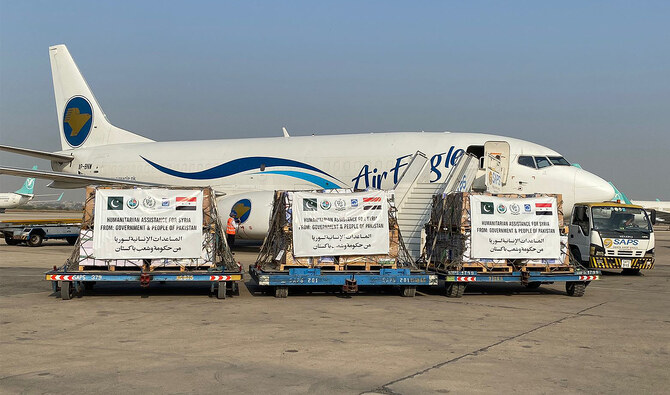
The picture shared by the National Disaster Management Authority on November 19, 2024, shows an aid consignment ready to be dispatched for Syria in Karachi, Pakistan. (NDMA)
Short Url
Updated 19 November 2024
Follow

Pakistan dispatches aid consignment to Syria amid Israeli strikes 

  • Israel has been hitting what it calls Iran-linked targets in Syria for years but has ramped up such raids since Oct. 7, 2023
  • Before latest dispatch, Pakistan has sent 12 aid consignments to Palestine, six shipments to Lebanon, one to Syria

ISLAMABAD: Pakistan’s National Disaster Management Authority (NDMA) on Tuesday dispatched a consignment of aid for Syria where Israel has been carrying out strikes as part of its military actions in the Middle East.

Israel has been hitting what it calls Iran-linked targets in Syria for years but has ramped up such raids since the Oct. 7, 2023, attack by Hamas on Israel, leading Israel to launch a military campaign in which more than 43,000 Palestinians have been killed in Gaza and more than 3,500 people in Lebanon.

Israel launched its campaign in Gaza after a Hamas-led assault on southern Israeli communities in which some 1,200 people were killed and another 250 taken hostage, according to Israeli tallies.

“On Tuesday, 20th consignment of aid was dispatched from Karachi to Syria,” the NDMA said in a statement. 

“This aid shipment, sent by NDMA in collaboration with Al-Khidmat Foundation [NGO], comprised approximately 17 tons of supplies, including rice buckets, powdered milk, tin food, family packs, sleeping bags, medical support kits and generator. The aid was dispatched via chartered flight from Jinnah International Airport, Karachi, to Damascus, Syria.”

Before Tuesday’s dispatch, the government of Pakistan had sent 12 aid consignments to Palestine, six to Lebanon, and one to Syria. 

Pakistan does not recognize nor have diplomatic relations with Israel and calls for an independent Palestinian state based on “internationally agreed parameters” and the pre-1967 borders with Al-Quds Al-Sharif as its capital.

Since the beginning of the war in October last year, Pakistan has repeatedly called for a ceasefire in Gaza and raised the issue at the United Nations, the Organization of Islamic Cooperation (OIC) and other international forums, urging an end to Israeli military actions.


Pakistani, Bangladeshi officials discuss trade, investment and aviation as ties thaw

Updated 28 December 2025
Follow

Pakistani, Bangladeshi officials discuss trade, investment and aviation as ties thaw

  • Pakistan and Bangladesh were once one nation, but they split in 1971 as a result of a bloody civil war
  • Ties between Pakistan, Bangladesh have warmed up since last year and both nations have resumed sea trade

ISLAMABAD: Pakistan's High Commissioner to Bangladesh Imran Haider on Sunday met Chief Adviser Muhammad Yunus in Dhaka, the latter's office said on, with the two figures discussing trade, investment and aviation.

Pakistan and Bangladesh were once one nation, but they split in 1971 as a result of a bloody civil war, which saw the part previously referred to as East Pakistan seceding to form the independent nation of Bangladesh.

Ties between Pakistan and Bangladesh have warmed up since former prime minister Sheikh Hasina’s ouster as a result of a student-led uprising in August 2024. Relations remain frosty between Dhaka and New Delhi over India’s decision to grant asylum to Hasina.

Pakistan has attempted to forge closer ties with Bangladesh in recent months and both South Asian nations last year began sea trade, followed by efforts to expand government-to-government commerce.

"During the meeting, both sides discussed ways to expand cooperation in trade, investment, and aviation as well as scaling up cultural, educational and medical exchanges to further strengthen bilateral relations between the two South Asian nations," Yunus's office said in a statement on X.

In 2023-24 Pakistan exported goods worth $661 million to Bangladesh, while its imports were only $57 million, according to the Trade Development Authority of Pakistan. In Aug. this year, the Pakistani and Bangladeshi commerce ministries signed a memorandum of understanding to establish a Joint Working Group on Trade, aiming to raise their bilateral trade volume to $1 billion in the financial year that began in July.

The Pakistani high commissioner noted that bilateral trade has recorded a 20 percent growth compared to last year, with business communities from both countries actively exploring new investment opportunities, according to the statement.

He highlighted a significant increase in cultural exchanges, adding that Bangladeshi students have shown strong interest in higher education opportunities in Pakistan, particularly in medical sciences, nanotechnology, and artificial intelligence. Haider also said that Dhaka-Karachi direct flights are expected to start in January.

"Chief Adviser Professor Muhammad Yunus welcomed the growing interactions between the two countries and emphasized the importance of increased visits as well as cultural, educational and people-to-people exchanges among SAARC (South Asian Association for Regional Cooperation) member states," the statement read.

"Professor Yunus also underscored the need to further boost Bangladesh–Pakistan trade and expressed hope that during Mr. Haider’s tenure, both countries would explore new avenues for investment and joint venture businesses."