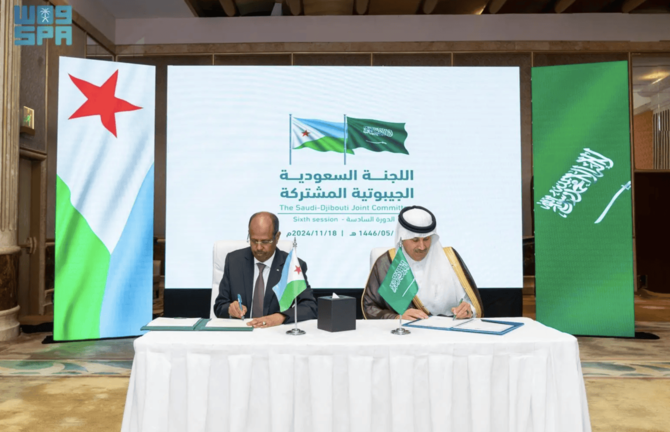

RIYADH: Logistical, trade, and investment ties between Saudi Arabia and Djibouti are set to grow stronger following the sixth session of their joint committee, held in Riyadh on Nov. 18.
The meeting was chaired by Saudi Minister of Transport and Logistic Services, Saleh Al-Jasser, and Djibouti’s Minister for Foreign Affairs and International Cooperation, Mahamoud Ali Youssouf, according to the Saudi Press Agency.
In his opening remarks, Al-Jasser emphasized the deep-rooted ties between the two nations, noting that the discussions were just the beginning of efforts to further enhance trade and investment across vital sectors, particularly logistics.
He highlighted the significant progress in bilateral trade, which reached approximately SR7 billion ($1.86 billion) in 2023, marking an important step toward sustainable growth and stronger economic ties between Saudi Arabia and Djibouti.
Al-Jasser pointed out that these figures serve as a foundation for deepening trade cooperation, noting that the previous session of the joint committee had already laid the groundwork for expanded collaboration.
The continued growth of trade between the two countries is reflected in the ongoing efforts to build more robust economic partnerships.
Earlier in August, the two nations agreed to launch a maritime initiative to strengthen trade connections. This initiative includes the establishment of new shipping lines designed to boost connectivity with East African markets, which serve a consumer base of around 500 million people.
A centerpiece of the partnership is the Saudi Logistics City, planned for development within Djibouti's Free Zone. This ambitious project, formalized through a contract signed in June, aims to facilitate the export of Saudi products to East Africa and further strengthen economic relations. The 92-year agreement, which covers an initial 120,000 sq. meters, is expected to have a transformative impact on both countries’ economies, fostering long-term growth and collaboration.
The ongoing efforts between Saudi Arabia and Djibouti are poised to significantly enhance bilateral trade, investment, and regional connectivity, marking a promising chapter in their economic partnership.