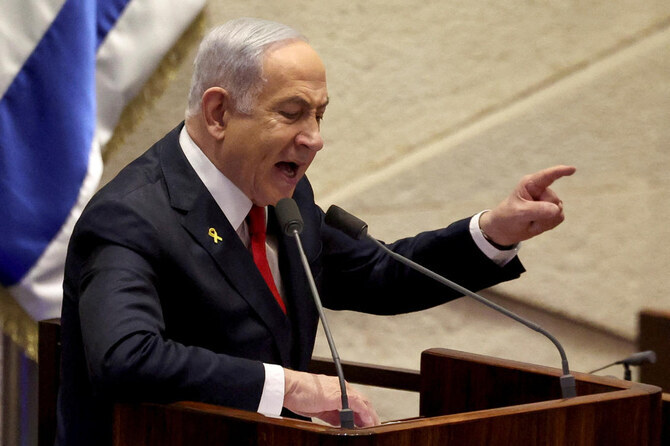
JERUSALEM: Prime Minister Benjamin Netanyahu said on Monday that Israel will continue to operate militarily against the Iran-backed Lebanese armed movement Hezbollah even if a ceasefire deal is reached in Lebanon.
“The most important thing is not (the deal that) will be laid on paper,” Netanyahu told the Israeli parliament.
“We will be forced to ensure our security in the north (of Israel) and to systematically carry out operations against Hezbollah’s attacks... even after a ceasefire,” to keep the group from rebuilding, he said.
Netanyahu also said there was no evidence that Hezbollah would respect any ceasefire reached.
“We will not allow Hezbollah to return to the state it was in on October 6” 2023, the eve of the strike by its Palestinian ally Hamas into southern Israel, he said.
Hezbollah then began firing into northern Israel in support of Hamas, triggering exchanges with Israel that escalated into full-on war in late September this year.
Lebanon’s government has largely endorsed a US truce proposal to end the Israel-Hezbollah war and was preparing final comments before responding to Washington, a Lebanese official told AFP on Monday.
Israel insists that any truce deal must guarantee no further Hezbollah presence in the area bordering Israel.

Even with Lebanon truce deal, Israel will operate against Hezbollah — Netanyahu
https://arab.news/vm5jk
Even with Lebanon truce deal, Israel will operate against Hezbollah — Netanyahu
- Lebanon’s government has largely endorsed US truce proposal to end Israel-Hezbollah war
- Israel insists any truce deal must guarantee no further Hezbollah presence in area bordering Israel
Hallelujah! This Christmas, join us as we wish for peace across the region
RIYADH: In continuing with a tradition that began in December 2022, Arab News extends a heartfelt Merry Christmas to our Christian readers and all who celebrate. This year’s special edition spotlights Christmas across the Middle East, emphasizing interfaith harmony, resilience and cultural integration. All wrapped with a special, and sincere, message of hope that we see peace spreading across the region in 2026.
Leading our coverage is an exclusive column from renowned scholar Dr. Mohammad bin Abdulkarim Al-Issa, secretary-general of the Muslim World League and president of the Organization of Muslim Scholars. His message clarifies a vital principle: “There is no Shariah text that prohibits congratulating non-Muslims on their religious holidays, including Christmas.” He frames this goodwill not as a dilution of faith, but as its strength; one that affirms human dignity and fosters the social harmony desperately needed today.
This theme of solidarity amid suffering is echoed from Bethlehem, where Palestinian pastor Rev. Dr. Munther Isaac explains that Palestinian Christianity is inseparable from national identity. In response to Gaza’s devastation, his congregation erected a nativity scene from rubble, the infant Jesus wrapped in a keffiyeh. “It was a message of faith,” he states. “Christ stands in solidarity with the suffering ... because he was born into suffering.”
From this depth emerges stories of renewal. In Damascus, festive lights return as Syrians of all faiths embrace a fragile peace. In Lebanon, celebrations pierce through political gloom with moments of joy. Jordan’s public spaces glow with trees and Fairouz’s Christmas hymns, while the UAE’s multicultural diaspora erupts in bustling, festive unity.
The historical and intellectual depth of the region’s Christian heritage is underscored by Dr. Abdellatif El-Menawy, who notes Egypt’s indispensable role in shaping Christianity from a spiritual message into a civilization. This legacy of deep-rooted faith finds vibrant, modern expression.
Here in Saudi Arabia, the festive season is acknowledged with innovative hospitality, as chefs reimagine Christmas menus through a lens of local flavors and creative culinary identity.
This special edition paints a picture far richer than simple seasonal cheer. It reveals a Middle East where different faiths deepen their own roots by extending respect to others, where celebrations are woven with threads of historical endurance, and where the message of Christmas — one of hope, peace and shared humanity — resonates with cheer and confidence.


