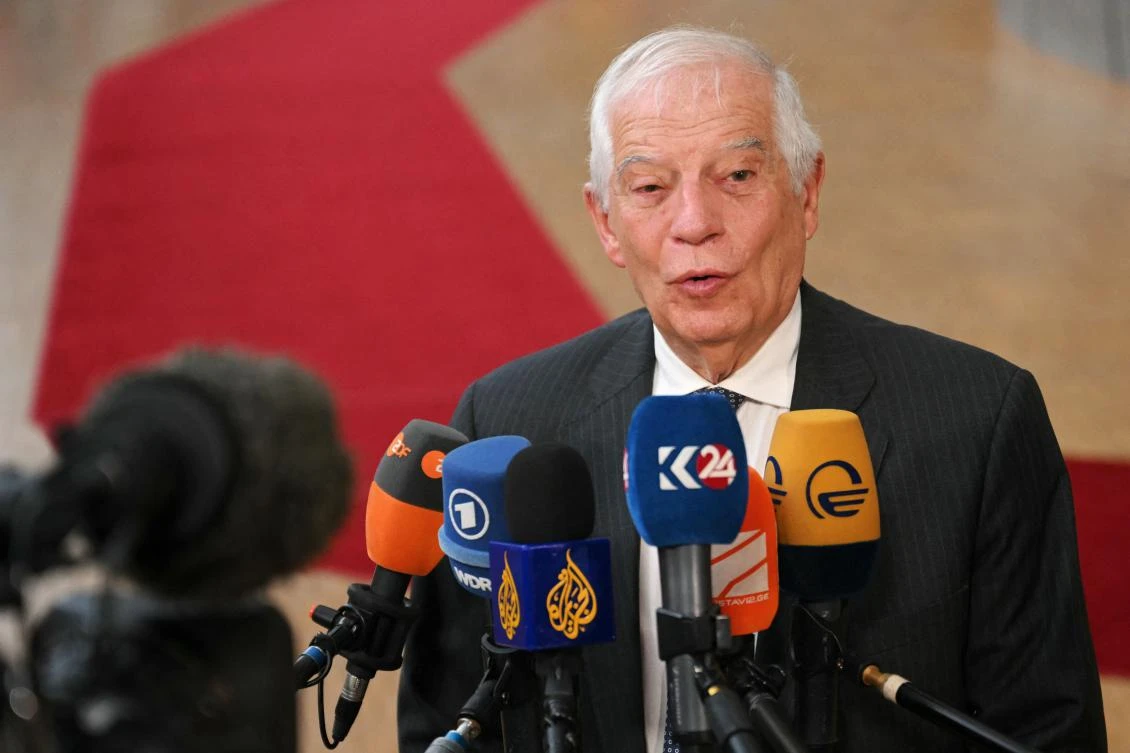
BRUSSELS: The EU’s outgoing top diplomat Josep Borrell said Monday he had “no more words” to describe the crisis in the Middle East as he delivered a bleak assessment at his swansong foreign ministers’ meeting.
At a somber press briefing after the Brussels talks, Borrell said a majority of the 27 European Union states had — as expected — rejected his call to suspend political dialogue with Israel over the Gaza war.
Barely concealing his frustration at the EU’s failure to weigh on the Israeli-Palestinian conflict during his five-year mandate, Borrell earlier said he had “exhausted the words to explain what’s happening.”
“This is a war against the children,” the 77-year-old foreign policy chief told reporters after the talks. “The most frequent age of the casualties in Gaza is five years old.”
He described an “apocalyptical situation in Gaza, where 70 percent of the death toll is being paid by children and women,” with two million people displaced. He also acknowledged the suffering of Israeli hostages held by Hamas and other militant groups since the October 7, 2023 attacks on Israel.
The Hamas attack resulted in the deaths of 1,206 people, mostly civilians, according to an AFP tally of Israeli official figures. The health ministry in Hamas-run Gaza says that 43,922 people, mostly civilians, have been killed there since October 7.
Borrell’s proposal to suspend the EU’s political dialogue with Israel — part of a wider agreement governing trade ties — had been expected to hit opposition from numerous member states including key powers France and Germany.
“Most of the member states considered that it was much better to continue having diplomatic and political relationship with Israel,” Borrell confirmed.
But he said his services had “at least put on the table” all the information produced by UN bodies and international organizations on the ground “in order to judge the way the war is being waged.”
Since Israel unleashed its devastating retaliatory offensive in Gaza, EU states have been deeply divided over the conflict — with Borrell often an outlier in denouncing what he views as Israel’s excesses.
On Russian President Vladimir Putin’s invasion of Ukraine, Borrell likewise voiced frustration at the shortcomings in Europe’s response as the conflict reaches its 1,000th day.
“It’s not only 1,000 days. It is 4,000 days since Putin attacked Ukraine the first time,” Borrell said.
“Maybe our response should have been firmer, stronger since the beginning,” he said.
“It’s clear that each step that is being left without reaction encourages Russia to escalate further,” he warned — pointing at Russia’s use of drones from Iran, weapons and troops from North Korea, and dual-use goods from China.
Moscow’s all-out assault in February 2022 upended European security and came to dominate Borrell’s time at the helm of the bloc’s diplomacy.
Since then the EU has spent billions of dollars on arming Ukraine and Russia has been hit by repeated sanctions despite regular obstacles from reluctant EU states such as Hungary.
But Borrell leaves the stage at a perilous time — with the re-election of Donald Trump in the United States heralding challenges for Europe and Russia advancing in Ukraine.
“If we want to be a geopolitical player, if we want to use the language of power, we have to be more united,” warned Borrell, who is to hand over to former Estonian prime minister Kaja Kallas in December.
“It’s time for Europe to take their strategic responsibilities,” Borrell said. “It’s time for Europe to step up.”
EU top diplomat has ‘no more words’ on Mideast suffering
Short Url
https://arab.news/zv7s8
EU top diplomat has ‘no more words’ on Mideast suffering
- Borrell said a majority of the 27 European Union states had — as expected — rejected his call to suspend political dialogue with Israel over the Gaza war
Human rights situation in Colombia is backsliding, UN warns as nation heads into elections
The annual report on Colombia’s human rights situation highlights a surge in attacks on rural communities by rebel groups and drug traffickers
Murders of human rights defenders increased by 9 percent last year
BOGOTA: Colombia is at risk of “reverting to the serious human rights situation” it faced before a peace deal with the nation’s largest rebel group improved security conditions, the United Nations warned Thursday, adding that an uptick of violence in rural areas could also “undermine” the nation’s upcoming elections.
The annual report on Colombia’s human rights situation highlights a surge in attacks on rural communities by rebel groups and drug traffickers as they fight over territory abandoned by the Revolutionary Armed Forces of Colombia following their 2016 peace deal with Colombia’s government.
According to the report, the number of people displaced by violence in Colombia increased by 85 percent in 2025 from the year before, with approximately 94,000 people forced to flee their homes.
Murders of human rights defenders increased by 9 percent last year alongside a 12 percent increase in the number of lockdowns imposed by armed groups on rural communities. During the lockdowns, villagers are banned from hunting or tending to their farms. Schools and businesses are also forced to shut down in small towns, disrupting the livelihoods of civilians.
“This report is an early warning,” said Scott Campbell, the Colombia representative for the United Nations High Commissioner for Human Rights. “There are a number of indicators that we are trying to draw attention to in order to prevent further degradation” of the human rights situation in Colombia.
While human rights violations in Colombia are not as numerous as they were at the height of the nation’s conflict with the FARC rebels — when an average of 300,000 people were displaced by violence each year — the report says that Colombia’s government has to take firmer actions to protect civilians from illegal groups.
One problem that persists is the forced recruitment of children by rebel groups that now use social media platforms to lure kids into their ranks.
Although the UN confirmed 150 cases of forced recruitment in 2025, the report notes this is likely an undercount, because many families are afraid to denounce these cases for fear of retaliation.
The administration of left-wing President Gustavo Petro, a former member of Colombia’s M-19 guerrilla group, has tried to reduce violence in Colombia by staging peace negotiations with the nation’s remaining rebel groups under a strategy known as “total peace.”
But often, the report notes, ceasefires between the Colombian government and rebel groups have failed to reduce attacks on civilians.
“We think it is very important that the government push for remedies to that,” Campbell said.
As Colombia prepares for upcoming elections, the report warns of a risky environment for political candidates. Last year alone, there were 18 murders of political leaders in Colombia and 126 attacks against them.
In June, conservative presidential hopeful Miguel Uribe was shot in the head during a rally in Bogota, marking the first attack against a Colombian presidential candidate in three decades. Uribe died from his injuries two months later.
“Violence and conflict, including the emergence of pre-electoral violence, have generated greater risks for the free and safe exercise of certain civil and political rights” the report said.
On March 8, Colombia will elect a new Senate and House of Representatives, with candidates competing to fill more than 300 congressional seats.
That will be followed up by a presidential election in May, in which at least half a dozen candidates are expected to run.
To improve the human rights situation in Colombia, the report said that the next administration must focus on the full implementation of the 2016 peace pact with FARC rebels.
While some parts of the deal have been implemented — including the FARC’s disarmament and the creation of a transitional justice system — others remain unfulfilled.
One of those is the creation of an agrarian jurisdiction to resolve conflicts over land. Schemes that could lure farmers away from growing coca, the base ingredient for cocaine, also require further implementation.
“It’s crucially important at this juncture ahead of elections to make sure that the current government and the future government take concrete actions to make sure that Colombia moves forward,” Campbell said.
He added that the 2016 peace deal provides a “road map” to a “Colombia of sustainable peace and respect for human rights.”
Murders of human rights defenders increased by 9 percent last year
BOGOTA: Colombia is at risk of “reverting to the serious human rights situation” it faced before a peace deal with the nation’s largest rebel group improved security conditions, the United Nations warned Thursday, adding that an uptick of violence in rural areas could also “undermine” the nation’s upcoming elections.
The annual report on Colombia’s human rights situation highlights a surge in attacks on rural communities by rebel groups and drug traffickers as they fight over territory abandoned by the Revolutionary Armed Forces of Colombia following their 2016 peace deal with Colombia’s government.
According to the report, the number of people displaced by violence in Colombia increased by 85 percent in 2025 from the year before, with approximately 94,000 people forced to flee their homes.
Murders of human rights defenders increased by 9 percent last year alongside a 12 percent increase in the number of lockdowns imposed by armed groups on rural communities. During the lockdowns, villagers are banned from hunting or tending to their farms. Schools and businesses are also forced to shut down in small towns, disrupting the livelihoods of civilians.
“This report is an early warning,” said Scott Campbell, the Colombia representative for the United Nations High Commissioner for Human Rights. “There are a number of indicators that we are trying to draw attention to in order to prevent further degradation” of the human rights situation in Colombia.
While human rights violations in Colombia are not as numerous as they were at the height of the nation’s conflict with the FARC rebels — when an average of 300,000 people were displaced by violence each year — the report says that Colombia’s government has to take firmer actions to protect civilians from illegal groups.
One problem that persists is the forced recruitment of children by rebel groups that now use social media platforms to lure kids into their ranks.
Although the UN confirmed 150 cases of forced recruitment in 2025, the report notes this is likely an undercount, because many families are afraid to denounce these cases for fear of retaliation.
The administration of left-wing President Gustavo Petro, a former member of Colombia’s M-19 guerrilla group, has tried to reduce violence in Colombia by staging peace negotiations with the nation’s remaining rebel groups under a strategy known as “total peace.”
But often, the report notes, ceasefires between the Colombian government and rebel groups have failed to reduce attacks on civilians.
“We think it is very important that the government push for remedies to that,” Campbell said.
As Colombia prepares for upcoming elections, the report warns of a risky environment for political candidates. Last year alone, there were 18 murders of political leaders in Colombia and 126 attacks against them.
In June, conservative presidential hopeful Miguel Uribe was shot in the head during a rally in Bogota, marking the first attack against a Colombian presidential candidate in three decades. Uribe died from his injuries two months later.
“Violence and conflict, including the emergence of pre-electoral violence, have generated greater risks for the free and safe exercise of certain civil and political rights” the report said.
On March 8, Colombia will elect a new Senate and House of Representatives, with candidates competing to fill more than 300 congressional seats.
That will be followed up by a presidential election in May, in which at least half a dozen candidates are expected to run.
To improve the human rights situation in Colombia, the report said that the next administration must focus on the full implementation of the 2016 peace pact with FARC rebels.
While some parts of the deal have been implemented — including the FARC’s disarmament and the creation of a transitional justice system — others remain unfulfilled.
One of those is the creation of an agrarian jurisdiction to resolve conflicts over land. Schemes that could lure farmers away from growing coca, the base ingredient for cocaine, also require further implementation.
“It’s crucially important at this juncture ahead of elections to make sure that the current government and the future government take concrete actions to make sure that Colombia moves forward,” Campbell said.
He added that the 2016 peace deal provides a “road map” to a “Colombia of sustainable peace and respect for human rights.”
© 2026 SAUDI RESEARCH & PUBLISHING COMPANY, All Rights Reserved And subject to Terms of Use Agreement.