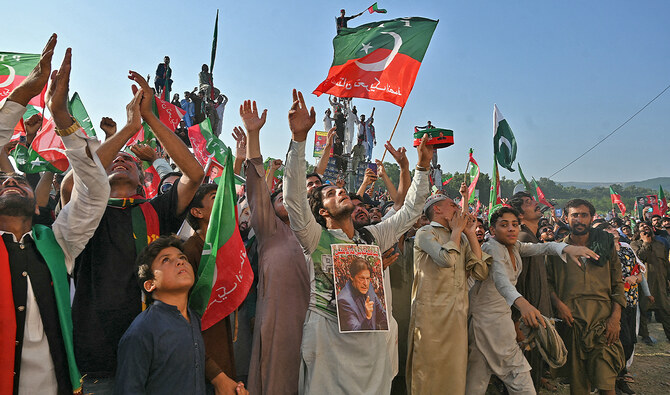

ISLAMABAD: The Pakistan Tehreek-e-Insaf party (PTI) of jailed former Prime Minister Imran Khan on Monday urged followers to go ahead with a planned protest march to the federal capital as a two-month ban on public gatherings was imposed in Islamabad by the district magistrate.
The PTI announced last week it would lead a ‘long march’ to the capital on Nov. 24 over alleged rigging in Feb. 8 general elections and to call for the release of political prisoners, including Khan, and in support of the independence of the judiciary.
In a notification dated Nov. 18, the district magistrate imposed a two-month-long ban on the gathering of more than five people in Islamabad, effective immediately.
“The long march will start from Punjab, Sindh, Balochistan & KP [Khyber Pakhtunkhwa] provinces, Azad Kashmir & Gilgit Baltistan under the provincial leadership of each province, etc., making its way toward the federal capital Islamabad,” the PTI said in a statement, hours after the district magistrate announced the ban.
The party’s recent rallies and marches have been thwarted by similar bans on public gatherings imposed under Section 144 of the Pakistan Penal Code which allows the government to prohibit various forms of political assembly, gatherings, sit-ins, rallies, demonstrations, and other activities for a specified period.
Khan has been in jail since August 2023 and has faced dozens of cases since he was removed as prime minister in 2022 after which he launched a protest movement against a coalition of his rivals led by current Prime Minister Shehbaz Sharif and backed by the all-powerful military, which denies interfering in politics.
Khan says cases against him, which disqualified him from contesting the February elections, are politically motivated. His party has held several protest rallies in recent months to build public pressure for its leader’s release.
With regards to the latest protest, the PTI’s first demand is a rollback of recent constitutional amendments like the 26th amendment that the PTI says is an attempt to curtail the independence of the senior judiciary. It is also calling for the release of party leaders and supporters and a return of what it describes as a “stolen mandate” after Feb. 8 general elections.
Pakistan’s government denies being unfair in its treatment of Khan and his party and the election commission rejects allegations the elections were rigged. The government also says recent amendments related to the judiciary are meant to smooth out its functioning and tackle a backlog of cases.
“The purpose of this peaceful demonstration by PTI, is to stage a peaceful protest demanding, the restoration of the judiciary, the return of mandate stolen ... and the release of political prisoners under custody without trial,” the PTI statement said.
Earlier on Monday, the district magistrate, without naming the PTI, said processions being planned in the capital “can disrupt public place and tranquility and keeping in view the current law & order and security environment, it is necessary to control such types of illegal activities which present a threat to public peace, tranquility and maintenance of law & order.”
He added that the demonstrations would cause “public annoyance or injury, endanger human life and safety, pose a threat to public property, and may lead to a riot or an affray including sectarian riot within the revenue/territorial limits of district Islamabad.”
In light of this, all gatherings of more than five people are banned in the capital, the notification said:
“This order shall come into force with immediate effect and shall remain in force for a period of TWO MONTHS.”