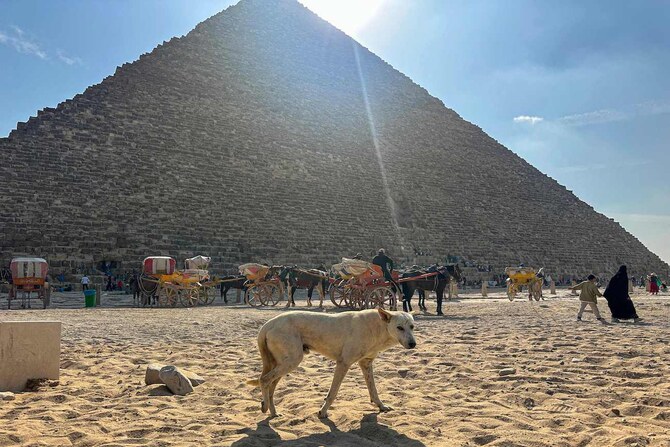
CAIRO: Beneath the blazing Egyptian sun, crowds at the Giza Pyramids gazed up at the ancient wonders, but some had their eyes peeled for a new attraction.
“There he is,” one Polish tourist told his wife as they spotted a scrappy dog perched on one of the stones.
They were talking about Apollo, a stray who became an overnight sensation last month after being filmed scaling the Great Pyramid of Khafre, one of the seven wonders of the world.
The viral footage, captured by American paragliding enthusiast Alex Lang and shared online by his friend Marshall Mosher, showed Apollo fearlessly climbing the 136-meter monument, barking at birds from the summit.
“He was acting like a king,” Lang told AFP.
As news of Apollo’s daring climb spread worldwide, interest grew in the dogs who have long made their homes among the ancient stones.
“He is climbing over there,” said Arkadiusz Jurys, a tourist from Poland, craning his neck for a better view.
“It is unusual,” he added, describing Apollo as surveying the picture-snapping crowd from above.
Another visitor, Diego Vega from Argentina, felt a special bond with the dogs.
“Connecting with them feels like connecting with the pharaohs,” he said, while petting a member of Apollo’s pack.
Apollo’s newfound fame has even inspired local guides to include him and his pack in their stories for tourists.
“This is Anubis,” one tour guide told two American tourists, comparing Apollo, now known as the “pyramid puppy,” with the ancient Egyptian god of the dead, often depicted as a man with a jackal’s head.
“He and his pack are now part of our tour conversations,” said Sobhi Fakhry, another tour guide.
Businesses around the Giza plateau are also seeing a boost.
Umm Basma, a 43-year-old woman selling souvenirs near the Khafre pyramid, reported an increase in sales thanks to the influx of tourists eager to meet the so-called pyramid dogs.
“We’ve always seen these dogs climbing the pyramids, but we never thought they would become a blessing for us,” she said.
One pyramid guard, who preferred to remain anonymous, also said that some celebrities had paid for permits to have their own dogs photographed with Apollo.
Apollo, a three-year-old Baladi dog, is part of a pack of about eight that has made their home among the ancient ruins.
The dogs, a local breed, are known for their resilience, intelligence and ability to survive in Egypt’s harsh climate.
Ibrahim el-Bendary, co-founder of the American Cairo Animal Rescue Foundation, which monitors the pyramid dogs, described Apollo as the pack’s “alpha male.”
“He is the bravest and strongest in his pack,” he said.
Apollo was born in a rocky crevice within the Khafre pyramid where his mother, Laika, found shelter. Sadly, some of Apollo’s siblings did not survive the site’s perilous heights.
A sympathetic guard eventually relocated Laika to a safer spot where Apollo now stands out with his distinctive curled tail and confident nature.
The initial focus of Lang and Marshall was the daring canine climber, but their visit led to a deeper connection with Cairo’s stray dogs.
Intrigued by the challenges they face, Mosher decided to adopt a puppy from the pack: Anubi, who is Apollo’s daughter.
Anubi will join Marshall in the US after she receives the dedicated care she needs in Egypt to grow up healthy.
At the pyramids, local animal care groups are now working with the government in order to set up food and water stations for the strays, as well as for other animals including camels and horses.
A permanent veterinary center will be established at the pyramids with staff set to receive animal care training, said Egypt’s tourism minister.
Vicki Michelle Brown, the other co-founder of the American Cairo Animal Rescue Foundation, believes that Apollo’s story can make a difference.
“It sheds so much light on the dogs and cats that are here,” Brown said.
“I definitely believe him (Apollo) climbing the pyramids can help all of the dogs in Egypt to have a better life.”


Stray dogs in Giza become tourist draw after ‘pyramid puppy’ sensation

https://arab.news/7ntxm
Stray dogs in Giza become tourist draw after ‘pyramid puppy’ sensation

- Apollo became an overnight sensation last month after being filmed scaling the Great Pyramid of Khafre
- As news of Apollo’s daring climb spread worldwide, interest grew in the dogs who have long made their homes among the ancient stones


Trump awards medals to the Kennedy Center honorees in an Oval Office ceremony
- Trump said they are a group of “incredible people” who represent the “very best in American arts and culture”
WASHINGTON: President Donald Trump on Saturday presented the 2025 Kennedy Center honorees with their medals during a ceremony in the Oval Office, hailing the slate of artists he was deeply involved in choosing as “perhaps the most accomplished and renowned class” ever assembled.
This year’s recipients are actor Sylvester Stallone, singers Gloria Gaynor and George Strait, the rock band Kiss and actor-singer Michael Crawford.
Trump said they are a group of “incredible people” who represent the “very best in American arts and culture” and that, “I know most of them and I’ve been a fan of all of them.”
“This is a group of icons whose work and accomplishments have inspired, uplifted and unified millions and millions of Americans,” said a tuxedo-clad Trump. “This is perhaps the most accomplished and renowned class of Kennedy Center Honorees ever assembled.”
Trump’s takeover of the Kennedy Center
Trump ignored the Kennedy Center and its premier awards program during his first term as president. But the Republican has instituted a series of changes since returning to office in January, most notably ousting its board of trustees and replacing them with GOP supporters who voted him in as chairman of the board.
Trump also has criticized the center’s programming and its physical appearance, and has vowed to overhaul both.
The president placed around each honoree’s neck a new medal that was designed, created and donated by jeweler Tiffany & Co., according to the Kennedy Center and Trump.
It’s a gold disc etched on one side with the Kennedy Center’s image and rainbow colors. The honoree’s name appears on the reverse side with the date of the ceremony. The medallion hangs from a navy blue ribbon and replaces a large rainbow ribbon decorated with three gold plates that rested on the honoree’s shoulders and chest and had been used since the first honors program in 1978.
Trump honors the honorees
Strait, wearing a cowboy hat, was first to receive his medal. When the country singer started to take off the hat, Trump said, “If you want to leave it on, you can. I think we can get it through.” But Strait took it off.
The president said Crawford was a “great star of Broadway” for his lead role in the long-running “Phantom of the Opera.” Of Gaynor, he said, “We have the disco queen, and she was indeed, and nobody did it like Gloria Gaynor.”
Trump was effusive about his friend Stallone, calling him a “wonderful” and “spectacular” person and “one of the true, great movie stars” and “one of the great legends.”
Kiss is an “incredible rock band,” he said.
Songs by honorees Gaynor and Kiss played in the Rose Garden just outside the Oval Office as members of the White House press corps waited nearby for Trump to begin the ceremony.
The president president said in August that he was “about 98 percent involved” in choosing the 2025 honorees when he personally announced them at the Kennedy Center, the first slate chosen under his leadership. The honorees traditionally had been announced by press release.
It was unclear how they were chosen. Before Trump, it fell to a bipartisan selection committee.
“These are among the greatest artists, actors and performers of their generation. The greatest that we’ve seen,” Trump said. “We can hardly imagine the country music phenomena without its king of country, or American disco without its first lady, or Broadway without its phantom — and that was a phantom, let me tell you — or rock and roll without its hottest band in the world, and that’s what they are, or Hollywood without one of its greatest visionaries.”
“Each of you has made an indelible mark on American life and together you have defined entire genres and set new standards for the performing arts,” Trump said.
Trump also attended an annual State Department dinner for the honorees on Saturday. In years past, the honorees received their medallions there but Trump moved the ceremony to the White House.
Trump to host the Kennedy Center Honors
Meanwhile, the glitzy Kennedy Center Honors program and its series of tribute speeches and performances for each recipient is set to be taped on Sunday at the performing arts center for broadcast later in December on CBS and Paramount+. Trump is to attend the program for the first time as president, accompanied by his wife, first lady Melania Trump.
The president said in August that he had agreed to host the show, and he seemed to confirm on Saturday that he would do so, predicting that the broadcast would garner its highest ratings ever as a result. Presidents traditionally attend the program and sit with the honorees in the audience. None has ever served as host.
He said he looked forward to Sunday’s celebration.
“It’s going to be something that I believe, and I’m going to make a prediction: this will be the highest-rated show that they’ve ever done and they’ve gotten some pretty good ratings, but there’s nothing like what’s going to happen tomorrow night,” Trump said.
The president also swiped at late-night TV show host Jimmy Kimmel, whose program was briefly suspended earlier this year by ABC following criticism of his comments related to the killing of conservative activist Charlie Kirk in September.
Kimmel and Trump are sharp critics of each other, with the president regularly deriding Kimmel’s talent as a host. Kimmel has hosted the Primetime Emmy Awards and the Academy Award multiple times.
Trump said he should be able to outdo Kimmel.
“I’ve watched some of the people that host. Jimmy Kimmel was horrible,” Trump said. “If I can’t beat out Jimmy Kimmel in terms of talent, then I don’t think I should be president.”


