

Public gatherings banned in Islamabad for two months ahead of opposition protest

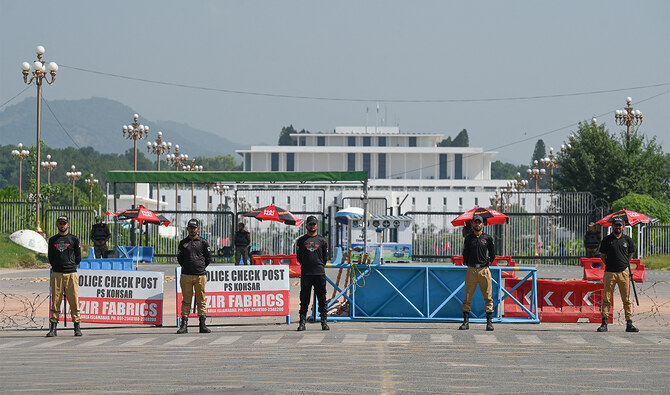
Security personnel stand guard in front of the Presidential Palace ahead of a Shanghai Cooperation Organisation (SCO) summit in Islamabad on October 13, 2024. (AFP/File)
Short Url
Updated 18 November 2024
Follow

Public gatherings banned in Islamabad for two months ahead of opposition protest

  • District magistrates bans gathering of more than five people for next two months
  • Ban comes as Pakistan Tehreek-e-Insaf is planning protest in Islamabad on Nov. 24

ISLAMABAD: A two-month ban on public gatherings has been imposed in Pakistan’s federal capital, Islamabad, a notification from the district magistrate said on Monday, days ahead of a planned protest march by the party of jailed former Prime Minister Imran Khan.

The Pakistan Tehreek-e-Insaf party (PTI) announced last week it would lead a ‘long march’ to the capital on Nov. 24 over alleged rigging in Feb. 8 general elections and to call for the release of political prisoners, including Khan, and in support of the independence of the judiciary.

The party’s recent rallies and marches have been thwarted by similar bans on public gatherings imposed under Section 144 of the Pakistan Penal Code which allows the government to prohibit various forms of political assembly, gatherings, sit-ins, rallies, demonstrations, and other activities for a specified period.

In a notification dated Nov. 18, the district magistrate, without naming the PTI, said processions being planned in the capital “can disrupt public place and tranquility and keeping in view the current law & order and security environment, it is necessary to control such types of illegal activities which present a threat to public peace, tranquility and maintenance of law & order.”

He added that the demonstrations would cause “public annoyance or injury, endanger human life and safety, pose a threat to public property, and may lead to a riot or an affray including sectarian riot within the revenue/territorial limits of district Islamabad.”

In light of this, all gatherings of more than five people are banned in the capital, the notification said:

“This order shall come into force with immediate effect and shall remain in force for a period of TWO MONTHS.” 

Khan has been in jail since August 2023 and has faced dozens of cases since he was removed as prime minister in 2022 after which he launched a protest movement against a coalition of his rivals led by current Prime Minister Shehbaz Sharif and backed by the all-powerful military, which denies interfering in politics. 

Khan says cases against him, which disqualified him from contesting the February elections, are politically motivated. His party has held several protest rallies in recent months to build public pressure for its leader’s release.

With regards to the latest protest, the PTI’s first demand is a rollback of recent constitutional amendments like the 26th amendment that the PTI says is an attempt to curtail the independence of the senior judiciary. It is also calling for the release of party leaders and supporters and a return of what it describes as a “stolen mandate” after Feb. 8 general elections.

Pakistan’s government denies being unfair in its treatment of Khan and his party and the election commission rejects allegations the elections were rigged. The government also says recent amendments related to the judiciary are meant to smooth out its functioning and tackle a backlog of cases.


Islamic military coalition, Pakistan to deepen cooperation to combat ‘terrorism’ — Pakistani military

Updated 02 February 2026
Follow

Islamic military coalition, Pakistan to deepen cooperation to combat ‘terrorism’ — Pakistani military

  • Islamic Military Counter Terrorism Coalition is a 43-member alliance that includes Pakistan, Saudi Arabia, Egypt, Jordan, UAE and other nations
  • The Pakistani military statement comes after a meeting between IMCTC secretary-general and the chief of Pakistani defense forces in Rawalpindi

ISLAMABAD: Pakistan and the Islamic Military Counter Terrorism Coalition (IMCTC) have reaffirmed their commitment to deepening cooperation, including intelligence sharing and capacity building, to jointly combat “terrorism” and “extremism,” the Pakistani military said on Monday.

The IMCTC is a 43-member military alliance that was formed on Saudi Arabia’s initiative in Dec. 2015 to consolidate Muslim countries’ efforts in countering “terrorism.”

A 17-member IMCTC delegation is visiting Pakistan from Feb. 2-6 to conduct a training at National University of Sciences and Technology on “Re-integration and Rehabilitation of Extremist Elements,” according to the Pakistani military.

On Monday, IMCTC Secretary-General Maj. Gen. Mohammed bin Saeed Al-Moghedi held a meeting with Chief of Pakistani Defense Forces Field Marshal Asim Munir to discuss cooperation among IMCTC member states.

“During the meeting, matters of mutual interest were discussed, with particular emphasis on regional security dynamics and enhanced cooperation in counter-terrorism efforts,” the Inter-Services Public Relations (ISPR), the Pakistani military’s media wing, said in a statement.

“Both sides reaffirmed their shared commitment to combating terrorism and extremism through collaborative strategies, intelligence sharing, and capacity building among member states.”

The IMCTC features Pakistan, Saudi Arabia, Türkiye, Afghanistan, Egypt, Jordan, Qatar, Palestine, UAE, Bangladesh and other nations. In 2017, Pakistan’s former army chief Gen. (retd) Raheel Sharif was appointed as the IMCTC commander-in-chief.

During discussions with Major General Al-Moghedi, Field Marshal Munir appreciated the role of IMCTC in fostering stability and promoting coordinated counterterrorism initiatives across the Islamic world, according to the ISPR.

The IMCTC secretary-general acknowledged Pakistan’s significant contributions and sacrifices in the fight against militancy and lauded the professionalism of Pakistan’s armed forces.

“The meeting underscored the resolve of both sides to further strengthen institutional collaboration for peace, stability, and security in the region,” the ISPR added.

Pakistan enjoys cordial ties with most Muslim countries around the world, particularly Gulf Cooperation Council countries. In Sept. 2025, Pakistan signed a landmark defense pact with Saudi Arabia according to which an act of aggression against one country will be treated as an act of aggression against both.