

Why has ethnic violence escalated in India’s Manipur state again?

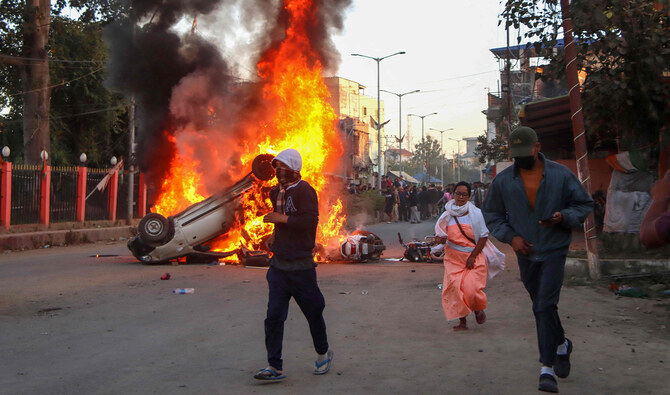
People run past burning vehicles of India's Bharatiya Janata Party (BJP) MLA during a protest to condemn the alleged killing of women and children in Imphal, capital of India's violence-hit northeastern state of Manipur on November 16, 2024. (AFP)
Short Url
Updated 18 November 2024
Follow

Why has ethnic violence escalated in India’s Manipur state again?

  • On May 3, 2023, members of the Kuki and Naga tribes launched protest against extension of benefits to dominant Meiteis
  • Latest violence flared this month after 31-year-old woman from Kuki tribe was found burned to death in a village in Jiribam district

Hundreds of people defied a curfew to stage demonstrations in India’s northeastern state of Manipur over the weekend and 23 were arrested for violence as tensions between two ethnic communities flared up again.
These are the reasons behind the violence in the border state.

HOW DID THE MANIPUR VIOLENCE BEGIN?

On May 3, 2023, members of the Kuki and Naga tribes, who inhabit Manipur’s hills and are regarded as Scheduled Tribes, or India’s most disadvantaged groups, launched a protest against the possible extension of their benefits to the dominant Meiteis.
The Meitei have sought special benefits for more than a decade, but received a fillip in April last year after the Manipur High Court recommended the state government should consider the demand and set a deadline of mid-May.
Meiteis account for half of Manipur’s population and extending limited affirmative action quotas to them would mean they would get a share of education and government jobs reserved for Kukis and Nagas.
Meiteis have traditionally lived in Manipur’s more prosperous valley region that makes up 10 percent of the state’s area.
They have also had better access to employment and economic opportunities. Nagas and Kukis live in the poorly developed hill regions.
The imbalance in development that has favored the valley over the hills has been a point of contention and rivalry between the ethnic groups.

WHAT WERE THE TRIGGERS?

The groups co-existed peacefully until unrelated events in 2023 exposed old faultlines.
Manipur shares a nearly 400-km (250-mile) border with Myanmar and the coup there in 2021 pushed thousands of refugees into the Indian state.
Kukis share ethnic lineage with Myanmar’s Chin tribe and Meiteis feared they would be outnumbered by the arrival of the refugees.

WHY IS PEACE YET TO RETURN?

Both the Meiteis and Kukis are known to be flush with arms, including automatic weapons either stolen from the state police or sourced from Myanmar.
The Indian Army and federal paramilitary forces in the state cannot act independently and are legally bound to work with state police and authorities, who analysts say are also divided along ethnic lines.
Kukis also accuse Biren Singh, the chief minister of the Bharatiya Janata Party-ruled state and a Meitei, of complicity in violence against them and have sought his removal. Singh denies the accusations.

WHAT IS BEHIND THE LATEST SPIRAL OF VIOLENCE?

The latest violence flared this month after a 31-year-old Kuki woman was found burned to death in a village in Jiribam district, an area that was untouched by the conflict until June.
Kuki groups blamed Meitei militants for the act.
Kukis and Meiteis have moved to separate parts elsewhere in Manipur since the clashes last year but Jiribam still has a mixed population, leading to tensions and violence.
Days after the incident, 10 armed Kuki men were killed in a gunfight with security forces after they tried to attack a police station in Jiribam district, and security forces retaliated. During this gunfight, a Meitei family of six people went missing.
On Friday, bodies of three of the six were found floating in a river, triggering angry protests in the state capital Imphal. Police said on Sunday they had arrested 23 people for ransacking and setting fire to the homes of lawmakers and ministers, in a second straight day of unrest in the area.


Counter protesters chase off conservative influencer during Minneapolis immigration crackdown

Updated 59 min 28 sec ago
Follow

Counter protesters chase off conservative influencer during Minneapolis immigration crackdown

MINNEAPOLIS: Hundreds of counterprotesters drowned out a far-right activist’s attempt to hold a small rally in support of the Trump administration’s latest immigration crackdown in Minneapolis on Saturday, as the governor’s office announced that National Guard troops were mobilized and ready to assist law enforcement though not yet deployed to city streets.
There have been protests every day since the Department of Homeland Security ramped up immigration enforcement in the Twin Cities of Minneapolis and St. Paul by bringing in more than 2,000 federal officers.
Conservative influencer Jake Lang organized an anti-Islam, anti-Somali and pro-ICE demonstration, saying on social media beforehand that he intended to “burn a Qur’an” on the steps of City Hall. But it was not clear if he carried out that plan.
Only a small number of people showed up for Lang’s demonstration, while hundreds of counterprotesters converged at the site, yelling over his attempts to speak and chasing the pro-ICE group away. They forced at least one person to take off a shirt they deemed objectionable.
Lang appeared to be injured as he left the scene, with bruises and scrapes on his head.
Lang was previously charged with assaulting an officer with a baseball bat, civil disorder and other crimes before receiving clemency as part of President Donald Trump’s sweeping act of clemency for Jan. 6 defendants last year. Lang recently announced that he is running for US Senate in Florida.
In Minneapolis, snowballs and water balloons were also thrown before an armored police van and heavily equipped city police arrived.
“We’re out here to show Nazis and ICE and DHS and MAGA you are not welcome in Minneapolis,” protester Luke Rimington said. “Stay out of our city, stay out of our state. Go home.”
National Guard ‘staged and ready’
The state guard said in a statement that it had been “mobilized” by Democratic Gov. Tim Walz to support the Minnesota State Patrol “to assist in providing traffic support to protect life, preserve property, and support the rights of all Minnesotans to assemble peacefully.”
Maj. Andrea Tsuchiya, a spokesperson for the guard, said it was “staged and ready” but yet to be deployed.
The announcement came more than a week after Walz, a frequent critic and target of Trump, told the guard to be ready to support law enforcement in the state.
During the daily protests, demonstrators have railed against masked immigration officers pulling people from homes and cars and other aggressive tactics. The operation in the deeply liberal Twin Cities has claimed at least one life: Renee Good, a US citizen and mother of three, was shot by an ICE officer during a Jan. 7 confrontation.
On Friday a federal judge ruled that immigration officers cannot detain or tear gas peaceful protesters who are not obstructing authorities, including while observing officers during the Minnesota crackdown.
Living in fear
During a news conference Saturday, a man who fled civil war in Liberia as a child said he has been afraid to leave his Minneapolis home since being released from an immigration detention center following his arrest last weekend.
Video of federal officers breaking down Garrison Gibson’s front door with a battering ram Jan. 11 become another rallying point for protesters who oppose the crackdown.
Gibson, 38, was ordered to be deported, apparently because of a 2008 drug conviction that was later dismissed. He has remained in the country legally under what’s known as an order of supervision. After his recent arrest, a judge ruled that federal officials did not give him enough notice that his supervision status had been revoked.
Then Gibson was taken back into custody for several hours Friday when he made a routine check-in with immigration officials. Gibson’s cousin Abena Abraham said Immigration and Customs Enforcement officials told her White House Deputy Chief of Staff Stephen Miller ordered the second arrest.
The White House denied the account of the re-arrest and that Miller had anything to do with it.
Gibson was flown to a Texas immigration detention facility but returned home following the judge’s ruling. His family used a dumbbell to keep their damaged front door closed amid subfreezing temperatures before spending $700 to fix it.
“I don’t leave the house,” Gibson said at a news conference.
DHS said an “activist judge” was again trying to stop the deportation of “criminal illegal aliens.”
“We will continue to fight for the arrest, detention, and removal of aliens who have no right to be in this country,” Assistant Homeland Security Secretary Tricia McLaughlin said.
Gibson said he has done everything he was supposed to do: “If I was a violent person, I would not have been out these past 17 years, checking in.”