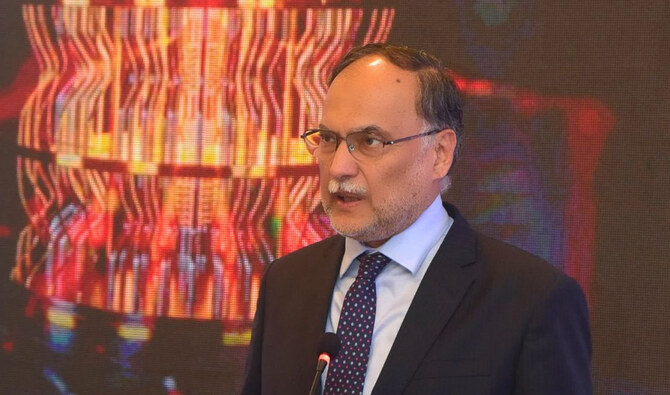
ISLAMABAD: Pakistan’s Planning Minister Ahsan Iqbal said on Monday that Washington and Islamabad have a “unique opportunity” to revitalize their partnership and tackle global challenges together under a new administration headed by President-elect Donald Trump, state-run media reported.
Ties between Islamabad and Washington, once close allies, have just started to warm after many years of frosty relations, mostly due to concerns about Pakistan’s alleged support of the Taliban in Afghanistan. Pakistan denies it supported the group.
Relations strained further under the government of former prime minister Imran Khan, who ruled from 2018-22 and antagonized Washington throughout his tenure, welcoming the Taliban takeover of Afghanistan in 2021 and later accusing Washington of being behind attempts to oust him. Washington has dismissed the accusations. Shehbaz Sharif’s government, now in its second term, has tried to mend ties but analysts widely believe the United States will not seek a significant broadening of ties with Islamabad in the near future but remain mostly focused on security cooperation, especially on counterterrorism and Afghanistan.
“Addressing a USAID event in Islamabad today, he [Iqbal] stated that the two countries have a unique opportunity to revitalize their partnership and adapt to the needs of a rapidly changing world, with a new US administration taking the helm,” Radio Pakistan said in a report.
The planning minister spoke about Pakistan’s desire to strengthen relations with the United States in key sectors such as economy, climate change, science and technology, agriculture, education and health.
The minister said that the US remains one of Pakistan’s largest trading partners, with trade exceeding $6.5 billion between the two countries in 2023. He said Pakistan’s key exports to the US include textiles, surgical instruments and IT services which contribute significantly to the country’s economy.
“He however emphasized that there is a vast untapped potential for growth,” the state broadcaster said. “He said the trade relations will not only create jobs and foster innovation but also enhance economic resilience.”
Iqbal said that while bilateral relations between Pakistan and the US have flourished, both nations need to respect each other’s sovereignty and work together constructively to address shared challenges.
“Iqbal said Pakistan-US relationship remains critical to addressing global challenges and achieving regional stability,” Radio Pakistan said.
Pakistan’s Defense Minister Khawaja Asif earlier this month signaled Islamabad’s intentions to collaborate with the new US administration where its interests were aligned. However, he cautioned that cooperation could be strained if interests diverged or Washington persisted in supporting wars in the Middle East.
Trump is widely regarded as an unpredictable leader, with analysts worldwide assessing the potential impact of his return to the top US office on global affairs. However, the Pakistani defense minister praised him during Geo TV’s special election transmission this month for promising to end conflicts around the world after assuming power in Washington.


![]()

Pakistan says Islamabad, Washington have ‘unique opportunity’ to revitalize partnership under Trump
Short Url
https://arab.news/5gepn
Pakistan says Islamabad, Washington have ‘unique opportunity’ to revitalize partnership under Trump
- Ties between Islamabad and Washington have just started to warm after years of frosty relations
- Planning Minister Ahsan Iqbal says Pakistan desires enhanced partnership in economy, education, health
Latest updates


Recommended


© 2026 SAUDI RESEARCH & PUBLISHING COMPANY, All Rights Reserved And subject to Terms of Use Agreement.