

G20 leaders to grapple with climate, taxes, Trump comeback

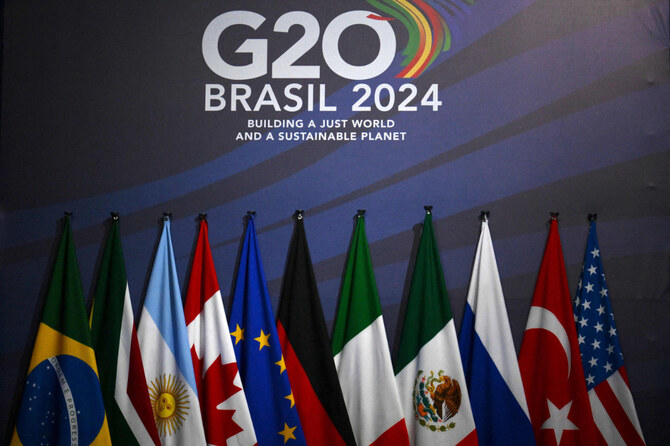
National flags of Brazil and other G20 members are seen at the media center in the MAM Modern Art Museum ahead of the G20 Summit in Rio de Janeiro, Brazil, on Nov. 17, 2024. (AFP)
Short Url
Updated 18 November 2024
Follow

G20 leaders to grapple with climate, taxes, Trump comeback

  • UN chief has called onG20 members, who account for 80 percent of global emissions, to show “leadership and compromise” to facilitate a deal
  • At the last G20 in India, leaders called for a tripling of renewable energy sources by the end of the decade, but without explicitly calling for an end to the use of fossil fuels

RIO DE JANEIRO: G20 leaders gather in Brazil on Monday to discuss fighting poverty, boosting climate financing and other multilateral initiatives that could yet be upended by Donald Trump’s impending return to the White House.
US President Joe Biden will attend his last summit of the world’s leading economies but only as a lame duck whom other leaders are already looking beyond.
The main star of the show is expected to be Chinese President Xi Jinping, who has cast himself as a global statesman and protector of free trade in the face of Trump’s “America First” agenda.
Brazil’s left-wing President Luiz Inacio Lula da Silva will be using his hosting duties to highlight his championing of Global South issues and the fight against climate change.
The summit venue is Rio de Janeiro’s stunning bayside museum of modern art.
Security is tight for the gathering, which comes days after a failed bomb attack on Brazil’s Supreme Court in Brasilia by a suspected far-right extremist, who killed himself in the process.
The summit will cap a farewell diplomatic tour by Biden which took him to Lima for a meeting of Asia-Pacific trading partners, and then to the Amazon in the first such visit for a sitting US president.
Biden, who has looked to burnish his legacy as time runs down on his presidency, has insisted his climate record would survive another Trump mandate.

Climate conference
The G20 meet is happening at the same time as the COP29 climate conference in Azerbaijan, which has stalled on the issue of greater climate finance for developing countries.
All eyes have turned to Rio for a breakthrough.
UN Secretary-General Antonio Guterres has called for G20 members, who account for 80 percent of global emissions, to show “leadership and compromise” to facilitate a deal.
A Brazilian diplomatic source said fast-developing nations like China were refusing pressure by rich countries to join them in funding global climate projects but added that he was hopeful of progress at the summit.
The meeting comes in a year marked by another grim litany of extreme weather events, including Brazil’s worst wildfire season in over a decade, fueled by a record drought blamed at least partly on climate change.
At the last G20 in India, leaders called for a tripling of renewable energy sources by the end of the decade, but without explicitly calling for an end to the use of fossil fuels.
One invited leader who declined to come to Rio is Russian President Vladimir Putin, whose arrest is sought by the International Criminal Court and who said his presence would “wreck” the gathering.
Lula, 79, told Brazil’s GloboNews channel on Sunday that the wars in Ukraine and the Middle East would be kept off the summit agenda to focus on the poor.
“Because if not, we will not discuss other things which are more important for people that are not at war, who are poor people and invisible to the world,” he said.

The summit will open on Monday with Lula, a former steelworker who grew up in poverty, launching a “Global Alliance against Hunger and Poverty.”
“What I want to say to the 733 million people who are hungry in the world, children who go to sleep and wake up not being sure if they will have any food to put in their mouths, is: today there isn’t any, but tomorrow there will be,” Lula said on the weekend.
Brazil is also pushing for higher taxes on billionaires.
Lula had faced resistance to parts of his agenda from Argentina but on Sunday a Brazilian diplomatic source said negotiators from all G20 members had agreed on a draft final statement to be put to their respective leaders.


Deadly militant offensive sweeps northern and eastern Burkina Faso

Updated 6 sec ago
Follow

Deadly militant offensive sweeps northern and eastern Burkina Faso

  • Burkina Faso, ruled by a military junta since September 2022, has faced more than 10 years of raids by groups linked to Al-Qaeda and the Daesh
ABIDJAN: Al-Qaeda-affiliated JNIM has in recent days claimed to have inflicted heavy losses in Burkina Faso as a surge in deadly militant attacks sweeps across the Sahelian state.
Burkina Faso, ruled by a military junta since September 2022, has faced more than 10 years of raids by groups linked to Al-Qaeda and the Daesh, including the Group for the Support of Islam and Muslims (JNIM).
A February UN Security Council report noted that the “pace of JNIM attacks” had slowed in September as fighters were diverted to Mali to back an attempted fuel blockade.
“The group’s efforts in Mali have been the primary focus since early September last year,” said Heni Nsaibia, analyst at conflict monitor ACLED.
But attacks never fully stopped, and JNIM has launched a string of large-scale assaults in northern and eastern Burkina Faso since mid-February, killing dozens, including civilians.
“Since February 14, JNIM has claimed responsibility for 10 attacks across different regions of Burkina Faso,” said Hasret Kargin, an Africa studies researcher at intelligence firm Mintel World.
Deadly assaults
The deadliest incidents targeted Titao’s military base on February 15 in the northwest, where the group says it killed dozens of soldiers.
A separate ambush on the same day left around 50 forestry officers dead in Tandjari in the east.
Around 10 civilians were also killed in Titao, including seven Ghanaian traders.
“This latest round demonstrated a high degree of coordination, given the number of large-scale attacks that occurred between 12 and 22 February,” Nsaibia said.
“Over 130 people” — Burkinabe soldiers, civilian auxiliaries and JNIM fighters — “were killed in this series of battles.”
Kargin noted that JNIM has issued no formal statement explaining the recent uptick after several months of reduced activity.
But militant groups often strike “right before and during” the Muslim holy month of Ramadan, he said, adding current dry-season conditions had helped them on the ground.
‘Smuggling zones’
Recent attacks have gripped the country’s north and east, areas seen as financial hubs for Al-Qaeda’s Sahel branch.
“These are zones with numerous gold sites and key routes that fuel the group’s smuggling activities,” a Burkinabe security analyst said, requesting anonymity.
The north “acts as a bridge” to JNIM’s “main central command” in Mali, Kargin said, while he east — home to a vast nature reserve straddling Niger, Benin and Burkina Faso — allows the group to push into neighboring countries.
The forests, he added, both shield fighters from airstrikes and generate income through illegal timber sales and control of artisanal gold mining.
The Tandjari attack near regional capital Fada N’Gourma highlights JNIM’s growing freedom of movement after having “gained a lot of ground in recent years,” Nsaibia said.
“The question is not the frequency of attacks — they never stopped — but how these groups are able to inflict such heavy losses” when the army claims to be better equipped and better organized, said a Burkinabe political scientist.
The army, which rarely comments on attacks, said in mid-February it now controls 74 percent of national territory, with some “600 villages retaken.”
According to the UN report, JNIM recently appointed a senior leader in eastern Burkina Faso tasked with expanding into Benin, Ivory Coast, Ghana, Niger and Togo.