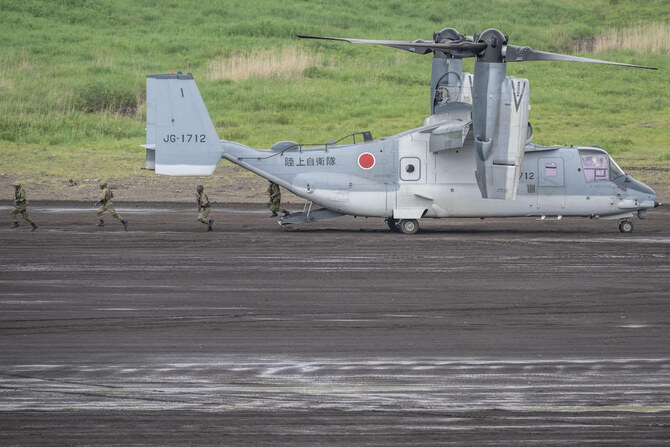
SYDNEY: Japanese troops will begin regular deployments in northern Australia as part of military cooperation with Australia and the US, Australia’s Defense Minister Richard Marles said on Sunday.
Around 2,000 US Marines are already hosted in Darwin, the capital of the Northern Territory, for six months of the year amid growing concern among Washington and its allies about China’s growing military power in the Indo Pacific region.
“Today we are announcing that there will be regular deployments of Japan’s amphibious Rapid Deployment Brigade to Australia,” Marles said at a televised press conference in Darwin, alongside US Defense Secretary Lloyd Austin and Japanese Defense Minister Gen Nakatani.
“Having a more forward leaning opportunity for greater training with Japan and the US together is a really fantastic opportunity for our defense,” Marles told Sky News on Sunday, according to a transcript.
The deployment has special significance given Darwin was a major base for Allied forces in World War Two and was heavily bombed by Japanese forces. The wartime air raids on the port city are sometimes described as Australia’s Pearl Harbor.
Austin said on Sunday he was confident the US will provide the capabilities set out in the AUKUS deal, which will see Australia buy US nuclear submarines and develop a new class of nuclear-powered submarines with the US and Britain.
The US Defense Department was focused “on a smooth and effective transition” to the incoming administration of President-elect Donald Trump, Austin said.
“I’m really proud of the things that this administration has accomplished over the last four years, in terms of what we’ve done in this region to strengthen alliances and to work with countries that share the vision of a free and open Indo Pacific,” Austin added.
Sunday’s trilateral meeting between Australia, the US and Japan in Darwin is the 14th meeting of its kind between the three allies.
At the last trilateral, held in Singapore in June, the nations expressed serious concern about security in the East China Sea and said they opposed “any destabilizing and coercive unilateral actions” there, a veiled reference to China.
China, building its military capacity in the Indo Pacific, in September carried out the rare launch of intercontinental ballistic missile that landed in the Pacific Ocean. The test launch was described as concerning by several Pacific nations including Australia.


![]()

Japanese troops to train with Australia, US militaries in Darwin
Short Url
https://arab.news/bmss4
Japanese troops to train with Australia, US militaries in Darwin
- The deployment has special significance given Darwin was a major base for Allied forces in World War Two


Latest updates


Recommended


© 2026 SAUDI RESEARCH & PUBLISHING COMPANY, All Rights Reserved And subject to Terms of Use Agreement.