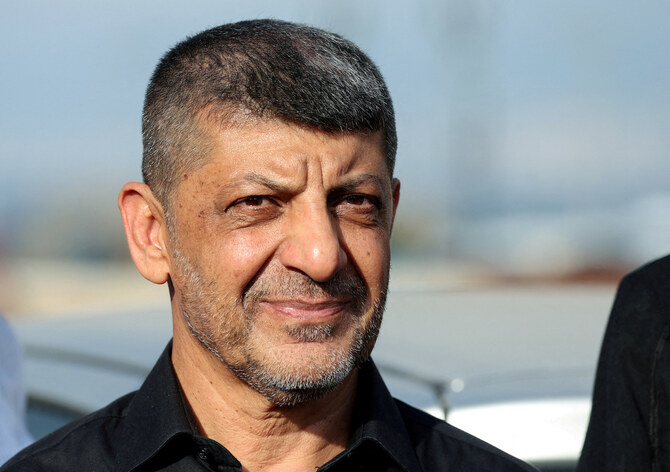

BEIRUT: An Israeli strike on a building in central Beirut on Sunday killed Hezbollah’s media relations chief, Mohammad Afif.
It was later announced that Mahmoud Al-Sharqawi, who was assisting Afif, was also killed at the headquarters of the Arab Socialist Ba’ath Party in Ras Al-Nabaa, a neighborhood of Beirut.
This is the first time this area has been attacked since Israel began operations in the country.
It is densely populated with residents and displaced people from the south, and Beirut’s southern suburbs who have taken refuge there.
The strike also wounded three others, the Health Ministry said in a preliminary count.
Paramedics at the scene of the attack told Arab News about “seeing more blood under the rubble, which is being cleared to determine the fate of those who were inside the building.”
BACKGROUND
Hezbollah began firing rockets, missiles and drones into Israel the day after the Oct. 7, 2023 attack by Hamas ignited the war in Gaza.
The targeted center has belonged to the Ba’ath Party for decades.
Its Secretary-General Ali Hijazi said he was not in the building at the time of the airstrike, and did not explain why Afif was holding a meeting in the Ba’ath Party building.
Information circulated at the site of the attack that a group from Hezbollah’s media relations department was in the building when it was targeted, raising fears that three people accompanying Afif and who are missing might also have been killed.
On Oct. 22 and Nov. 11, Afif held two press conferences in the open air in the southern suburb of Beirut to present Hezbollah’s positions on developments under the watchful eye of Israeli reconnaissance planes, which are constantly flying over the southern suburb.
Afif was a founding member of Hezbollah, joining the party in 1983, and has been in charge of its media since 2014.
He managed Hezbollah-affiliated media outlets such as Al-Manar TV, Al-Nour radio station, and Al-Ahed news website.
Several residents of the targeted area said they received calls warning them to evacuate their homes immediately beforehand.
A 50-year-old woman said: “I just left the house without taking anything with me. It is a real terror.”
The airstrike, which is suspected to have been launched by a drone, destroyed the upper floors of the five-story building, and damaged neighboring buildings on the narrow street.
Israeli army radio confirmed Mohammed Afif was the target of the strike.
It is the third time Beirut has been targeted since the Israeli military expanded its operations in Lebanon.
On Oct. 10, three airstrikes were directed at Wafiq Safa, the head of the liaison and coordination unit of Hezbollah, severely injuring him, as well as the destruction of two buildings in the neighborhoods of Basta and Nuwairi.
A week before, a Hezbollah ambulance center in Bachoura was attacked, leading to the deaths of six people and injuries to seven others.
On Sunday, residents of the Ain Al-Rummaneh area adjacent to the Chiyah district received evacuation warnings issued by Israeli army spokesperson Avichay Adraee via X, accompanied by maps indicating locations to be targeted on the outskirts of Ain Al-Rummaneh, Haret Hreik, and Hadath.
Israeli warplanes subsequently demolished tall residential and commercial buildings in the area.
Our Lady of Salvation Church in Hadath was severely damaged, as were the surroundings of Mar Mikhael Church.
This was followed by a second wave of raids on residential buildings in Burj Al-Barajneh and Bir Al-Abed, and a third wave targeted more than one location in Haret Hreik and Sfeir.
The Israeli spokesperson claimed that the airstrikes “targeted military command centers and other terrorist infrastructures belonging to Hezbollah in the southern suburbs.”
The claim came as Israeli attacks targeting southern Lebanon continued.
The residents of 15 towns deep in the south were asked to evacuate their houses immediately and move north of the Awali River.
The Lebanese military said an Israeli attack on Sunday killed two soldiers, accusing Israel of directly targeting their position in southern Lebanon.
“The Israeli enemy directly targeted an army center” in Al-Mari in the Hasbaya area, causing “the death of one of the soldiers and the wounding of three others, one of whom is in critical condition,” the army said in a statement.
A separate statement shortly afterward said “a second soldier” had died of his wounds.
The Lebanese Army has lost 36 soldiers to Israeli attacks in southern Lebanon over the past year.
Prime Minister Najib Mikati paid tribute to the “martyrs of the army who gave their lives.”
He said: “We must all cooperate so their sacrifices do not go in vain by working first to stop the Israeli aggression on Lebanon and enable the army to carry out all the tasks required of it, to extend the authority of the state alone over all Lebanese territories.”
Mikati said he was hopeful that the ongoing talks would result in a ceasefire.
Also on Sunday, Israeli strikes targeted a house in Chabriha, Sidon District, causing injuries, with raids hitting Tefahta and Aanquoun as well.
In another incident, a person was killed and three injured at dawn in an air raid on the town of Jdeidet Marjayoun.
On Saturday night, a family of seven, including three children, were killed when their house in Arabsalim was targeted.
The displaced Al-Hattab family had moved to the north but was not able to adapt to the conditions of displacement and decided to go back to their home in Arabsalim days before it was hit.
Hezbollah said its confrontations with the Israeli army continued at the borders, especially in Shama.