

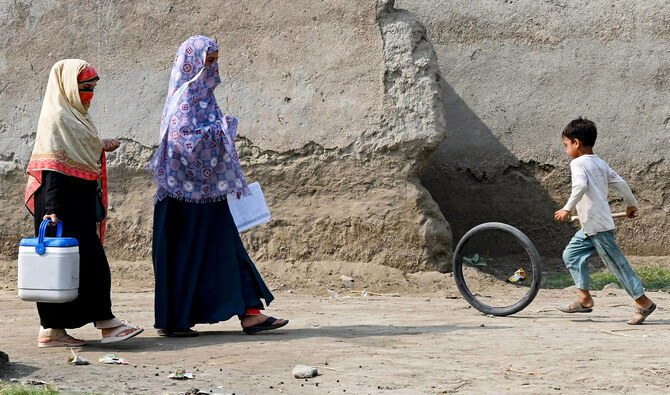

ISLAMABAD, PESHAWAR, KARACHI: The World Health Organization (WHO) and Pakistani officials have identified “immunity gap” as a key factor behind the resurgence of polio in the country, as Pakistan on Friday reported its 49th case this year from the southwestern Balochistan province.
Polio is a highly contagious disease that can cause irreversible paralysis, particularly in young children, and remains incurable, posing a persistent threat as long as the virus is not eradicated.
Most cases in Pakistan have emerged from the conflict-hit Khyber Pakhtunkhwa and Balochistan provinces. Along with neighboring Afghanistan, Pakistan remains one of the last two countries in the world where polio is endemic. After significant progress in reducing cases, Pakistan has seen a resurgence since late 2018, underscoring the fragility of earlier gains.
Health officials explain that an “immunity gap” occurs when a large segment of the population lacks sufficient resistance to the poliovirus, leaving communities vulnerable to infection and outbreaks despite immunization efforts.
“The ongoing transmission and resurgence of the poliovirus was largely attributed to a widespread immunity gap that has developed over time,” WHO told Arab News.
The global health body attributed this “to a compromised campaign quality because of security-related challenges, community resistance, boycotts and demands of local communities, suboptimal routine immunization coverage and internal displacement of mobile and migrant populations.”
It added that high-quality vaccination campaigns were needed to bridge the immunity gap, highlighting that the WHO had organized back-to-back large-scale campaigns in September and October that vaccinated around 45 million children.
“These will follow another campaign in December to effectively plug the immunity gap,” the WHO said. “The mobile and migrant populations were redefined and mapped with revitalized focus on their vaccination.”
Health officials from the restive Khyber Pakhtunkhwa and Balochistan provinces also echoed the same concerns, saying that immunity gaps played a major role in the resurgence of poliovirus.
KP’s Special Health Secretary Abdul Basit said the provincial government was undertaking efforts to “plug remaining immunity gaps” from the region by ensuring timely immunization of children.
A tribal elder from South Waziristan, Malik Anwar Wazir, told Arab News the increasing number of polio cases raised question about the government’s polio eradication efforts.
He termed the decades of infighting and unrest in parts of KP and tribal areas responsible for “inconsistent health care initiatives.”
“Mass exodus or displacement of families because of militancy hinder vaccination drives,” he added. “Most of the families in the tribal belt and parts of KP move for safer areas due to constant war, which creates problems for full immunization dose.”
Dr. Aftab Kakar, a health official in Balochistan, said international donors funding Pakistan’s polio eradication program had expressed concerns and given the authorities in the province new targets to prevent poliovirus transmission by June 2025.
“After being declared a polio-free province for almost years, we received the first transmission of poliovirus from Kandahar [Afghanistan] in September 2023,” he said. “If our children were immunized and well nourished, the virus would not have survived and spread all over the province.”
This year, 24 polio cases have been reported in Balochistan, 13 in Sindh, 10 in Khyber Pakhtunkhwa and one each in Punjab and the federal capital, Islamabad. In the early 1990s, Pakistan recorded approximately 20,000 cases annually, but the number dropped to eight in 2018, six in 2023 and only one in 2021.
Pakistan’s polio eradication program, launched in 1994, has significantly reduced the number of cases over the years. However, the country continues to face major challenges, including militancy, with polio workers frequently targeted in attacks, particularly in the northwestern Khyber Pakhtunkhwa province.
The program has adapted to address climate disasters, such as floods, but continues to experience disruptions. Additionally, there are gaps in supplementary immunization activities, particularly in areas where the virus remains active.


