Protesters storm parliament in breakaway Georgian region Abkhazia over deal with Russia

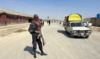
In this photo taken from video released by AIASHARA Independent Agency, Protesters gather outside the parliament building of the Georgian separatist region of Abkhazia as tensions flared over a proposed pact that would allow Russians to buy apartments in the region, Georgia, on Nov. 15, 2024. (AP)
Short Url
Updated 15 November 2024
Follow

Protesters storm parliament in breakaway Georgian region Abkhazia over deal with Russia

  • Eshsou Kakalia, an opposition leader and former deputy prosecutor general, said the parliament building was under the control of the protesters
  • “We will now seek the resignation of the current president of Abkhazia,” he was quoted by Russia’s Interfax news agency as saying

TBILISI: Protesters stormed the parliament of the Russian-backed breakaway Georgian region of Abkhazia on Friday and opposition politicians demanded the resignation of the self-styled president over an unpopular investment agreement with Moscow.
Protesters used a truck to smash through the metal gates surrounding the parliament in the capital Sukhumi. Video from the scene then showed people climbing through windows after prying off metal bars and chanting in the corridors.
Eshsou Kakalia, an opposition leader and former deputy prosecutor general, said the parliament building was under the control of the protesters.
“We will now seek the resignation of the current president of Abkhazia,” he was quoted by Russia’s Interfax news agency as saying. Protesters also broke into the presidential administration offices located in the same building as the parliament.
Emergency services said at least eight people were taken to hospital.
The presidential administration said in a statement that authorities were preparing to withdraw the investment agreement with Russia that some Abkhaz fear will price them out of the property market.
Russia recognized Abkhazia and another breakaway region, South Ossetia, as independent states in 2008 after Russian troops repelled a Georgian attempt to retake South Ossetia in a five-day war.
Most of the world recognizes Abkhazia as part of Georgia, from which it broke away during wars in the early 1990s, but Russian money has poured into the lush sub-tropical territory where Soviet-era spa resorts cling to the Black Sea coast.

RUSSIAN MONEY
Abkhazian lawmakers had been set to vote on Friday on the ratification of an investment agreement signed in October in Moscow by Russian Economy Minister Maxim Reshetnikov and his Abkhazian counterpart, Kristina Ozgan.
Abkhazian opposition leaders say the agreement with Moscow, which would allow for investment projects by Russian legal entities, would price locals out of the property market by allowing far more Russian money to flow in.
The opposition said in a statement that the protesters’ actions were not against Russian-Abkhazian relations.
“Abkhazian society had only one demand: to protect the interests of our citizens and our business, but neither the president nor the parliament have heard the voice of the people until today,” Interfax cited the statement as saying.
Earlier this week Abkhazia’s self-styled president, Aslan Bzhania, held an emergency security council meeting after protesters blocked a key highway and rallied in central Sukhumi to demand the release of four activists.
The activists, who were subsequently freed, had been detained for opposing the passage of a law regulating the construction industry which references the Russian-Abkhazian agreement.
In 2014, demonstrators stormed the presidential headquarters, forcing then-leader Alexander Ankvab to flee. He later resigned over accusations of corruption and misrule.
Opposition leader Raul Khadzhimba, elected following the unrest in 2014, was himself forced to step down in 2020 after street protests over disputed election results.


Filmmakers defend Berlin festival chief in Gaza row

Updated 3 sec ago
Follow

Filmmakers defend Berlin festival chief in Gaza row

  • Actors and filmmakers rushed to defend the head of the Berlin film festival Thursday following a media report that her job was on the line over a director’s anti-Israel speech at the event
BERLIN: Actors and filmmakers rushed to defend the head of the Berlin film festival Thursday following a media report that her job was on the line over a director’s anti-Israel speech at the event.
Syrian-Palestinian filmmaker Abdallah Al-Khatib kicked off a controversy during Saturday’s closing ceremony by accusing Germany of being complicit in genocide in Gaza through its support for Israel.
German tabloid Bild had reported that Tricia Tuttle was due to be dismissed at an emergency meeting on Thursday, citing sources close to state-owned KBB, the company that runs the festival.
Culture minister Wolfram Weimer’s office confirmed the meeting had taken place but made no mention of Tuttle being sacked, stating that discussions had been “constructive and open” and would “continue in the coming days.”
A group of cinema luminaries including Tilda Swinton, Todd Haynes, Sean Baker and Tom Tykwer signed an open letter defending the Berlinale as a forum for free expression.
“As filmmakers in Germany and beyond, we are following the debates surrounding the Berlinale and the discussion about the dismissal of Tricia Tuttle with great concern,” they wrote. “We defend the Berlinale for what it is: a place of exchange.”
Angry rows over the Israel-Palestinian conflict have repeatedly rocked the Berlinale, held every February as Europe’s first major film festival of the year.
Environment Minister Carsten Schneider walked out of Saturday’s closing ceremony, labelling Khatib’s remarks “unacceptable.”
Germany, as it has sought to atone for the horrors of the Holocaust, has been a steadfast supporter of Israel, and criticism of Israel’s conduct in Gaza has been more muted than in many other countries.
Conservative lawmaker Ellen Demuth was among those who condemned the “antisemitic incident” at the awards ceremony and urged “a fresh start at the top of the film festival.”
The Berlinale Team in an Instagram post meanwhile defended Tuttle, praising her “clarity, integrity and artistic vision.”
The writers’ association PEN Berlin said Khatib’s comments were protected by freedom of expression and that if Tuttle were to be sacked over them, it would cause “immense damage” to the festival.
“Such wanton destruction of the German cultural scene, such self-inflicted insularity, must not be allowed to happen,” it said.
The backdrop of the Middle East conflict led to a tense 76th edition of the festival from the start.
More than 80 film professionals criticized the Berlinale’s “silence” on the Gaza war in an open letter, accusing the festival of censoring artists “who reject the genocide” they believe Israel has committed in Gaza.
Award-winning Indian writer Arundhati Roy withdrew from the festival after the jury president, German director Wim Wenders, said cinema should “stay out of politics” when asked about Gaza.