

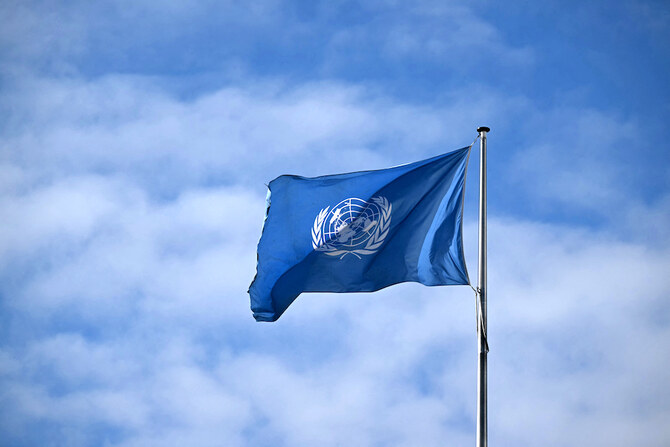
UN resolutions back Palestinian sovereignty, compensation for Lebanon, Syria

The UN Economic and Financial Committee has approved resolutions calling on Israel to compensate Lebanon and Syria for an oil slick, and to hand sovereignty to the Palestinians over their natural resources. (AFP)
Short Url
Updated 14 November 2024
Follow

UN resolutions back Palestinian sovereignty, compensation for Lebanon, Syria

  • US, Argentina, Canada, Israel, Micronesia, Nauru, Palau vote against both resolutions
  • Palestinian representative: Israel allowed to act ‘above the law with brazen impunity’

LONDON: The UN Economic and Financial Committee has approved resolutions calling on Israel to compensate Lebanon and Syria for an oil slick, and to hand sovereignty to the Palestinians over their natural resources.

The US, Argentina, Canada, Israel, Micronesia, Nauru and Palau voted against both resolutions.

The slick occurred after the Israeli Air Force struck storage tanks near the Jiyah electric power plant in 2006, covering two-thirds of Lebanon’s coastline with oil.

The draft resolution was introduced by Uganda’s representative, who highlighted the disastrous impact the slick has had on biodiversity and the local economy.

It reiterated the UN General Assembly’s “deep concern” over the negative impact the incident has had on Lebanon’s long-term sustainable development, and reaffirmed a UN report that damage to the country caused by the slick amounted to $856.4 million in 2014.

The resolution was passed by 161 votes in favor to seven against, with nine abstentions. It called for “prompt and adequate compensation” from Israel to Lebanon and Syria, which was also affected by the slick.

Lebanon’s representative thanked his country’s supporters at the UN, the World Bank and elsewhere.

He said the slick had hindered Lebanon’s ability to implement the UN’s Sustainable Development Goals by 2030, and Israel’s use of chemical and toxic substances in its ongoing military campaign could cause long-term agricultural, economic and biodiversity damage.

He called for an investigation into Israeli war crimes in Lebanon and for further compensation.

The Ugandan representative also introduced a draft resolution calling on Israel to “cease the exploitation, damage, cause of loss or depletion and endangerment of the natural resources in the Occupied Palestinian Territory, including East Jerusalem, and in the occupied Syrian Golan.”

The draft also recognizes the right of the Palestinian people to seek compensation for any illegal activity by Israel or Israeli settlers that exploits or damages their natural resources.

It cited an International Court of Justice advisory opinion from July 19, and reaffirmed “the principle of the permanent sovereignty of the peoples under foreign occupation over their natural resources and the applicability of the Geneva Convention on the protection of civilians in time of war.”

The committee passed the resolution with 159 states in favor. Seven countries opposed the motion, with 11 abstentions.

The Palestinian representative said Israel must be held accountable for crimes committed against her people and on their territory, saying it has “for over a year” violated the UN Charter with its “incomprehensible” acts in Gaza.

She added that Israel has been allowed to act as a state “above the law with brazen impunity, classifying all Palestinians as terrorists to justify its acts.” 

The Syrian delegate said genocide, destruction and displacement committed by Israel “have also threatened to set fire to the entire region and beyond.” He blamed the US for preventing the UN Security Council from taking firm action.

The Algerian delegate said people living under occupation should have sovereignty over their natural resources, and damage caused by Israeli aggression will take years of reconstruction to undo.


Women returning to Gaza say Israeli troops bound and interrogated them after Rafah crossing

Updated 2 sec ago
Follow

Women returning to Gaza say Israeli troops bound and interrogated them after Rafah crossing

  • Abuse took place at a screening station on the edge of the area of Gaza under Israeli military control
  • The women’s ordeal came after a long and arduous day for the returnees
KHAN YOUNIS, Gaza Strip: Many hoped the reopening of the Rafah crossing between Egypt and Gaza would bring relief to the war-battered territory, but for the first few Palestinians allowed to cross, it proved more harrowing than a homecoming.
Three women who entered Gaza on the first day of the reopening said on Tuesday that Israeli troops blindfolded and handcuffed them, then interrogated and threatened them, holding them for several hours and inflicting what they said was humiliating treatment until they were released.
The three were among 12 Palestinians — mostly women, children and the elderly — who entered Gaza on Monday through Rafah, which reopened after being closed for most of the Israel-Hamas war. Israeli forces seized the crossing in May 2024.
Asked about the reports, the Israeli military said, “No incidents of inappropriate conduct, mistreatment, apprehensions, or confiscation of property by the Israeli security establishment are known.” The Shin Bet intelligence agency and COGAT, the Israeli military body overseeing humanitarian aid in Gaza, did not immediately respond to questions about the women’s allegations.
‘A humiliation room’
The three women said the abuse took place at a screening station on the edge of the area of Gaza under Israeli military control that all returnees were required to pass through after crossing Rafah.
The 12 returnees were brought by bus through the crossing, then drove until they reached the Israeli military zone, said one of the returnees, Rotana Al-Regeb, who was coming back with her mother, Huda Abu Abed. The two had left Gaza in March last year for the mother to get medical treatment abroad.
At the screening station, they were ordered out of the bus and members of an Israeli-backed Palestinian armed group, Abu Shabab, including one woman, searched their bags and bodies, she said.
Israeli officers then called them one by one into a room, she said. She said her mother was called first. When Al-Regeb was called, she said she found her mother, who is in her 50s, kneeling on the floor, blindfolded with her hands handcuffed behind her back.
Al-Regeb said Israeli soldiers did the same with her and took her to an “interrogation room — or, a humiliation room.” They questioned her about Hamas and other things in Gaza, “things we didn’t know and had no connection to,” she said.
They also pressured her to act as an informant for the Israeli military, she said. “They threatened that they will detain me and I won’t return to my children,” said Al-Regeb, who has four daughters and a son, living with her husband in a tent in Khan Younis. “There was no beating, but there were insults, threats, and psychological pressure.”
Abu Abed, her mother, confirmed the account to the AP.
The third woman, Sabah Al-Qara, a 57-year-old from Khan Younis who left for medical treatment in Egypt in December 2023, gave a similar account, describing being handcuffed, blindfolded and interrogated.
“They interrogated us and asked us about everything that happened in Gaza,” she said. “We were outside Gaza and knew nothing …. The Israelis humiliated us.”
An arduous day
Under the terms of Rafah’s reopening, a European Union mission and Palestinian officials run the border crossing itself, though the names of those entering are first approved by Israel. Israel then has its screening facility some distance away. The military said authorities at the facility cross-check the identities of people returning to Gaza with Defense Ministry lists and screen their luggage.
Israeli authorities banned returnees from bringing in any liquid, including drinking water, according to some of those who crossed back to Gaza on Monday. Each passenger was allowed to carry one mobile phone and 2,000 shekels, the equivalent of about $650, if they submitted a declaration 24 hours ahead of their travel.
Other electric and digital devices, as well as cigarettes, are not allowed, according to instructions that were posted on the Palestinian side of the crossing and shared with the AP.
Israel has said checkpoints — both in Gaza and the occupied West Bank — are for security. But Palestinians and rights groups have long claimed that Israel mistreats Palestinians passing through them and tried to gather information and recruit informants.
The women’s ordeal came after a long and arduous day for the returnees, with far fewer Palestinians entering than expected and confusion over the rules.
Al-Regeb said 42 Palestinian patients and their relatives were brought to the Egyptian side of Rafah at 6 a.m. and completed their paperwork to cross at around 10 a.m. Monday. They then had to wait until around 6 p.m. for the gate to open for their buses. In the end, only one bus with the 12 people was allowed through, she and Al-Qara said.
On the Gazan side of the crossing, the European team searched their luggage — loaded with gifts for relatives — and took much of it, Al-Regeb and Al-Qara said. Al-Regeb said they took mobile phones and food, kids games and electronic games. “We were only allowed to take the clothes on our backs and one bag per person,” she said.
A person familiar with the situation speaking on condition of anonymity because they were discussing a diplomatic matter told the AP that returnees were carrying more luggage than anticipated, requiring additional negotiations.
The military said the luggage entry policy had been published in advance, without elaborating.
Tens of thousands seeking to come back to Gaza
Al-Regeb said that after they were released from the Israeli screening facility, UN buses took them to Nasser Hospital in Khan Younis, where they finally arrived at 1 a.m. on Tuesday.
“Thank God that I have returned and found my loved ones,” she said. “I am happy that I am in my nation, with my family and with my children.”
Hamas on Tuesday blasted Israel over the allegations of abuse against the returnees, calling it “fascist behavior and organized terrorism.” It called on mediators to take immediate action to stop the practices and ensure travelers’ safety and freedom during transit.
Rights groups and Palestinian officials warn that abuses during the initial reopening could deter others from attempting to cross in the coming days, undermining confidence in the fragile process.
More than 110,000 Palestinians left Gaza in the first months of the war before Rafah was shut, and thousands of patients were evacuated abroad for treatment. Many are expected to seek to return. So far, some 30,000 Palestinians have registered with the Palestinian Embassy in Egypt to go back to Gaza, according to an embassy official, speaking on condition of anonymity because he was not authorized to release the information.
But the crossing only gives a symbolic chance at return: Israeli officials have spoken of allowing around 50 Palestinians a day back into Gaza.