

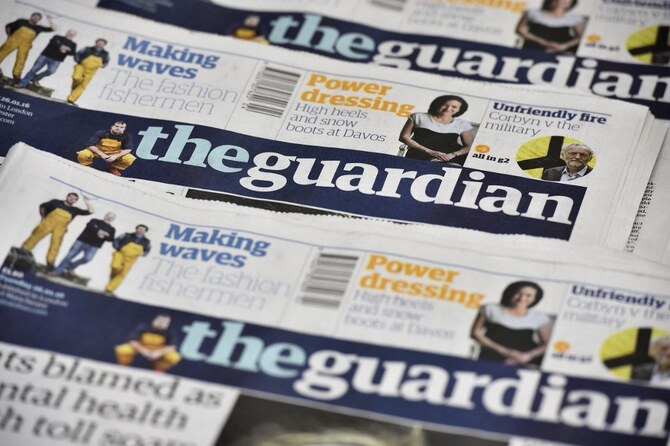
Guardian exits Elon Musk’s X platform over ‘toxic content’ and US election coverage

Short Url
Updated 13 November 2024
Follow

Guardian exits Elon Musk’s X platform over ‘toxic content’ and US election coverage

  • British newspaper said Musk’s ability to influence political discourse during US election reinforced its decision

LONDON: The Guardian announced Wednesday it will cease posting from its official accounts on X, the social media platform owned by Elon Musk, citing concerns over its recent coverage of the US election and a growing prevalence of “toxic content.”

The British newspaper, which operates over 80 accounts on X with a combined following of nearly 27 million, said the decision takes effect immediately.

“We wanted to let readers know that we will no longer post on any official Guardian editorial accounts on the social media site X (formerly Twitter),” said The Guardian.

“We think that the benefits of being on X are now outweighed by the negatives and that resources could be better used promoting our journalism elsewhere.”

The Guardian pointed to a rise in “disturbing content” on the platform, including far-right conspiracy theories and racist content, as well as coverage of the US presidential election that it said reinforced its decision.

Since Musk’s $44 billion acquisition of X in October 2022, the platform has come under fire for its perceived failure to curb misinformation, especially on high-stakes topics like the ongoing conflicts in Gaza and Lebanon and government elections, including in the US.

Despite mounting pressure from rights groups and government officials who have warned of potential fines, Musk has upheld what he calls a “free speech absolutist” approach, defending his stance on minimal content moderation.

The Guardian described X as a “toxic media platform” that no longer meets conditions for responsible publishing.

“Social media can be an important tool for news organisations and help us to reach new audiences but, at this point, X now plays a diminished role in promoting our work,” it explained.

Content from The Guardian will still be shareable on X, and reporters will continue to use the platform for news-gathering purposes.

The Guardian joins other media outlets in boycotting X over disputes with Musk. Last year, National Public Radio stopped posting after the platform labeled it “state-affiliated media,” a designation that also prompted PBS, a US public broadcaster, to suspend its activity on X.


BBC backs Israel’s participation in Eurovision Song Contest amid expanding boycott

Updated 06 December 2025
Follow

BBC backs Israel’s participation in Eurovision Song Contest amid expanding boycott

  • Ireland, Spain, the Netherlands and Slovenia withdraw, citing concerns about the war in Gaza, after organizers clear Israel to compete
  • Critics accuse organizers of double standards, given that Russia was banned from Eurovision in 2022 after invasion of Ukraine

LONDON: The BBC has backed the European Broadcasting Union’s decision to allow Israel to participate in the 2026 Eurovision Song Contest, despite mounting opposition and an expanding boycott by European countries and public broadcasters.

National broadcasters in Ireland, Spain, the Netherlands and Slovenia have formally withdrawn from next year’s event, citing what they described as Israel’s violations of international law during its ongoing war on Gaza, which has killed more than 70,000 people, left much of the territory in ruins and prompted accusations of war crimes.

The BBC, however, said it backed the decision to allow Israel to take part in the contest.

“We support the collective decision made by members of the EBU,” a BBC spokesperson said. “This is about enforcing the rules of the EBU and being inclusive.”

Israel’s participation in the 2026 event, set to take place in the Austrian capital Vienna in May, was confirmed during the EBU’s general assembly in Geneva on Thursday. 

However, pressure continued to build in opposition to the decision, with broadcasters from four countries pulling out and critics accusing organizers of double standards, given that Russia was banned from Eurovision in 2022 after the invasion of Ukraine.

Following the EBU decision, Irish public broadcaster RTE said it would neither participate in nor screen the contest. It said Ireland’s participation “remains unconscionable given the appalling loss of lives in Gaza and the humanitarian crisis there.” It also condemned the killing of journalists in Gaza and the denial of access to the international media. More than 200 Palestinian journalists have reportedly been killed since the start of the war.

Slovenian broadcaster RTV said it was withdrawing from the competition “on behalf of the 20,000 children who died in Gaza.” Chairperson Natalija Gorscak said the decision reflected growing public demand to uphold European values of peace and press freedoms, noting that the international media are still banned from Gaza.

She added that Israel’s 2025 Eurovision performance had been overtly political, and contrasted the decision about Israel with the ban on Russia’s participation following the invasion of Ukraine.

Dutch broadcaster AVROTROS also withdrew from the contest, describing the decision of the EBU as “incompatible with the public values that are essential to us.”

CEO Taco Zimmerman said: “Culture unites, but not at all costs. What happened last year touches our boundaries … Universal values like humanity and a free press have been seriously violated.”

The EBU did not hold a vote on Israel’s participation in the contest. Instead, member broadcasters voted in favor of new rules for contest voting to prevent governments or other groups from unfairly promoting songs to manipulate the result.

Austria, which is set to host the competition after Viennese singer JJ won this year with “Wasted Love,” supports Israel’s participation. Germany, too, was said to back Israel.