

Toxic smog smothering India’s capital smashes WHO limit

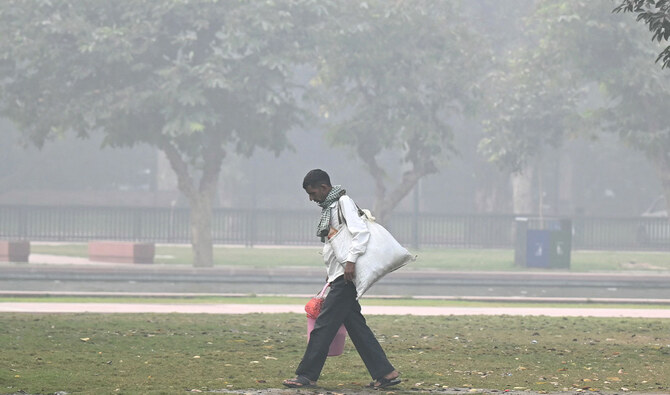
A hawker walks near India Gate engulfed in smog in New Delhi on November 13, 2024. (AFP)
Short Url
Updated 13 November 2024
Follow

Toxic smog smothering India’s capital smashes WHO limit

  • Pollutant levels in New Delhi topped 806 micrograms per cubic meter Wednesday morning 
  • This is over 53 times WHO recommended daily maximum of fine particulate matter

NEW DELHI: Residents of India’s capital New Delhi choked in a blanketing toxic smog Wednesday as worsening air pollution surged past 50 times the World Health Organization’s recommended daily maximum.

Many in the city cannot afford air filters, nor do they have homes they can effectively seal from the misery of foul smelling air blamed for thousands of premature deaths.

Cooler temperatures and slow-moving winds trap deadly pollutants each winter, stretching from mid-October until at least January.

At dawn on Wednesday, “hazardous” pollutant levels in parts of the sprawling urban area of more than 30 million people topped 806 micrograms per cubic meter, according to monitoring firm IQAir.

That is more than 53 times the World Health Organization recommended daily maximum of fine particulate matter — dangerous cancer-causing microparticles known as PM2.5 pollutants that enter the bloodstream through the lungs.

By midday, when air usually is at its best, it eased to about 25-35 times above danger levels, depending on different districts.

Bikramjeet Singh, 25, who works as an environmental health safety manager walking on the streets, said breathing in Delhi was like “smoking cigarettes” and he worried for those with asthma.

“Older people have difficulties breathing,” he said.

The city is blanketed in acrid smog each year, primarily blamed on stubble burning by farmers in neighboring regions to clear their fields for plowing, as well as factories and traffic fumes.

But a report by The New York Times this month, based on air and soil samples it collected over five years, revealed the dangerous fumes also spewing from a power plant incinerating the city’s landfill garbage mountains.

Experts the newspaper spoke to said that the levels of heavy metals found were “alarming.”

Swirling white clouds of smog also delayed several flights across northern India.

The India Meteorological Department said that at least 18 regional airports had a visibility lower than 1,000 meters (1,093 yards) — dropping below 500 meters in Delhi.

India’s Supreme Court last month ruled that clean air was a fundamental human right, ordering both the central government and state-level authorities to take action.

But critics say arguments between rival politicians heading neighboring states — as well as between central and state-level authorities — have compounded the problem.

Politicians are accused of not wanting to anger key figures in their constituencies, particularly powerful farming groups.

City authorities have launched several initiatives to tackle pollution, which have done little in practice.

Government trucks are regularly used to spray water to briefly dampen the pollution.

A new scheme unveiled earlier this month to use three small drones to spray water mist was derided by critics as another “band-aid” solution to a public health crisis.

The WHO says that air pollution can trigger strokes, heart disease, lung cancer and other respiratory diseases.

It is particularly punishing for babies, children and the elderly.

A study in The Lancet medical journal attributed 1.67 million premature deaths to air pollution in the world’s most populous country in 2019.

The choking carbon smog across Delhi came as researchers warned that planet-warming fossil fuel emissions would hit a record high this year, according to new findings from an international network of scientists at the Global Carbon Project.

Researchers said increases in CO2 emissions from India — as well as growth in international aviation — drove emissions up.

It found no sign the world was moving away from fossil fuels as planned.


US hotels seek World Cup boost after tourism dip under Trump

Updated 58 min ago
Follow

US hotels seek World Cup boost after tourism dip under Trump

  • At the US hotels that Meade Atkeson manages, a drop in tourism weighs heavily on business — but hoteliers like him hope that World Cup enthusiasm will soon eclipse wariness over President

WASHINGTON: At the US hotels that Meade Atkeson manages, a drop in tourism weighs heavily on business — but hoteliers like him hope that World Cup enthusiasm will soon eclipse wariness over President Donald Trump’s policies.
The US hospitality sector has been reeling from a tourism slump in the world’s biggest economy, which became the only major destination to see a drop in foreign visitors last year.
“Just financially, it’s difficult when international travel is down,” Atkeson told AFP, noting that such visitors tend to stay longer and spend more.
Foreign travelers account for nearly a quarter of business at the three hotels under Sonesta group that he manages — two in Washington and a third in Miami Beach.
Yet, in the first eleven months of 2025, US official data showed that inbound travel dropped by 5.4 percent.
Canadians were noticeably absent, with travel plunging by 21.7 percent from 2024, translating to about four million fewer people. The decline was nearly seven percent for French visitors.
Industry professionals see this as a consequence of Trump’s policies, even if they may not openly say so.
Visitors have chafed at the Republican president’s sweeping tariffs on foreign goods, broadsides against other countries, tightening immigration rules and portrayal of certain Democrat-led cities as ridden with crime.
Canadians “were asked to be the 51st state, right?” Atkeson said.
“If you talk to Canadians, many of them have chosen not to travel out of conscience” or on principle, he added.
Brazilian tourists meanwhile “can go anywhere they want,” he said. “And so they may have gone to Europe, they may have gone to the islands.”
‘Fear’
Thousands of kilometers away, the major resort city of Las Vegas in Nevada — boasting 150,000 hotel rooms — has also had a bad year.
Elsa Rodan, a chambermaid at the Bellagio resort and casino, says her establishment is “blessed” compared with others.
But even so, it has had to lower prices to attract guests, added Rodan, a representative of the Unite Here union who spoke at a Washington press conference.
Unite Here President Gwen Mills urges for a renewed effort to lobby the Trump administration over policies and rhetoric that she believes are jeopardizing the sector employing more than two million people.
According to her, hoteliers are not pushing the government enough.
Employers express “fear, the fear of picking your head up,” she said.
Hopefully ‘better’
Fewer visitors and overnight stays, alongside a drop in revenue, have triggered a $6.7 billion shortfall for Nevada hotels in 2025, according to the American Hotel and Lodging Association (AHLA).
But the organization hopes that 2026 will be a turning point — it is counting on the World Cup, from June 11 to July 19, to attract visitors.
Eleven US cities will be hosting matches.
“It’s being equated to having nearly 80 Super Bowls in just over a month,” AHLA spokesman Ralph Posner told AFP.
“The economic lift won’t be limited to host cities,” he added. “Destinations across the country are hoping to benefit as international visitors extend their trips and travel between markets.”
Las Vegas, for example, hopes to draw fans who might stop there before or after a game in Los Angeles or Kansas City.
Organizers say that besides the seven million spectators in stadiums, the World Cup is set to attract 20-30 million tourists.
The whole event, they believe, can generate $30 billion for the US economy.
“I hope that things will look better,” Atkeson said.
His Miami hotel is under renovations and cannot host much World Cup-related activity.
But his Washington establishments are highlighting their proximity to Philadelphia, where several matches will be held.
Another complication is war in the Middle East following US-Israeli strikes on Iran, which could snarl travel.
“It’s a little too soon to tell how we’re going to do with that, but we’ll see,” he said.