

Pakistan announces $50 million assistance for climate startups

A man walks atop boats moored on the banks of river Ravi engulfed in smog in Lahore on November 13, 2024. (AFP)
Short Url
Updated 13 November 2024
Follow

Pakistan announces $50 million assistance for climate startups

  • Project seeks to attract private investment in climate-tech ventures
  • Initiative is backed by $25 million commitment from Green Climate Fund

ISLAMABAD: The Pakistan government has launched Climaventures, an initiative led by the National Rural Support Programme (NRSP) under which it will provide $50 million in assistance to climate-tech startups, Radio Pakistan reported on Wednesday. 

Pakistan is ranked the 5th most vulnerable country to climate change, according to the Global Climate Risk Index. In 2022, devastating floods killed over 1,700 people and affected over 33 million, with economic losses exceeding $30 billion.

“Under this project, an investment of fifty million dollars will be made … aimed at providing technical guidance, grants and equity to climate startups," said Radio Pakistan, reporting on the Climaventures initiative. 

“This project will increase private sector investment to deal with climate related challenges in Pakistan.”

In a video posted on X last week by NRSP, Georges Sander, a climate investment specialist, said Climaventures was exciting as it supported “local entrepreneurs […] develop local solutions for local climate problems”.

The $50 million project is designed to attract private investment in climate ventures, NRSP said.

With a core $25m funding commitment from the Green Climate Fund (GCF), Climaventures says it aims to address Pakistan’s funding gaps for sustainable solutions by offering technical guidance, grants and equity for climate-focused startups.

It is the first initiative of its kind in Pakistan and brings together key stakeholders, including government officials, international organizations like the World Bank and ADB, and climate entrepreneurs.
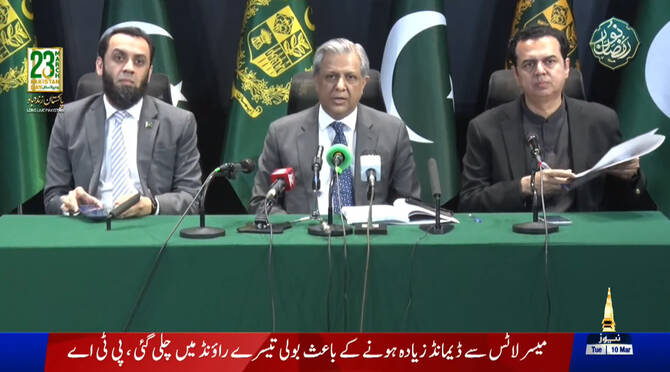

Pakistan law minister urges media caution on foreign policy debate amid Middle East tensions

Updated 10 sec ago
Follow

Pakistan law minister urges media caution on foreign policy debate amid Middle East tensions

  • Azam Nazeer Tarar says constitutional limits must be respected when discussing diplomatic matters
  • He says people can express themselves but sensitive external issues fall outside freedom of expression

ISLAMABAD: Federal Minister for Law and Justice Azam Nazeer Tarar urged journalists on Tuesday to exercise caution when discussing the country’s foreign policy, saying constitutional limits must be respected as regional tensions rise following the escalating conflict in the Middle East.

Tarar said citizens have the right to receive accurate information and express their views, but warned that public debate on sensitive diplomatic matters could cross constitutional boundaries and trigger legal consequences.

His remarks come as tensions in the Gulf have intensified after coordinated strikes by the United States and Israel against Iran on Feb. 28, followed by retaliatory Iranian attacks targeting American bases and infrastructure in several Arab states.

The crisis has complicated diplomatic balancing for countries such as Pakistan that maintain ties across the region.

“Journalism is such a profession, and particularly given the way information flows today, it is the right of every person living in Pakistan that correct information should reach them, and every individual also has the right to express what is in their heart,” Tarar told the media.

“However, we cannot ignore constitutional limits and restrictions,” he said, adding that criticism often arises when authorities register criminal cases or initiate prosecution after those limits were crossed.

The minister said debate that frames Pakistan’s foreign policy choices in binary terms — such as whether the country stands with Iran or Gulf states — risks undermining delicate diplomatic relations.

He maintained even the Constitution of Pakistan does not permit people to casually comment on such issues, adding that the public should trust the state in managing these matters.

“Your constitution, which is the fundamental document and the social contract with the state, the agreement between the state and its citizens about how life is to be conducted here, also obliges you to exercise great caution in such discussions and commentary, as they do not fall within the bounds of freedom of expression,” he said.

The remarks come amid debate in the country about limits of online free speech, as authorities frequently invoked the Prevention of Electronic Crimes Act (PECA) to pursue cases related to digital content.

Critics say the law has been used to curb dissent and intimidate journalists and activists, while the government maintains it is necessary to combat misinformation, cybercrime and threats to national security.

Tarar said legal action should not automatically be viewed as excessive if authorities enforce constitutional limits.

“Every profession also has a basic responsibility to conduct itself within the limits of the law,” he added.