Lebanon says Israeli strike on far north kills at least 8

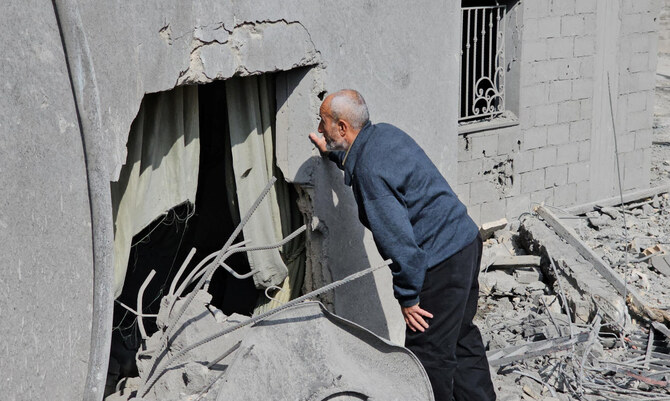
A man inspects his damaged house, in the aftermath of an Israeli strike in Sohmor, in the western part of Lebanon's Bekaa Valley, Lebanon November 10, 2024. (Reuters)
Short Url
Updated 11 November 2024
Follow

Lebanon says Israeli strike on far north kills at least 8

  • “The Israeli enemy strike on Ain Yaacoub in Akkar killed eight people and injured 14 others,” the health ministry said in a statement
  • Local official Rony Al-Hage said “displaced people lived in the two-story house”

BEIRUT: Lebanon said an Israeli strike on the northernmost Akkar region killed at least eight people Monday in one of the farthest attacks from the Israeli border since war erupted in September.
A security official told AFP the target of the strike was a Hezbollah member who was part of a displaced family from south Lebanon that had moved into the building.
“The Israeli enemy strike on Ain Yaacoub in Akkar killed eight people and injured 14 others,” the health ministry said in a statement, giving what it said was a preliminary toll.
Earlier, Lebanese state-run media said Israel struck a house in Ain Yaacoub, a village inhabited mostly by Sunni Muslims and Christians that is far from the Iran-backed Hezbollah’s traditional bastions.
Since September 23, Israel has intensified its air campaign against Hezbollah, mainly targeting the group’s strongholds in Lebanon’s east and south and south Beirut, and very rarely in the north.
“An enemy strike targeted a house in the village of Ain Yaacoub,” some 150 kilometers (93 miles) from Israel, said Lebanon’s official National News Agency.
Local official Rony Al-Hage told AFP that “displaced people lived in the two-story house,” and that it was the northernmost Israeli attack since the full-blown war erupted.
After Israel ramped up its campaign of air raids, it also sent ground troops into south Lebanon on September 30.
“Rescue and rubble-removing operations are still ongoing,” Hage said.
Residents of a nearby village heard a loud explosion and ambulance sirens.
A local Facebook page broadcast a live video feed it said was from the scene that showed a destroyed house, with people removing rubble with their bare hands and using their phones as flashlights.
The health ministry earlier said an Israeli strike on the southern town of Saksakiyeh killed at least seven people.
On Sunday, the ministry said an Israeli strike killed 23 people, including seven children, in the village of Almat north of the capital.
The Lebanon war erupted after nearly a year of cross-border exchanges of fire, launched by Hezbollah in support of its Palestinian ally Hamas following their October 7, 2023 attack on Israel. That attack triggered the ongoing Gaza war.
More than 3,240 people have been killed in Lebanon since the cross-border fire began last year, according to the health ministry, with most of the deaths coming since late September.


Israel’s new NGO regulations threaten vital aid to Palestinians

Displaced Palestinians stand next to destroyed houses in Nuseirat camp in the central Gaza Strip on December 19, 2025. (AFP)
Updated 10 sec ago
Follow

Israel’s new NGO regulations threaten vital aid to Palestinians

  • Bureaucratic pressure ‘is being used for political control, with catastrophic consequences,’ say relief workers

GAZA: New rules in Israel for registering nongovernmental organizations, under which more than a dozen groups have already been rejected, could have a catastrophic impact on aid work in Gaza and the West Bank, relief workers warn.

The NGOs have until Dec. 31 to register under the new framework, which Israel says aims not to impede aid distribution but to prevent “hostile actors or supporters of terrorism” operating in the Palestinian territories.
The controversy comes with Gaza, which lacks running water and electricity, still battling a humanitarian crisis even after the US-brokered October ceasefire in the war between Israel and Hamas, sparked by the Palestinian militant group’s Oct. 7, 2023 attack on Israel.
Israel’s Ministry of Diaspora Affairs and Combating Antisemitism said that, as of November 2025, approximately 100 registration requests had been submitted and “only 14 organization requests have been rejected ... The remainder have been approved or are currently under review.”
Requests are rejected for “organizations involved in terrorism, antisemitism, delegitimization of Israel, denial of the crimes of Oct. 8,” it said.
The amount of aid entering Gaza remains inadequate. 
While the Oct. 10 ceasefire agreement stipulated the entry of 600 trucks per day, only 100 to 300 are carrying humanitarian aid, according to NGOs 
and the UN.
The NGOs barred under the new rules include Save the Children, one of the best-known and oldest in Gaza, where it helps 120,000 children, and the American Friends Service Committee, or AFSC.
They are being given 60 days to withdraw all their international staff from the Gaza Strip, the occupied West Bank, and Israel, and will no longer be able to deliver any aid.
The forum that brings together UN agencies and NGOs working in the area on Thursday issued a statement urging Israel to “lift all impediments,” including the new registration process, that “risk the collapse of the humanitarian response.”
The Humanitarian Country Team for the Occupied Palestinian Territory, or HCT, warned that dozens of NGOs face deregistration and that, although some had been registered, “these NGOs represent only a fraction of the response in Gaza and are nowhere near the number required just to meet immediate and basic needs.”
“The deregistration of NGOs in Gaza will have a catastrophic impact on access to essential and basic services,” it said.
Several NGOs declined to be quoted on the record due to the issue’s sensitivity, saying they had complied with most of Israel’s requirements to provide a complete dossier.
Some, however, refused to cross what they described as a “red line” of providing information about their Palestinian staff.
“After speaking about genocide, denouncing the conditions under which the war was being waged and the restrictions imposed on the entry of aid, we tick all the boxes” to fail the registration, predicted the head of 
one NGO.
“Once again, bureaucratic pressure is being used for political control, with catastrophic consequences,” said the relief worker.
Rights groups and NGOs, including Amnesty International and Human Rights Watch, have accused Israel of carrying out a genocide against Palestinians in Gaza, a term vehemently rejected by the Israeli government.
“If NGOs are considered to be harmful for passing on testimonies from populations, carrying out operational work, and saying what is happening, and this leads to a ban on working, then this is very problematic,” said Jean-Francois Corty, president of French NGO Medecins 
du Monde.
The most contentious requirement for the NGOs is to prove they do not work for the “delegitimization” of Israel, a term that appears related to calling into question Israel’s right to exist, but which aid workers say is dangerously vague.
“Israel sees every little criticism as a reason to deny their registration ... We don’t even know what delegitimization actually means,” said Yotam Ben-Hillel, an Israeli lawyer who is assisting several NGOs with the process and has filed legal appeals.
He said the applications of some NGOs had already been turned down on these grounds.
“So every organization that operates in Gaza and the West Bank and sees what happens and reports on that could be declared as illegal now, because they just report on what they see,” he said
With the Dec. 31 deadline looming in just over a fortnight, concerns focus on what will happen in early 2026 if the selected NGOs lack the capacity and expertise of organizations with a long-standing presence.
Several humanitarian actors said they had “never heard of” some of the accredited NGOs, which currently have no presence in Gaza but were reportedly included in Trump’s plan for Gaza.
The US “is starting from scratch, and with the new registration procedure, some NGOs will leave,” said a European diplomatic source in the region, asking not to be named. 
“They might wake up on Jan. 1 and realize there is no-one to replace them.”