

Saudi Arabia’s flyadeal boosts Dammam network with 3 domestic routes

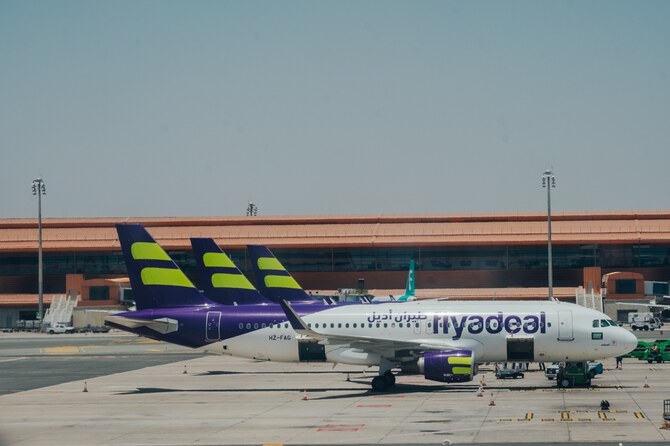
The airline’s fleet comprises 36 modern Airbus A320 narrowbody aircraft. Shutterstock
Short Url
Updated 10 November 2024
Follow

Saudi Arabia’s flyadeal boosts Dammam network with 3 domestic routes

  • The new destinations, Najran, Tabuk, and Yanbu, are strategically significant
  • Expansion marks the first phase of flyadeal’s 2025 growth plan

RIYADH: Saudi Arabia’s low-cost airline, flyadeal, will launch three new domestic routes from Dammam starting in January, aligning with the Kingdom’s Vision 2030 objectives. 

The airline will launch daily flights from Dammam to Najran and four weekly services to Tabuk on Jan. 1, followed by three weekly flights to Yanbu starting Jan. 2.

The announcement was made by Steven Greenway, CEO of flyadeal, on the sidelines of the World Travel Market in London.

Greenway said the new routes are part of flyadeal’s mission to connect smaller towns and cities across the Kingdom, catering to populations under 400,000 that are underserved yet have a growing demand for air travel.

“Having well-established bases in Riyadh and Jeddah, flyadeal is now strengthening its presence in the Eastern Province by increasing frequencies on existing routes and adding three new destinations connected to Dammam,” Greenway said.

He added: “Our new flights will facilitate travel for business and leisure purposes, support the growing desire among Saudis and international visitors to discover the rich diversity that the country offers, and attract a growing expatriate population to explore the Kingdom.”

The expansion complements Vision 2030, which seeks to diversify Saudi Arabia’s economy and transform the Kingdom into a global transportation and logistics hub.

By enhancing access to remote and economically vital cities, flyadeal supports Vision 2030 objectives to strengthen tourism, stimulate business opportunities, and increase domestic mobility.

The new routes will also advance the nation’s strategy to welcome 150 million visitors annually by 2030.

The expansion marks the first phase of flyadeal’s 2025 growth plan, which includes adding more domestic routes and launching international flights from its primary hubs in Riyadh, Jeddah, and Dammam in the coming months.

The developments align with Saudi Arabia’s broad national efforts to establish itself as a key player in the aviation sector, with enhanced infrastructure, expanded air service networks, and a focus on customer experience.

Operating from its three main bases, Riyadh, Jeddah, and Dammam, flyadeal serves nearly 30 year-round and seasonal destinations across the Kingdom and select cities in the Middle East, Europe, and North Africa.

The airline’s fleet comprises 36 modern Airbus A320 narrowbody aircraft, optimized for efficiency and passenger comfort, reinforcing Saudi Arabia’s commitment to advancing sustainable and high-quality air travel.

The new destinations, Najran, Tabuk, and Yanbu, are strategically significant. Najran, an agricultural hub in the southwest, contributes substantially to the local economy.

Tabuk serves as a gateway to the Red Sea coast and plays a pivotal role in the Kingdom’s large-scale tourism and development projects.

Yanbu, Saudi Arabia’s second-largest port in the Madinah province, is a hub for petroleum and petrochemical industries, supporting national economic objectives and Vision 2030’s goals for diversified growth.

With international routes to Amman, Cairo, and Istanbul, flyadeal positions itself as a crucial connector between the Kingdom and key regional and international destinations, advancing Vision 2030’s ambition of creating an integrated, globally connected Saudi Arabia.


Reforms target sustained growth in Saudi real estate sector, says Al-Hogail

Updated 26 January 2026
Follow

Reforms target sustained growth in Saudi real estate sector, says Al-Hogail

RIYADH: The Real Estate Future Forum opened its doors for its first day at the Four Seasons Riyadh, with prominent global and local figures coming together to engage with one of the Kingdom’s most prospering sectors.

With new regulations, laws, and investments underway, 2026 is expected to be a year of momentous progress for the real estate sector in the Kingdom.

The forum opened with a video highlighting the sector’s progress in the Kingdom, during which an emphasis was placed on the forum’s ability to create global reach, representation, as well as agreements worth a cumulative $50 billion

With the Kingdom now opening up real estate ownership to foreigners, this year’s Real Estate Future Forum is placing a great deal of importance on this new milestone and its desired outcomes and impact on the market. 

Aside from this year’s forum’s unique discussions surrounding those developments, it will also be the first of its kind to launch the Real Estate Excellence Award and announce its finalist during the three-day summit.

Minister of Municipalities and Housing and Chairman of the Real Estate General Authority Majed Al-Hogail took to stage to address the diverse audience on the real estate market’s achievements thus far and its milestones to come.

Of those important milestones, he underscored “real estate balance” as a key pillar of the sector’s decisions to implement regulatory tools “with the aim of constant growth which can maintain the vitality of this sector.” He pointed to examples of those regulatory measures, such as the White Land Tax.

On 2025’s progress, the minister highlighted the jump in Saudi family home ownership, which went from 47 percent in 2016 to 66 percent in 2025, keeping the Kingdom’s Vision 2030 goal of 70 percent by the end of the decade on track.

He said the opening of the real estate market to foreigners is an indicator of the sector’s maturity under the leadership of Crown Prince Mohammed bin Salman. He said his ministry plans to build over 300,000 housing units in Riyadh over the next three years.

Speaking to Arab News,  Al-Hogail elaborated on these achievements, stating: “Today, demand, especially local demand, has grown significantly. The mortgage market has reached record levels, exceeding SR900 billion ($240 billion) in mortgage financing, we are now seeing SRC (Saudi Real Estate Refinance Co.) injecting both local and foreign liquidity on a large scale, reaching more than SR54 billion”

Al-Hogail described Makkah and Madinah as unique and special points in the Kingdom’s real estate market as he spoke of the sector’s attractiveness.

 “Today, the Kingdom of Saudi Arabia has become, in international investment indices, one that takes a good share of the Middle East, and based on this, many real estate investment portfolios have begun to come in,” he said. 

Al-Ahsa Gov. Prince Saud bin Talal bin Badr Al-Saud told Arab News the Kingdom’s ability to balance both heritage sites with real estate is one of its strengths.

He said: “Actually the real estate market supports the whole infrastructure … the whole ecosystem goes back together in the foundation of the real estate; if we have the right infrastructure we can leverage more on tourism plus we can leverage more on the quality of life … we’re looking at 2030, this is the vision … to have the right infrastructure the time for more investors to come in real estate, entertainment, plus tourism and culture.”