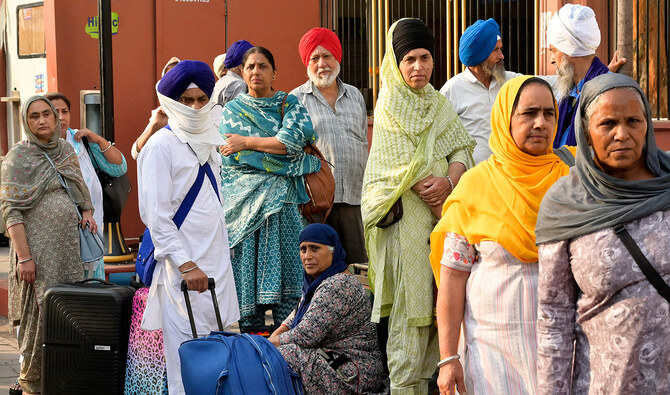
ISLAMABAD: The Pakistan High Commission in New Delhi said on Sunday it has issued over 3,000 visas to Sikh pilgrims in the country to attend the birthday celebrations of Sikhism founder Baba Guru Nanak.
Pakistan last month renewed its agreement with India regarding the Kartarpur Corridor that gives Sikh pilgrims from the neighboring country visa-free access to the final resting place of Nanak, their religion’s founder.
The visa-free border crossing, from India to Kartarpur in the Narowal district of Pakistan’s Punjab, was inaugurated in November 2019 just ahead of Nanak’s 550th birthday.
The corridor connects the Sikh shrines of Dera Baba Nanak in India to Gurdwara Darbar Sahib, Nanak’s final resting place, in Kartarpur and is seen as a rare example of cooperation and diplomacy between the two South Asian neighbors.
“The Pakistan High Commission in New Delhi has issued over 3000 visas to Sikh pilgrims from India to participate in the birthday celebrations of Baba Guru Nanak Dev Ji to be held in Pakistan from 14-23 November 2024,” the Pakistan High Commission in New Delhi wrote on social media platform X.
It said Pakistan’s Charge d’Affaires to India, Saad Ahmad Warraich, extended his heartfelt felicitations to the Sikh pilgrims and wished them a “fulfilling yatra.”
Much of Sikh heritage is located in Pakistan. When Pakistan was carved out of India at the end of British rule in 1947, Kartarpur ended up on the Pakistani side of the border, while most of the region’s Sikhs remained on the other side.
For over seven decades, the Sikh community had lobbied for easier access to their holiest temple.
Pakistan’s initiative to open the corridor earned widespread appreciation from the international community, including the United Nations Secretary-General António Guterres, who had described it as a “Corridor of Hope.”


![]()

Pakistan issues over 3,000 visas to Indian Sikh pilgrims to attend religious event
Short Url
https://arab.news/2r9q6
Pakistan issues over 3,000 visas to Indian Sikh pilgrims to attend religious event
- Islamabad provides visas to Indian pilgrims to attend Sikhism founder Baba Guru Nanak’s birthday celebrations from Nov. 14-23
- A visa-free corridor in Pakistan’s Punjab provides easy access to Indian pilgrims to Nanak’s final resting place in Narowal
Latest updates






© 2026 SAUDI RESEARCH & PUBLISHING COMPANY, All Rights Reserved And subject to Terms of Use Agreement.