

Saudi Arabia’s industrial production holds steady in September: GASTAT 

According to data from the General Authority for Statistics, the Kingdom’s manufacturing sector decreased by 0.5 percent in September, bringing the Industrial Production Index to 105.6 points. Shutterstock
Short Url
Updated 10 November 2024
Follow

Saudi Arabia’s industrial production holds steady in September: GASTAT 

  • The manufacture of chemicals and chemical products grew by 2 percent, while food product manufacturing saw a 12.3 percent increase
  • GASTAT revealed that the sub-index for mining and quarrying activity remained stable in September

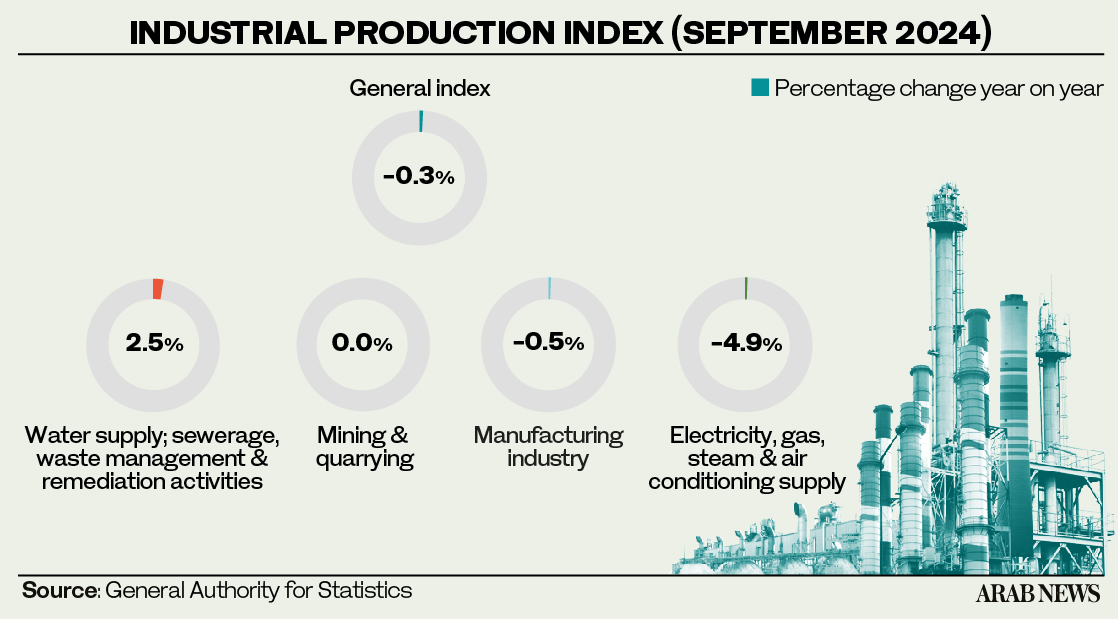
RIYADH: Saudi Arabia’s industrial production held steady in September, showing a slight year-on-year decrease of 0.3 percent due to a modest decline in manufacturing output, official data showed.  

According to data from the General Authority for Statistics, the Kingdom’s manufacturing sector decreased by 0.5 percent in September, bringing the Industrial Production Index to 105.6 points. This decrease was largely attributed to a 12.3 percent drop in the production of coke and refined petroleum products. 

In contrast, the manufacture of chemicals and chemical products grew by 2 percent, while food product manufacturing saw a 12.3 percent increase. 

Saudi Arabia’s growth in the manufacturing sector is crucial to achieving the goals outlined in Vision 2030, as the Kingdom continues to diversify its economy and reduce its dependence on crude revenues. 

GASTAT revealed that the sub-index for mining and quarrying activity remained stable in September compared to the same month in 2023. 
“Oil production level in Saudi Arabia reached 8.97 million barrels per day in September 2024, which is the same level recorded in the previous year,” said GASTAT.  

In a bid to maintain market stability, Saudi Arabia, in alignment with the decision of OPEC+, reduced its oil output by 500,000 barrels per day in April 2023. This cut has now been extended until December 2024. 

IPI is an economic indicator that reflects the relative changes in the volume of industrial output and is calculated based on the industrial production survey. 

According to the report, the sub-index for electricity, gas, steam, and air conditioning supply activity recorded a 4.9 percent annual decrease in September, while the sub-index for water supply, sewerage, and waste management activities increased by 2.5 percent during the same period. 

The authority revealed that the index for oil activities decreased by 2.5 percent in September compared to the same month the previous year. 

On a positive note, the index for non-oil activities increased by 5 percent year on year in September, supported by growth in all non-oil economic activities except for electricity, gas, steam, and air conditioning supply. 

Compared to August, Saudi Arabia’s IPI decreased by 1.2 percent. 

The Kingdom’s sub-index for mining and quarrying activity decreased by 0.2 percent in September compared to the previous month, while manufacturing activities saw a decline of 2.6 percent. 

Month-on-month, the index for oil activities decreased by 1.6 percent, and the index for non-oil activities declined by 0.3 percent. 


King Abdulaziz Airport among world’s busiest after record-breaking 2025

Updated 02 January 2026
Follow

King Abdulaziz Airport among world’s busiest after record-breaking 2025

RIYADH: King Abdulaziz International Airport has achieved a new historical milestone, reaching 53.4 million passengers in a single year.

This is the highest number ever recorded at a Saudi airport since the beginning of air travel in the Kingdom, placing it among the world’s mega airports in terms of passenger traffic, according to the Saudi Press Agency.

The airport handled a total of 310,000 flights and 60.4 million bags, representing a 12 percent increase compared to 2024. It also handled 9.57 million Zamzam water containers and 2,968 cargo flights. 

This achievement reflects the airport’s qualitative transformation and its position as a regional hub and national gateway connecting the Kingdom to the world. It also highlights its role in facilitating the movement of visitors and pilgrims, promoting tourism in line with the goals of Vision 2030, diversifying the economy, and providing a distinguished travel experience. 

For his part, CEO of Jeddah Airports Co. Mazen Johar, affirmed that reaching 53.4 million passengers confirms the airport’s high operational readiness and represents a pivotal milestone for moving to the next phase, in preparation for doubling this number, God willing, in the coming years. 

He pointed out that this national achievement would not have been possible without the grace of God Almighty, followed by the directives of the wise leadership and the continuous follow-up from the minister of transport and logistics, the president of the General Authority of Civil Aviation, and the CEO of Airports Holding Co. 

He explained that King Abdulaziz International Airport is strengthening its position as a major aviation hub in the region through expansions, increased capacity, and improved services, supporting the objectives of the aviation program and aligning with the goals of the Kingdom’s Vision 2030. 

The CEO of Jeddah Airports Co. expressed his gratitude to the partners in success from various government and private sectors for their fruitful cooperation through a collaborative work system that contributed to providing the best services.
