

California spearheads new ‘resistance’ to Trump’s plans of mass deportation, environmental protection rollback

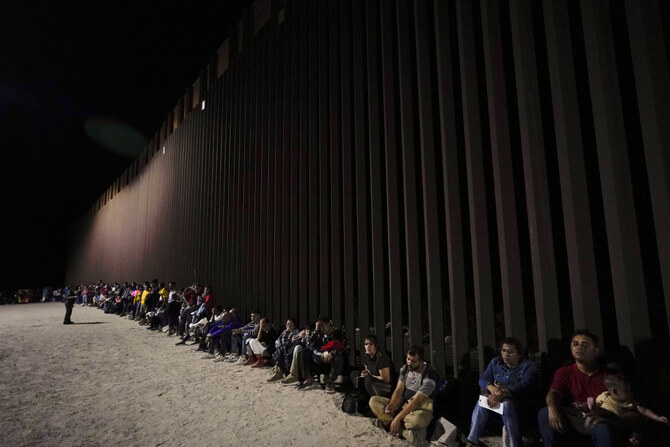
In this file photo, migrants wait to be processed after crossing into the United States near the end of a border wall near Yuma, Arizona. US president-elect Donald Trump has promised mass deportations of illegal immigrants once he sets foot at the White House. (AP)
Short Url
Updated 09 November 2024
Follow

California spearheads new ‘resistance’ to Trump’s plans of mass deportation, environmental protection rollback

  • Trump’s sweeping election victory this week came off the back of promises to swiftly expel millions of illegal immigrants and roll back nationwide environmental protections
  • But under the US constitution, states wield significant power and any such moves will certainly be met with lawsuits

LOS ANGELES: California is spearheading a new resistance to the incoming Donald Trump administration that will test the power of Democratic states to battle mass deportation, defend reproductive rights and combat climate change.
Trump’s sweeping election victory this week came off the back of promises to swiftly expel millions of illegal immigrants and roll back nationwide environmental protections. Critics fear his allies could move to restrict access to abortion medication.
But under the US constitution, states wield significant power and any such moves will certainly be met with lawsuits.
California’s top prosecutor stood in front of San Francisco’s Golden Gate Bridge this week and vowed to “take on the challenges of a second Trump Administration — together.”
“We lived through Trump 1.0. We know what he’s capable of,” said California Attorney General Rob Bonta.
“We’ll continue to be a check on overreach and push back on abuse of power,” he promised.
Governors and attorneys general of other liberal states including New York, Illinois, Oregon and Washington have made similar proclamations.
“If you try to harm New Yorkers or roll back their rights, I will fight you every step of the way,” Governor Kathy Hochul vowed.
“You come for my people, you come through me,” Illinois Governor J.B. Pritzker said, as Democratic prosecutors across the nation coordinate their strategies.
The pre-emptive maneuvers have swiftly drawn the ire of Trump, who singled out California Governor Gavin Newsom in an angry social media riposte Friday.
“He is using the term ‘Trump-Proof’ as a way of stopping all of the GREAT things that can be done to ‘Make California Great Again,’ but I just overwhelmingly won the Election,” complained Trump.

Hindrance by litigation
State plans to disrupt his agenda will bring an unwelcome sense of deja vu for Trump, whose efforts to rescind Barack Obama’s immigration and health care policies during his first term were repeatedly stymied in court.
During the last Trump administration, California alone sued over 100 times in a variety of areas, slowing down or restricting its policies. Republican states echoed that strategy under Joe Biden’s administration.
“It was as successful as you can get,” said Julian Zelezer, professor of political history at Princeton University.
“States, especially a state as large as California, do have the power to resist some of the changes that will come from the administration, to uphold emissions regulations and other laws, including on reproductive rights.”
A benefit of litigation is that “cases move about as fast as snails,” said Kevin Johnson, a law professor at University of California, Davis.
“Some cases go around the lower courts, and by the time they hit the Supreme Court, there’s a new president,” he told AFP.

“Sanctuary states”
Immigration is expected to be a flashpoint in the looming battle.
Republican states may cooperate with the Trump administration in identifying and detaining undocumented people. But Democratic states are likely to refuse.
During Trump’s previous term California was the first to declare itself a “sanctuary state,” prohibiting local law enforcement from working with federal agents to arrest illegal immigrants.
Trump could withhold federal funding to certain states as a means of exerting pressure.
He has also floated more radical measures, including massively expanding a process called “expedited removal” to evict undocumented people without court hearings, or even using the military to arrest suspected illegal immigrants.
But “there would almost immediately be a request for a preliminary injunction,” predicted Johnson.
“If you send the military on the border” to detain or deport immigrants, “it is unprecedented in all kinds of ways, and it raises all kinds of issues.”

“As California goes, so goes the nation”
One downside for states is the enormous financial cost of countless legal battles.
“State budgets are tight, and so that money has to come from somewhere else,” said Zelezer.
With Trump having won the popular vote and increased his vote share even in most liberal states, “politically, it might be a little harder as they try to move forward with doing this again,” he said.
Still, California’s leaders’ zeal in opposing Trump appeared undaunted.
“As is so often said, as California goes, so goes the nation,” said Bonta.
“In the days and months and years to come, all eyes will look west.”


US to cut roughly 200 NATO positions, sources say

Updated 21 January 2026
Follow

US to cut roughly 200 NATO positions, sources say

  • Trump famously threatened to withdraw from NATO during ⁠his first presidential term and said on the campaign trail that he would encourage Russia to attack NATO members that did not pay their fair share on defense

WASHINGTON: The United States plans to reduce the number of personnel it has stationed within several key NATO command centers, a move that could intensify concerns ​in Europe about Washington’s commitment to the alliance, three sources familiar with the matter said this week.
As part of the move, which the Trump administration has communicated to some European capitals, the US will eliminate roughly 200 positions from the NATO entities that oversee and plan the alliance’s military and intelligence operations, said the sources, who requested anonymity to discuss private diplomatic conversations.
Among the bodies that will be affected, said the sources, are the UK-based NATO Intelligence Fusion Center and the Allied Special Operations Forces Command in Brussels. Portugal-based STRIKFORNATO, which oversees some maritime operations, will also be cut, as will several other similar NATO entities, the sources said.
The sources did not specify why the US had decided to cut the number of staff dedicated to the NATO roles, but the moves broadly align with the ‌Trump administration’s stated intention to ‌shift more resources toward the Western Hemisphere.
The Washington Post first reported the decision.

TRUMP ‌RE-POSTS ⁠MESSAGE ​IDENTIFYING NATO ‌AS THREAT
The changes are small relative to the size of the US military force stationed in Europe and do not necessarily signal a broader US shift away from the continent. Around 80,000 military personnel are stationed in Europe, almost half of them in Germany. But the moves are nonetheless likely to stoke European anxiety about the future of the alliance, which is already running high given US President Donald Trump’s stepped-up campaign to wrest Greenland away from Denmark, raising the unprecedented prospect of territorial aggression within NATO.
On Tuesday morning, the US president, who is scheduled to fly to the World Economic Forum in Switzerland in the evening, shared another user’s post on social media that identified NATO as a threat to the ⁠United States. The post described China and Russia as merely “boogeymen.”
Asked for comment, a NATO official said changes to US staffing are not unusual and that the US presence in ‌Europe is larger than it has been in years.
“NATO and US authorities are in ‍close contact about our overall posture – to ensure NATO retains our ‍robust capacity to deter and defend,” the NATO official said.
The White House and the Pentagon did not respond to requests for ‍comment.

MILITARY IMPACT UNCLEAR, SYMBOLIC IMPACT OBVIOUS
Reuters could not obtain a full list of NATO entities that will be affected by the new policy. About 400 US personnel are stationed within the entities that will see cuts, one of the sources said, meaning the total number of Americans at the affected NATO bodies will be reduced by roughly half.
Rather than recalling servicemembers from their current posts, the US will for the most part decline to ​backfill them as they move on from their positions, the sources said.
The drawdown comes as the alliance traverses one of the most diplomatically fraught moments in its 77-year history. Trump famously threatened to withdraw from NATO during ⁠his first presidential term and said on the campaign trail that he would encourage Russian President Vladimir Putin to attack NATO members that did not pay their fair share on defense. But he appeared to warm to NATO over the first half of 2025, effusively praising NATO Secretary-General Mark Rutte and other European leaders after they agreed to boost defense spending at a June summit.
In recent weeks, however, his administration has again provoked alarm across Europe. In early December, Pentagon officials told diplomats that the US wants Europe to take over the majority of NATO’s conventional defense capabilities, from intelligence to missiles, by 2027, a deadline that struck European officials as unrealistic. A key US national security document released shortly after called for the US to dedicate more of its military resources to the Western Hemisphere, calling into question whether Europe will continue to be a priority theater for the US
In the first weeks of 2026, Trump has revived his longstanding campaign to acquire Greenland, an overseas territory of Denmark, enraging officials in Copenhagen and throughout Europe, many of whom believe any territorial aggression within the alliance would mark the end of NATO. Over the weekend, ‌Trump said he would slap several NATO countries with tariffs starting February 1 due to their support for Denmark’s sovereignty over the island. That has caused European Union officials to mull retaliatory tariffs of their own.