

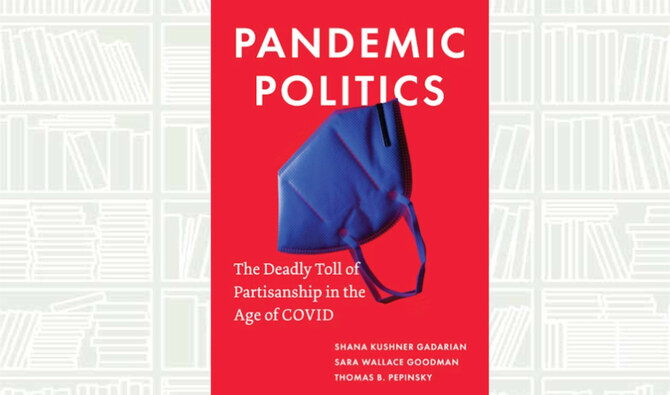
What We Are Reading Today: Pandemic Politics

Photo/Supplied
Short Url
Updated 08 November 2024
Follow

What We Are Reading Today: Pandemic Politics

  • Health is not an inherently polarizing issue, but the Trump administration’s partisan response to COVID-19 led ordinary citizens to prioritize what was good for their “team” rather than what was good for their country

Author: Shana Kushner Gadarian, Sara Wallace Goodman and Tomas B. Pepinsky

COVID-19 has killed more people than any war or public health crisis in American history, but the scale and grim human toll of the pandemic were not inevitable. Pandemic Politics examines how Donald Trump politicized COVID-19, shedding new light on how his administration tied the pandemic to the president’s political fate in an election year and chose partisanship over public health, with disastrous consequences for all of us.

Health is not an inherently polarizing issue, but the Trump administration’s partisan response to COVID-19 led ordinary citizens to prioritize what was good for their “team” rather than what was good for their country.

Democrats, in turn, viewed the crisis as evidence of Trump’s indifference to public well-being. At a time when solidarity and bipartisan unity were sorely needed, Americans came to see the pandemic in partisan terms, adopting behaviors and attitudes that continue to divide us today.


What We Are Reading Today: The Power of Hope by Carol Graham

Updated 25 February 2026
Follow

What We Are Reading Today: The Power of Hope by Carol Graham

In a society marked by extreme inequality of income and opportunity, why should economists care about how people feel? The truth is that feelings of well-being are critical metrics that predict future life outcomes.

In this timely and innovative account, economist Carol Graham argues for the importance of hope—little studied in economics at present—as an independent dimension of well-being.

Given America’s current mental health crisis, thrown into stark relief by COVID, hope may be the most important measure of well-being, and researchers are tracking trends in hope as a key factor in understanding the rising numbers of “deaths of despair” and premature mortality.

Graham, an authority on the study of well-being, points to empirical evidence demonstrating that hope can improve people’s life outcomes and that despair can destroy them. These findings, she argues, merit deeper exploration.