

Pakistan’s Punjab bans entry to parks, zoos and playgrounds amid pollution

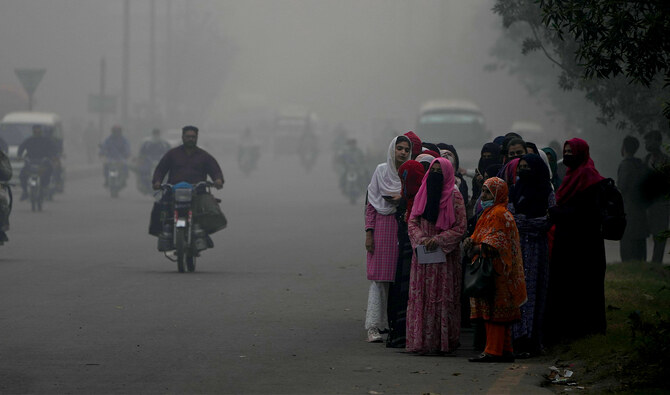
Students wait for transport in the morning at a roadside as smog envelops the area of Lahore, Pakistan, on November 8, 2024. (AP)
Short Url
Updated 08 November 2024
Follow

Pakistan’s Punjab bans entry to parks, zoos and playgrounds amid pollution

  • The province has set up a ‘smog war room,’ using satellite, drones and AI to monitor and address pollution
  • Environmentalists want government to address fuel quality, renewable electricity and industrial emissions

LAHORE: Pakistan's eastern Punjab province banned entry to parks, zoos, playgrounds and other public spaces on Friday to protect the public from polluted air, and is considering closing down universities after shutting schools earlier this week.

The air quality in Lahore has deteriorated drastically, earning Punjab's regional capital the rank of world's most polluted city from Swiss air purification equipment maker IQAir.

"We are closely monitoring the situation. There's a possibility of closing universities and colleges on Monday to reduce vehicle emissions," said Jahangir Anwar, Secretary of the Environment Protection Department Punjab.

Friday's order from the regional government placed a "complete ban on public entry in all parks ... zoos, playgrounds, historical places, monuments, museums and joy/play lands" until Nov. 17 in areas including Lahore.

In addition to shutting schools, the province has already taken other steps such as suggesting half of employees work from home and banning rickshaws in certain areas.

South Asia annually faces severe pollution due to trapped dust, emissions and stubble burning - the practice of setting fire to fields after the harvest of grain.

Punjab has attributed this year's particularly high pollution levels to toxic air from neighbouring India, where air quality has also reached hazardous levels.

Punjab has set up a "smog war room," using satellite, drone technology and AI to monitor and address pollution. Nevertheless, Anwar says there is not enough equipment to effectively monitor the province, with only four air quality monitoring machines for the entire city of Lahore, "whereas we should have 50.”

Anwar said the department had imported and deployed five mobile monitoring units and plans to deploy eight more by year-end.

Ahmad Rafay Alam, an environment lawyer and member of the Pakistan Climate Change Council, stressed the need for robust data and policy changes.

"Right now, we just simply don't have those monitors, we simply don’t have as robust data as we should have to make decisions," Alam said.

He warned that without addressing fuel quality, renewable electricity and industrial emissions, the problem will continue to worsen.



At ECO meeting, Pakistan proposes ‘Regional Innovation Hub’ to curb natural disasters

Updated 21 January 2026
Follow

At ECO meeting, Pakistan proposes ‘Regional Innovation Hub’ to curb natural disasters

  • Pakistan hosts high-level 10th ECO Ministerial Meeting on Disaster Risk Reduction in Islamabad
  • Innovation hub to focus on early warning technologies, risk informed infrastructure planning

ISLAMABAD: Pakistan has proposed to set up a “Regional Innovation Hub on Disaster Risk Reduction” that focuses on early warning technologies and risk informed infrastructure planning, the Press Information Department (PID) said on Wednesday, as Islamabad hosts a high-level meeting of the Economic Cooperation Organization (ECO).

The ECO’s 10th Ministerial Meeting on Disaster Risk Reduction (DRR) is being held from Jan. 21-22 at the headquarters of the National Disaster Management Authority (NDMA) in Pakistan’s capital. 

The high-level regional forum brings together ministers, and senior officials from ECO member states, representatives of the ECO Secretariat and regional and international partner organizations. The event is aimed to strengthen collective efforts toward enhancing disaster resilience across the ECO region, the PID said. 

“Key agenda items include regional cooperation on early warning systems, disaster risk information management, landslide hazard zoning, inclusive disaster preparedness initiatives, and Pakistan’s proposal to establish a Regional Innovation Hub on Disaster Risk Reduction, focusing on early warning technologies, satellite data utilization, and risk-informed infrastructure planning,” the statement said. 

The meeting was attended by delegations from ECO member states including Pakistan, Türkiye, Azerbaijan, Iran, Kyrgyzstan, Tajikistan, Turkmenistan and Uzbekistan. Representatives of regional and international organizations and development partners were also in attendance.

Discussions focused on enhancing regional coordination, harmonizing disaster risk reduction frameworks, and strengthening collective preparedness against transboundary and climate-induced hazards impacting the ECO region, the PID said. 

ECO members states such as Pakistan, Türkiye, Afghanistan and others have faced natural calamities such as floods and earthquakes in recent years that have killed tens of thousands of people. 

Heavy rains triggered catastrophic floods in Pakistan in 2022 and 2025 that killed thousands of people and caused damages to critical infrastructure, inflicting losses worth billions of dollars. 

Islamabad has since then called on regional countries to join hands to cooperate to avert future climate disasters and promote early warning systems to avoid calamities in future.