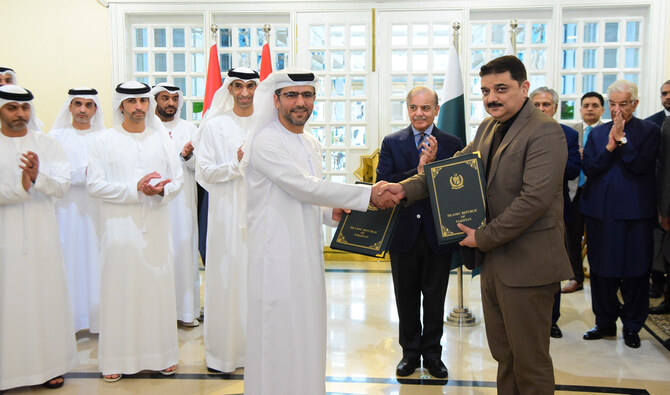
ISLAMABAD: Pakistan and the UAE on Friday signed four MoUs in the sectors of customs, rail and airport infrastructure, maritime shipping and logistics, Prime Minister Shehbaz Sharif’s office in Islamabad said in a statement.
The MoUs were signed between the Pakistani ministries of maritime affairs, aviation and railways and the Federal Board of Revenue with the Abu Dhabi (AD) Ports Group.
“As per these MoUs, Pakistan and AD Ports Group would explore potential collaboration in customs, rail, airport infrastructure and maritime shipping and logistics sectors,” the PM’s office said after Sharif met a delegation of UAE investors led by Dr. Thani bin Ahmed Al Zeyoudi, UAE minister of state for foreign trade.
“These MoUs are aimed at improving digital customs controls, developing dedicated freight rail corridors, upgrading Pakistan’s maritime fleet and marine services, as well as Pakistan’s international airports.”
Sharif said the delegation’s visit demonstrated that the UAE government wanted to enhance its “investment footprint” in Pakistan and continue to play a “crucial role” in boosting Pakistan’s economy.
“The Prime Minister highlighted the comprehensive economic partnership between the two nations across sectors such as trade, energy, and investment, which has contributed to growth and prosperity in both countries.”
The UAE delegation’s visit to Pakistan comes as Islamabad is seeking to strengthen trade and investment ties with friendly nations.
In May this, Pakistan said the UAE had committed $10 billion to invest in promising economic sectors in Pakistan.
Riyadh has also promised a $5 billion investment package that cash-strapped Pakistan desperately needs to shore up its dwindling foreign reserves and fight a chronic balance of payment crisis. Pakistan and Saudi Arabia also signed 34 MoUs worth $2.8 billion last month.

Pakistan, UAE sign agreements in customs, rail, airport infrastructure, maritime sectors
https://arab.news/49pch
Pakistan, UAE sign agreements in customs, rail, airport infrastructure, maritime sectors
- UAE minister of state for foreign trade calls on Pakistani PM Sharif
- In May, Pakistan said UAE had committed $10 billion in investments
Pakistan high court pauses tree-cutting in Islamabad until Feb. 2
- Islamabad High Court asks CDA to ‘explain and justify’ tree-cutting at next hearing
- CDA officials say 29,000 trees were cut due to allergies, deny felling in green belts
ISLAMABAD: The Islamabad High Court has ordered an immediate halt to tree-cutting in the federal capital until Feb. 2, seeking justification from civic authorities over the legality of a large-scale felling drive that has seen thousands of trees removed in recent months.
The interim order, issued by a single-judge bench led by Justice Khadim Hussain Soomro, came during proceedings on a petition challenging the Capital Development Authority’s (CDA) tree-cutting operations in Islamabad’s Shakarparian area and H-8 sector.
At the outset of the hearing, the petitioner’s counsel argued that trees were being felled in violation of the Pakistan Environmental Protection Act 1997, the Islamabad Wildlife Ordinance 1979 and the city’s master plan.
“Respondents shall not cut trees till the next date of hearing,” Justice Soomro said in the court order released on Friday while referring to CDA officials.
“Respondents are directed to come fully prepared and to file paragraph-wise comments before the next date of hearing, along with a comprehensive report explaining the justification and legal basis for the cutting of trees,” he added.
According to the court order, the petitioner maintained that the CDA had not made any public disclosure regarding the legal basis for the operation and that the felling was causing environmental harm.
The petition sought access to the official record of tree-cutting activities and called for the penalization of CDA officials responsible for the act under relevant criminal and environmental laws.
It also urged the court to impose a moratorium on infrastructure projects in Islamabad, order large-scale replanting as compensation and constitute a judicial commission headed by a retired Supreme Court judge to probe the alleged violations.
CDA officials acknowledge around 29,000 paper mulberry trees have been cut in the capital in recent months, arguing that the species triggers seasonal allergies such as sneezing, itchy eyes and nasal congestion.
They also maintain that no trees have been removed from designated green belts and that the number of replacement trees planted exceeds those felled.
Designed in the 1960s by Greek architect Constantinos Doxiadis, Islamabad was conceived as a low-density city with green belts and protected natural zones at its core.
Critics, however, say the recent felling has extended beyond paper mulberry trees and question whether authorities are adhering to the city’s master plan and the legal protections governing forested and green areas.
The court has adjourned its hearing until Feb. 2, 2026.