

Pakistan PM performs groundbreaking of first private sector university in Gilgit-Baltistan

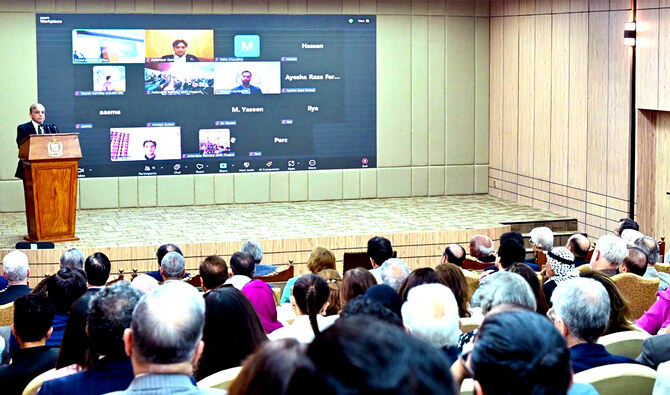
Pakistan Prime Minister Shehbaz Sharif is addressing the groundbreaking ceremony of Ramday University in Islamabad, Pakistan, on November 7, 2024. (Radio Pakistan)
Short Url
Updated 08 November 2024
Follow

Pakistan PM performs groundbreaking of first private sector university in Gilgit-Baltistan

  • Ramday University is being built by a trust with construction set to complete by donations from overseas Pakistanis
  • Home to some of the world’s tallest mountains, semi-autonomous GB region is among Pakistan’s least developed areas

ISLAMABAD: Prime Minister Shehbaz Sharif this week laid the foundation stone of first private sector university in Gilgit-Baltistan (GB), promising a bright future for the youth of the remote mountainous region.

Home to some of the tallest mountains in the world, the semi-autonomous GB region is counted among the least developed areas administered by Pakistan.

Ramday University is located in Thagos area of GB’s Ghanche district at an altitude of 11,000 feet. The university is being built on a 200-kanal area of land under a trust, with construction set to be completed through the donations of overseas Pakistanis, the state-run Associated Press of Pakistan reported.

GB-based news portal Pamir Times said the university will offer specialized programs in environmental studies, climate change, hydrology and mineral studies subjects.

“The establishment of an institution of higher learning in a remote area like Ghanche in Gilgit-Baltistan is highly encouraging,” Sharif was quoted as saying on by the APP during the groundbreaking ceremony in Islamabad on Thursday.

The prime minister congratulated former Supreme Cour judge Khalil ur Rehman Ramday on establishing the university.

“He expressed his confidence that this university, located at an altitude of 11,000 feet in Thagos, will reach the peak of modern knowledge and research standards,” the APP said.

Sharif stressed that GB’s development and the welfare of its people were among the government’s top priorities.

The development takes place a day after Sharif visited the mountainous northern region, where he inaugurated a model village for flood-affected families during a day-long visit to Ghizer.

There, Sharif pledged to provide residents with ownership documents to help them acquire new houses that were destroyed by the 2022 floods.


Pakistan launches double-decker buses in Karachi after 65 years to tackle transport woes

Updated 31 December 2025
Follow

Pakistan launches double-decker buses in Karachi after 65 years to tackle transport woes

  • Karachi citizens will be able to travel in double-decker buses from Jan. 1, says Sindh government
  • City faces mounting transport challenges such as lack of buses, traffic congestion, poorly built roads

ISLAMABAD: The government in Sindh province on Wednesday launched double-decker buses in the provincial capital of Karachi after a gap of 65 years, vowing to improve public transport facilities in the metropolis. 

Double-decker buses are designed to carry more passengers than single-deck vehicles without taking up extra road space. The development takes place amid increasing criticism against the Sindh government regarding Karachi’s mounting public transport challenges and poor infrastructural problems. 

Pakistan’s largest city by population faces severe transportation challenges due to overcrowding in buses, traffic congestion and limited bus options. Commuters, as a result, rely on private vehicles or unregulated transport options that are often unsafe and expensive.

“Double-decker buses have once again been introduced for the people of Karachi after 65 years,” a statement issued by the Sindh information ministry said. 

Sindh Transportation Minister Sharjeel Inam Memon and Local Government Minister Syed Nasir Hussain Shah inaugurated the bus service. The ministry said the facility will be available to the public starting Jan. 1. 

The statement highlighted that new electric bus routes will also be launched across the entire province starting next week. It added that the aim of introducing air-conditioned buses, low-fare services, and fare subsidies is to make public transport more accessible to the people.

The ministry noted that approximately 1.5 million people travel daily in Karachi using the People’s Bus Service, while around 75,000 passengers use the Orange Line and Green Line BRT services.

“With the integration of these routes, efforts are being made to benefit up to 100,000 additional people,” the ministry said.