

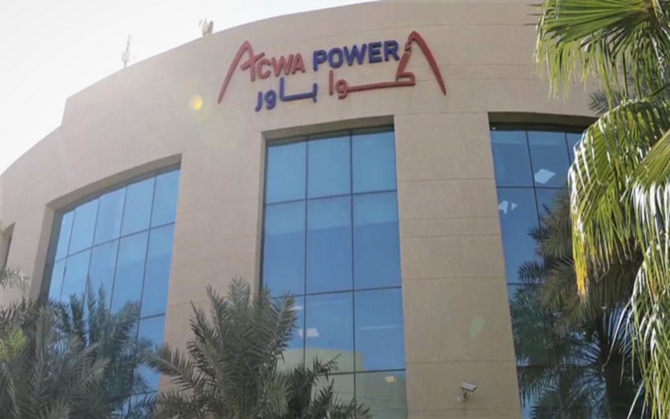
ACWA Power reports 16% profit increase amid record project launches

The company’s expansion in power generation is also evident, having added 2.4 GW of capacity during the same period, including the Ar Rass Solar PV project, a 700 MW solar plant that was completed in just 18 months.
Short Url
Updated 07 November 2024
Follow

ACWA Power reports 16% profit increase amid record project launches

RIYADH: ACWA Power, the Saudi-listed energy and water desalination company, has announced a 16 percent increase in its profits for the first nine months of 2024, underpinned by significant progress in its power and water production projects.

For the period, ACWA Power’s net profit attributable to equity holders reached SR1.25 billion ($334 million), a rise fueled by a 12.5 percent increase in operating income, which reached SR2.36 billion.

This marks a strong improvement from the same period in 2023. According to a company press release, the growth was primarily driven by an investment gain from the restructuring of a project, alongside a capital recycling gain.

ACWA Power’s CEO, Marco Arcelli, highlighted the company’s commitment to growth, noting that its portfolio now includes 26 projects — the largest in its 20-year history.

“These projects reflect both the speed at which we are realizing our growth, through swift financial closes, and the scale of future cash flows from a diverse and young portfolio,” Arcelli said.

He reiterated the company’s focus on providing reliable, cost-effective energy and water, aiming to create positive impacts across all its operations.

Over the past nine months, ACWA Power successfully achieved financial closure on seven major projects worth SR31 billion. These include Saudi Arabia’s Taiba and Qassim Combined Cycle Gas Turbine projects, the Tashkent Solar PV project in Uzbekistan, and the Hassyan Seawater Reverse Osmosis plant in the UAE.

The company’s expansion in power generation is also evident, having added 2.4 GW of capacity during the same period, including the Ar Rass Solar PV project, a 700 MW solar plant that was completed in just 18 months.

On the renewable energy front, ACWA Power secured a 5 GW Power Purchase Agreement for the Aral Wind project in Uzbekistan, as well as 5.5 GW of solar photovoltaic capacity as part of Saudi Arabia’s fourth round of Public Investment Fund projects.

In water desalination, the company signed a Water Purchase Agreement for the 410,000 cubic meters per day Hamriyah Independent Water Project in the UAE.

Abdulhameed Al-Muhaidib, ACWA Power’s Chief Financial Officer, expressed confidence in the company’s future, stating, “In the first nine months of 2024, we saw strong project mobilization, achieving financial closure on seven projects worth SR31 billion. We also began generating revenue from 2.2 GW of projects that reached partial or full commercial operation.”

He added: “Our diversified asset base, visible growth pipeline, and resilient business model, combined with our focus on operational excellence, give us confidence in achieving sustainable, long-term financial performance.”


Saudi Arabia’s approach to AI transformation delivering business value: Publicis Sapient CEO

Updated 16 sec ago
Follow

Saudi Arabia’s approach to AI transformation delivering business value: Publicis Sapient CEO

  • Nigel Vaz: We’re reimagining how, in the case of tourism, we transform Saudi Arabia into a destination that is actually relevant and attractive for people to explore
  • Vaz: Our Slingshot platform handles everything from design to deployment, allowing legacy modernization and new digital apps to be built

DAVOS: As 2026 emerges as a tipping point for artificial intelligence, executives across the Middle East are moving from experimentation to scaling AI in ways that can deliver real business value, according to Nigel Vaz, CEO of Publicis Sapient.

Speaking to Arab News at the World Economic Forum in Davos, Vaz highlighted Saudi Arabia’s proactive approach to integrating technology into national and sectoral strategies.

“I was in meetings with the minister for tourism in Saudi Arabia (Ahmed Al-Khateeb), where we do a lot of work for them, and meetings with (Communications) Minister Abdullah Alswaha,” he said.

“What you realize is technology is incredibly critical, but it’s critical to the extent that we’re reimagining how, in the case of tourism, we transform Saudi Arabia into a destination that is actually relevant and attractive for people to explore.”

Vaz also highlighted applications of AI beyond tourism, including energy and healthcare.

“You’re thinking about how it can enable a greener approach to energy, which is a big goal for their government,” he said.

“And in healthcare, predictive and preventative approaches allow trends to be addressed before they occur, which is a significant cost saving for the government,” he added.

The shift in mindset around AI reflects a broader trend globally.

“Last year there was a lot of excitement about AI, but most work was at a proof-of-concept stage,” Vaz said. “What’s tipped this year is the recognition that AI is only valuable if it drives real business outcomes.”

This involves moving beyond automating individual tasks to enabling entire workflows or decision sets that produce superior results.

“Individual tasks being automated by AI don’t create business benefit,” he said. “Entire workflows or decision sets need to be enabled by AI, and they must deliver better outcomes than are currently possible today.”

Vaz underscored the importance of integrating people and AI rather than treating technology as a replacement, adding: “Unless you’re a technology nerd, you’re not really caring about the technology for its own sake.”

Geopolitical tensions further heighten the importance of AI for real-time, intelligent decision-making. Vaz explained that Publicis Sapient has developed platforms such as Slingshot, Bodhi and SustainAI to deliver enterprise-grade AI solutions with measurable business impact.

“Our Slingshot platform handles everything from design to deployment, allowing legacy modernization and new digital apps to be built two to three times faster and 30 to 40 percent cheaper,” he said.

Bodhi leverages industry expertise to create agentic capabilities for autonomous decision-making, while Sustain transforms IT service management, using AI to monitor systems, self-heal, and reduce manual workload, he explained

“All of this is not to sell software; it’s to deliver outcomes to clients. That’s what we care about,” Vaz added.

He offered guidance for leaders navigating the AI era.

“An AI North Star is focusing on an area of the business where untapped value can be unlocked,” he said. “Focus on how that value will drive growth, reduce costs, or improve experiences for customers or employees, and use AI to achieve those outcomes, rather than experimenting in small pockets.”

For Vaz, 2026 represents a year when enterprises, particularly in forward-looking Middle Eastern economies like Saudi Arabia, are moving from theory to practice, scaling AI to deliver tangible impact and measurable outcomes for businesses, governments, and citizens alike.