

Pakistani province announces monetary rewards for whistleblowers exposing proxy ownership of assets

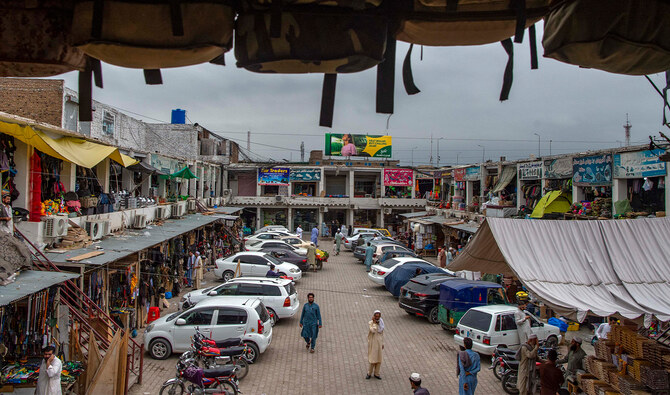
In this picture taken on July 14, 2021, a general view of Sitara market is pictured in the Karkhano area on the outskirts of Peshawar. (AFP/File)
Short Url
Updated 07 November 2024
Follow

Pakistani province announces monetary rewards for whistleblowers exposing proxy ownership of assets

  • KP chief minister promises 40% share of value of assets to people who identify ‘benami’ properties
  • Despite several donor-supported reform attempts, tax-to-GDP ratio remains at about 10% of GDP

PESHAWAR: In an effort to document the economy and broaden the tax net, a Pakistani provincial chief minister has announced a novel scheme this week: whistleblowers who assist the government in identifying ‘benami,’ in which property purchases conceal the identity of the true buyer, will be rewarded with 40% of the value of the asset.

Benami properties, or assets registered under another person’s name to disguise the actual owner’s identity, are often used to conceal movable or immovable assets for tax evasion or other purposes.

Addressing a ceremony on Wednesday evening, Khyber Pakhtunkhwa Chief Minister Ali Amin Gandapur outlined his plan to introduce a whistleblower law.

“We will give 40% [of the amount] to the person who identifies and informs us that this item belongs to Ali Amin and is registered under his driver’s name,” Gandapur said, explaining the scheme.

“When someone won’t be able to show the money trail, which we refer to as benami or nameless, it will be established through the transaction that this person doesn’t have the capability to own a fuel station, this property, this building or this vehicle. Either he will reveal who the culprit is or if he won’t tell, the government will seize it. But whoever will point it out, they will get 40% [value of the asset].”

The chief minister said public cooperation was crucial to the government, which could not advance in its tax collection targets without their support.

Pakistan’s tax collection body, the Federal Board of Revenue, announced in 2019 it would confiscate vehicles and properties with proxy ownership, as well as fictitious bank accounts.

Despite public resistance, Pakistan is pushing ahead with plans for new taxes in line with ambitious revenue targets adopted to clinch a staff-level deal on a 37-month IMF program this September. Pakistani authorities have recently taken stringent measures to broaden the country’s tax net, including blocking mobile phone connections of individuals and registering retailers.

Despite several donor-supported reform attempts, Pakistan’s tax-to-GDP ratio continues to hover at around 10% of GDP. The inability to expand tax revenue contributes to significant public service delivery gaps: over 20 million people live without clean water, almost one in every three people do not have a decent toilet, and about 40% children under the age of five have stunted growth.


Islamabad dismisses claims about paying up to 8 percent interest on foreign loans as ‘misleading’

Updated 22 February 2026
Follow

Islamabad dismisses claims about paying up to 8 percent interest on foreign loans as ‘misleading’

  • Pakistan has long relied on external loans to help bridge persistent gaps in public finances and foreign exchange reserves
  • Pakistan’s total external debt, liabilities stand at $138 billion at an overall average cost of around 4 percent, ministry says

KARACHI: Pakistan’s finance ministry on Sunday dismissed as “misleading” claims that the country is paying up to 8 percent interest on external loans, saying the overall average cost of external public debt is approximately 4 percent.

Pakistan has long relied on external loans to help bridge persistent gaps in public finances and foreign exchange reserves, driven largely by a narrow tax base, chronic trade deficits, rising debt-servicing costs and repeated balance-of-payments pressures.

Over the decades, successive governments have turned to multilateral and bilateral lenders, including the International Monetary Fund, the World Bank and the Asian Development Bank, to support budgetary needs and shore up foreign exchange reserves.

The finance ministry on Sunday issued a clarification in response to a “recent press commentary” regarding the country’s external debt position and associated interest payments, and said the figures required contextual explanation to ensure accurate understanding of Pakistan’s external debt profile.

“Pakistan’s total external debt and liabilities currently stand at $138 billion. This figure, however, encompasses a broad range of obligations, including public and publicly guaranteed debt, debt of Public Sector Enterprises (both guaranteed and non-guaranteed), bank borrowings, private-sector external debt, and intercompany liabilities to direct investors. It is therefore important to distinguish this aggregate figure from External Public (Government) Debt, which amounts to approximately $92 billion,” it said.

“Of the total External Public Debt, nearly 75 percent comprises concessional and long-term financing obtained from multilateral institutions (excluding the IMF) and bilateral development partners. Only about 7 percent of this debt consists of commercial loans, while another 7 percent relates to long-term Eurobonds. In light of this composition, the claim that Pakistan is paying interest on external loans ‘up to 8 percent’ is misleading.

The overall average cost of External Public Debt is approximately 4 percent, reflecting the predominantly concessional nature of the borrowing portfolio.”

With respect to interest payments, public external debt interest outflows increased from $1.99 billion in Fiscal Year (FY) 2022 to $3.59 billion in FY2025, representing an increase of 80.4 percent, not 84 percent as reported. In absolute terms, interest payments rose by $1.60 billion over this period, not $1.67 billion, it said.

According to the State Bank of Pakistan’s records, Pakistan’s total debt servicing payments to specific creditors during the period under reference were as follows: the IMF received $1.50 billion, of which $580 million constituted interest; Naya Pakistan Certificates payments totaled $1.56 billion, including $94 million in interest; the Asian Development Bank received $1.54 billion, including $615 million in interest; the World Bank received $1.25 billion, including $419 million in interest; and external commercial loans amounted to nearly $3 billion, of which $327 million represented interest payments.

“While interest payments have increased in absolute terms, this rise cannot be attributed solely to an expansion in the debt stock,” the ministry said. “Although the overall debt stock has increased slightly since FY2022, the additional inflows have primarily originated from concessional multilateral sources and the IMF’s Extended Fund Facility (EFF) under the ongoing IMF-supported program.”

Pakistan secured a $7 billion IMF bailout in Sept. 2024 as part of Prime Minister Shehbaz Sharif’s efforts to stabilize the South Asian economy that narrowly averted a default in 2023. The government has since been making efforts to boost trade and bring in foreign investment to consolidate recovery.

“It is also important to note that the increase in interest payments reflects prevailing global interest rate dynamics. In response to the inflation surge of 2021–22, the US Federal Reserve raised the federal funds rate from 0.75-1.00 percent in May 2022 to 5.25–5.50 percent by July 2023. Although rates have since moderated to around 3.75 percent, they remain significantly higher than 2022 levels,” the finance ministry said.

“The government remains committed to prudent debt management, transparency, and the continued strengthening of Pakistan’s macroeconomic stability,” it added.