

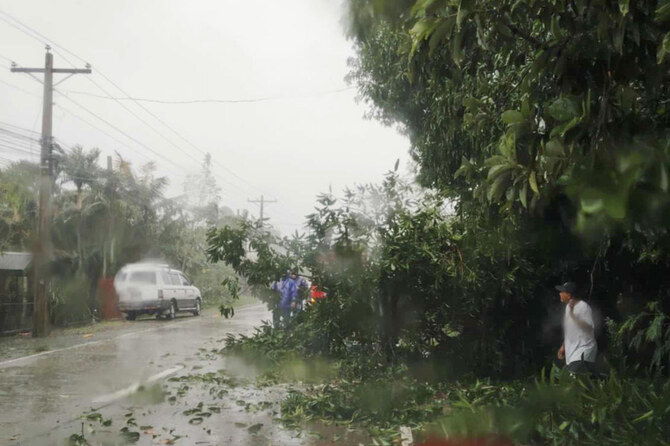
Typhoon Yinxing slams into northern Philippine region still reeling from back-to-back storms

Packing maximum sustained wind speeds of 175 kilometers (109 miles) per hour, Typhoon Yinxing could make landfall in the northern Philippines later in the day or early Friday, the state weather agency. (AP)
Short Url
Updated 07 November 2024
Follow

Typhoon Yinxing slams into northern Philippine region still reeling from back-to-back storms

  • Typhoon Yinxing is the 13th to batter the disaster-prone Southeast Asian archipelago in 2024
  • Tropical Storm Trami and Typhoon Kong-rey hit the northern Philippines in recent weeks

MANILA: A strong typhoon slammed into a northern Philippine province on Thursday as thousands were evacuated in a region still recovering from back-to-back storms that hit a few weeks ago.

Typhoon Yinxing is the 13th to batter the disaster-prone Southeast Asian archipelago in 2024.

“I really pity our people but all of them are tough,” Gov. Marilou Cayco of the province of Batanes said by telephone. Her province was ravaged by recent destructive storms and is expected to be affected by Yinxing’s fierce wind and rain.

Tens of thousands of villagers were returning to emergency shelters, and disaster-response teams were again put on alert in Cagayan and other northern provinces near the expected path of Yinxing. The typhoon blew into Santa Ana town in Cagayan province on Thursday afternoon.

The slow-moving typhoon, locally named Marce, was packing sustained winds of up to 175 kilometers (109 miles) per hour and gusts of up to 240 kph (149 mph) just before it made landfall in the coastal town of Santa Ana in Cagayan province, government forecasters said.

There were no immediate reports of casualties or major damage.

Aside from flash floods, authorities were concerned about the higher possibilities of landslides in northern mountainous region, which has been inundated by pounding rains from two previous storms.

The coast guard, army, air force and police were on high alert. Inter-island ferries and cargo services and domestic flights were suspended in northern provinces.

Tropical Storm Trami and Typhoon Kong-rey hit the northern Philippines in recent weeks, leaving at least 151 people dead and affecting nearly 9 million others. More than 14 billion pesos ($241 million) in rice, corn and other crops and infrastructure were damaged.

The death and destruction from the storms prompted President Ferdinand Marcos Jr. to declare a day of national mourning on Monday when he visited the worst-hit province of Batangas, south of the capital, Manila. At least 61 people perished in the coastal province.

Trami dumped one to two months’ worth of rain in just 24 hours in some regions, including in Batangas.

“We want to avoid the loss of lives due to calamities,” Marcos said in Talisay town in Batangas, where he brought key Cabinet members to reassure storm victims of rapid government help. “Storms nowadays are more intense, extensive and powerful.”

In 2013, Typhoon Haiyan, one of the strongest recorded tropical cyclones, left more than 7,300 people dead or missing, flattened entire villages and caused ships to run aground and smash into houses in the central Philippines.


South Korea scrambles jets after Russian, Chinese planes approach

Updated 09 December 2025
Follow

South Korea scrambles jets after Russian, Chinese planes approach

  • The Russian and Chinese aircraft entered the Korea Air Defense Identification Zone around 10 a.m. local time
  • Since 2019, China and Russia have regularly flown military aircraft into South Korea’s air defense zone without prior notice

SEOUL: South Korea said it had sent up fighter jets on Tuesday after seven Russian and two Chinese military aircraft entered its air defense zone.
The Russian and Chinese aircraft entered the Korea Air Defense Identification Zone (KADIZ) around 10 a.m. local time (0100 GMT), Seoul’s Joint Chiefs of Staff said in a statement.
None of the planes violated South Korean airspace, they said.
Seoul said it deployed “fighter jets to take tactical measures in preparation for any contingencies” in response.
The planes flew in and out of the zone for an hour before leaving, the military said, according to Yonhap.
The planes were spotted before they entered the air defense identification zone, defined as a broader area in which countries police aircraft for security reasons but which does not constitute their airspace.
China’s defense ministry later said it had organized drills with Russia’s military according to “annual cooperation plans.”
The drills took place Tuesday above the East China Sea and western Pacific Ocean, the ministry said, calling the exercises their “10th joint strategic air patrol.”
Since 2019, China and Russia have regularly flown military aircraft into South Korea’s air defense zone without prior notice, citing joint exercises.
In November last year, Seoul scrambled jets as five Chinese and six Russian military planes flew through its air defense zone.
Similar incidents occurred in June and December 2023, and in May and November 2022.
China and Russia have expanded military and defense ties since Moscow ordered troops into Ukraine nearly four years ago.
Both are also traditional allies of North Korea, Seoul’s arch-foe.
