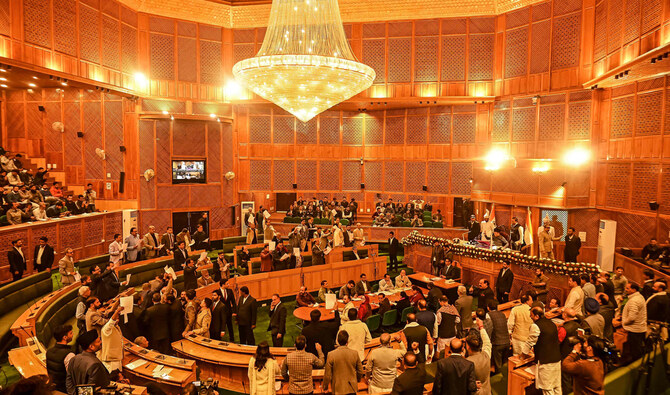
SRINAGAR: Indian-administered Kashmir ‘s regional legislature passed a resolution on Wednesday demanding the federal government restore the disputed region’s semi-autonomy that was scrapped by Prime Minister Narendra Modi’s administration in 2019.
The assembly passed the nonbinding resolution by a majority vote to noisy scenes in the house.
“This assembly calls upon the Government of India to initiate dialogue with elected representatives of people of Jammu and Kashmir for restoration of special status,” the resolution read.
Modi’s Bharatiya Janata Party, which has 29 members in the 90-seat assembly, rejected the resolution. It requires the approval of Lt. Gov. Manoj Sinha, New Delhi’s appointed top administrator in Kashmir.
The National Conference party, which sponsored the resolution, came to power last month in the region’s first vote in a decade and the first since Modi’s Hindu nationalist government scrapped its semi-autonomy.
The federal government also downgraded and divided the former state into two centrally governed union territories, Ladakh and Jammu-Kashmir.
The move — which largely resonated in India and among Modi supporters — was mostly opposed in Kashmir, including by the National Conference, as an assault on its identity and autonomy.
Many fear it would pave the way for demographic changes in the region, which has since been on edge with civil liberties were curbed and media freedoms restricted.
The region continues to remain a “union territory” — directly controlled by the federal government with India’s Parliament as its main legislator.
India and Pakistan each administer a part of Kashmir, but both claim the territory in its entirety. The nuclear-armed rivals have fought two of their three wars over the territory since they gained independence from British colonial rule in 1947.
Militants in the Indian-controlled portion of Kashmir have been fighting New Delhi’s rule since 1989. Many Muslim Kashmiris support the rebels’ goal of uniting the territory, either under Pakistani rule or as an independent country.
India insists the Kashmir militancy is Pakistan-sponsored “terrorism.” Pakistan denies the charge, and many Kashmiris consider it a legitimate freedom struggle. Tens of thousands of civilians, rebels and government forces have been killed in the conflict.
Modi and his powerful home minister, Amit Shah, have repeatedly stated that the region’s statehood will be restored after the election, without specifying a timeline. However, they vowed to block any move aimed at undoing the 2019 changes.


Indian-administered Kashmir legislature passes resolution asking Delhi to restore partial autonomy
https://arab.news/j3fej
Indian-administered Kashmir legislature passes resolution asking Delhi to restore partial autonomy

- PM Modi’s administration scrapped Delhi-controlled Kashmir’s autonomy in August 2019
- Modi’s Bharatiya Janata Party, which has 29 members in 90-seat assembly, rejected resolution

Pull him off TV: Steve Bannon shuts down Sen. Lindsey Graham
- Trump’s former chief strategist called for the senator to be registered as a foreign agent
DUBAI: Former White House chief strategist Steve Bannon called on Tuesday for US Senator Lindsey Graham to be registered as a foreign agent of the Israeli government, escalating a growing conservative backlash against the senator’s vocal support for Israel.
Speaking on his podcast “War Room,” Bannon said Graham should be “pulled off of television,” adding: "This is dangerous… because you have guys like Lindsey Graham and dozens more that are doing the wrong thing.”
In a Fox News interview on Monday, Graham said: “To all the antisemites, to all the isolationists… I’m not with you, I’m with Israel, I will be with Israel to our dying day.”
Graham also urged Gulf Arab states to join military action against Iran. “What I want you to do in the Middle East, to our friends in Saudi Arabia and other places, [is] step forward and say, ‘this is my fight too, I join America, I’m publicly involved in bringing this regime down,’” he said.
In a post on X, Graham questioned the value of a US defense agreement with Saudi Arabia following the evacuation of the American embassy in Riyadh, writing: “Why should America do a defense agreement with a country like the Kingdom of Saudi Arabia that is unwilling to join a fight of mutual interest?”
Faisal Abbas, editor-in-chief of Arab News, responded to Graham’s comments in a Sky News interview, saying: “He flip flops so much, it’s actually entertaining.”
“On one hand, he says he will never set foot in Saudi Arabia. The next day, he’s here signing multimillion-dollar deals.”
“I don’t think anyone here takes him seriously,” Abbas added.
He warned Graham to be careful what he wished for: “Do you really want Saudi Arabia involved in this war putting our oil facilities at risk or do you want us stabilizing the energy markets?”
Graham pressed further, warning that inaction would carry a price. “Hopefully Gulf Cooperation Council countries will get more involved as this fight is in their backyard. If you are not willing to use your military now, when are you willing to use it?”
“Hopefully this changes soon. If not, consequences will follow.”
Graham's remarks drew sharp criticism from Bannon and others including podcast host Megyn Kelly.
She questioned on X whether Graham was overstepping his authority as a senator, writing: “When did Lindsay Graham become our president?”
Kelly also said Graham had threatened Lebanon, Cuba, Saudi Arabia, the wider Arab region, and Spain within a 24-hour period.
The problem with Graham “isn’t (just) that he’s a homicidal maniac, it’s that Trump likes and is listening to him,” she said in another post.


