VALENCIA: Spain on Tuesday announced an aid package worth 10.6 billion euros ($11.5 billion) to rebuild regions devastated by its worst floods in a generation that have killed 219 people.
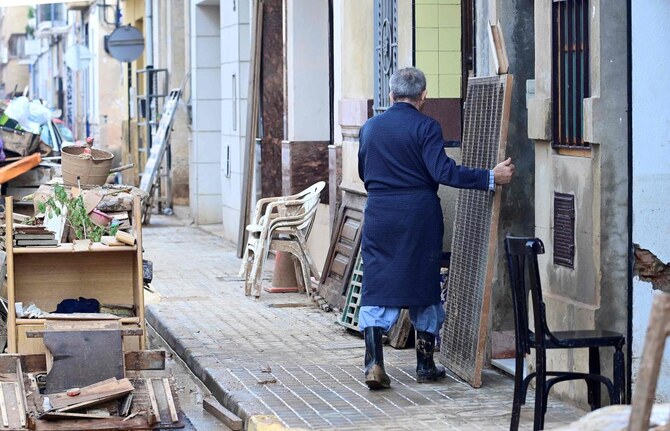
The exceptional Mediterranean storm that lashed eastern Spain a week ago triggered surging torrents of muddy water that have left a trail of destruction and an unknown number of missing.
Prime Minister Pedro Sanchez announced a series of measures including aid to small and midsize businesses, self-employed workers and households that have suffered deaths, incapacity and damage to homes and belongings.
Tax relief and a three-month postponement to repaying mortgages and loans were also among the announcements, which Sanchez likened to the state’s intervention during the Covid-19 pandemic to protect the economy and livelihoods.
The government would take on all emergency spending by local councils linked to clearing mud, debris and ruined property and restoring drinking water, Sanchez told a news conference.
Spain has also requested aid from the EU solidarity fund, he added.
Security forces and emergency services personnel are working around the clock to repair damaged infrastructure, distribute aid and search for bodies in Spain’s largest peacetime deployment of its armed forces.
Sanchez said almost 15,000 troops, police officers and civil guards were in the eastern Valencia region that has suffered most of the deaths and destruction, up from 7,300 on Saturday.
Firefighters combed through piles of damaged vehicles and pumped water from inundated garages and car parks where more victims may be discovered, AFP journalists saw.
Maribel Albalat, mayor of the ground-zero town of Paiporta, told public broadcaster TVE they were doing “better, but not well” with many streets still inaccessible and residents struggling to get a phone signal.
Rescuers in the southeastern town of Letur have found one of the missing bodies they were looking for, announced the central government’s representative in the Castilla-La Mancha region, Pedro Antonio Ruiz.
Two Chinese citizens, two Romanians and an Ecuadorian are among the dead, authorities in those countries have said. The floods also claimed three British victims, UK media have reported.
Many survivors are furious with the authorities for failing to warn the population on time last Tuesday and provide urgent rescue and relief work.
That anger reached a breaking point in Paiporta on Sunday when crowds heckled and hurled mud at King Felipe VI, Queen Letizia and Sanchez.
The outrage was also palpable in Valencia — Spain’s third-largest city that was unharmed despite being a stone’s throw from the hardest-hit zones — when AFP visited on Tuesday.
Local humorist Jose Antonio Lopez-Guitian, 61, had just returned from the town of Massanassa with his boots covered in mud and said residents were left to fend for themselves.
The situation was “a national disgrace” and “a dereliction of duty by all the institutions,” he said.
The floods affected more than 4,100 hectares (10,100 acres), the civil protection service said on X, using a map provided by the European Union’s Copernicus satellite.
Storms coming off the Mediterranean are common during this season. But scientists have warned that human-induced climate change is increasing the ferocity, length and frequency of extreme weather events.
“Climate change kills... we have to adapt to this reality,” Sanchez said at his news conference, lashing out at the “irresponsible discourse of deniers.”


![]()

Spain unveils $11 billion aid plan after catastrophic floods
Short Url
https://arab.news/zbaa8
Spain unveils $11 billion aid plan after catastrophic floods
- Prime Minister Pedro Sanchez announced a series of measures including aid to small and midsize businesses, self-employed workers and households
- Tax relief and a three-month postponement to repaying mortgages and loans were also among the announcements


Latest updates


© 2026 SAUDI RESEARCH & PUBLISHING COMPANY, All Rights Reserved And subject to Terms of Use Agreement.