Iran says killed eight militants since attack on police in province bordering Pakistan

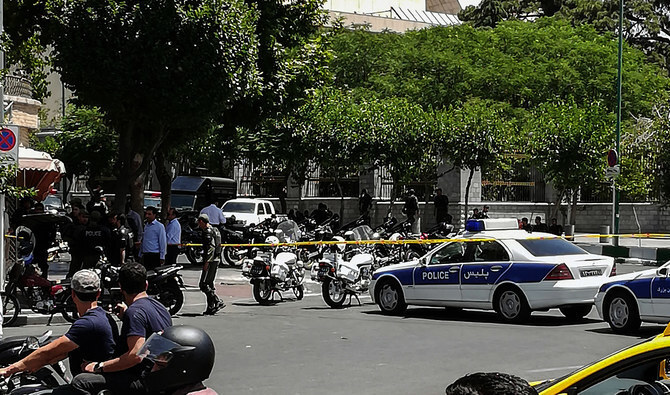
A picture taken on June 7, 2017 shows police vehicles and motorcycles outside Iranian parliament in the capital Tehran. (AFP/File)
Short Url
Updated 05 November 2024
Follow

Iran says killed eight militants since attack on police in province bordering Pakistan

  • Militants from the Jaish Al-Adl group killed 10 police officers during a raid in Sistan-Baluchistan province on October 26
  • Sistan-Baluchistan, which straddles border with Afghanistan and Pakistan, is one of Iran’s most impoverished provinces

TEHRAN: Iran’s military has killed eight militants in an operation in the restive southeast since a deadly attack last month on a police station, state media reported Tuesday.
Militants from the Pakistan-based Jaish Al-Adl group killed 10 police officers during a raid on October 26 in Sistan-Baluchistan province — one of the deadliest attacks in the region in recent months.
Sistan-Baluchistan, which straddles the border with Afghanistan and Pakistan, is one of Iran’s most impoverished provinces.
It has long been a flashpoint for cross-border attacks by separatists and extremists, opposed to the authorities in Iran.
Revolutionary Guards commander Ahmad Shafahi said “a total of eight terrorists have been killed” since the beginning of operations in the province, according to the official IRNA news agency on Tuesday.
“Fourteen other terrorists have been arrested,” including key figures involved in the attack, he said, adding security forces seized weapons and ammunition.
Shortly after the attack in Taftan county, some 1,200 kilometers (745 miles) southeast of the capital Tehran, a report on the Tasnim news agency said four militants had been killed and four others arrested.
Late on Monday, IRNA quoted Guards ground forces commander Mohammad Pakpour as saying the attackers “were not Iranian,” though he did not specify their nationalities.
In early October, at least six people including police officers were killed in two separate attacks in the province.
Jaish Al-Adl said on Telegram they had carried out the attacks.
Formed in 2012 by Baluch separatists, the group is proscribed as a “terrorist organization” by both Iran and the United States.



Trial opens in Tunisia of NGO workers accused of aiding migrants

Updated 15 December 2025
Follow

Trial opens in Tunisia of NGO workers accused of aiding migrants

  • Aid workers accused of assisting irregular migration to Tunisia went on trial on Monday, as Amnesty International criticized what it called “the relentless criminalization of civil society”

TUNIS: Aid workers accused of assisting irregular migration to Tunisia went on trial on Monday, as Amnesty International criticized what it called “the relentless criminalization of civil society” in the country.
Six staff members of the Tunisian branch of the France Terre d’Asile aid group, along with 17 municipal workers from the eastern city of Sousse, face charges of sheltering migrants and facilitating their “illegal entry and residence.”
If convicted, they face up to 10 years in prison.
Migration is a sensitive issue in Tunisia, a key transit point for tens of thousands of people seeking to reach Europe each year.
A former head of Terre d’Asile Tunisie, Sherifa Riahi, is among the accused and has been detained for more than 19 months, according to her lawyer Abdellah Ben Meftah.
He told AFP that the accused had carried out their work as part of a project approved by the state and in “direct coordination” with the government.
Amnesty denounced what it described as a “bogus criminal trial” and called on Tunisian authorities to drop the charges.
“They are being prosecuted simply for their legitimate work providing vital assistance and protection to refugees, asylum seekers and migrants in precarious situations,” Sara Hashash, Amnesty’s deputy MENA chief, said in the statement.
The defendants were arrested in May 2024 along with about a dozen humanitarian workers, including anti-racism pioneer Saadia Mosbah, whose trial is set to start later this month.
In February 2023, President Kais Saied said “hordes of illegal migrants,” many from sub-Saharan Africa, posed a demographic threat to the Arab-majority country.
His speech triggered a series of racially motivated attacks as thousands of sub-Saharan African migrants in Tunisia were pushed out of their homes and jobs.
Thousands were repatriated or attempted to cross the Mediterranean, while others were expelled to the desert borders with Algeria and Libya, where at least a hundred died that summer.
This came as the European Union boosted efforts to curb arrivals on its southern shores, including a 255-million-euro ($290-million) deal with Tunis.