

Pakistan says revamping polio program as virus tally reaches 45 this year

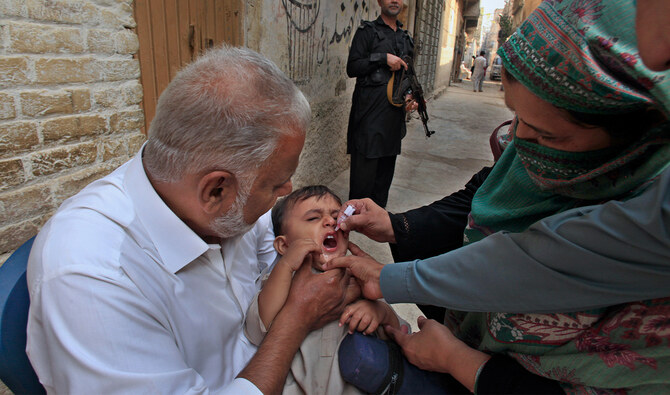
A police officer stands guard as a health worker, right, administers a polio vaccine to a child in a neighbourhood of Peshawar, Pakistan, on October 28, 2024. (AP)
Short Url
Updated 04 November 2024
Follow

Pakistan says revamping polio program as virus tally reaches 45 this year

  • Pakistan and Afghanistan are only two countries where polio remains endemic
  • Pakistan launched this year’s third nationwide polio campaign last month 

ISLAMABAD: The Pakistani Prime Minister’s Focal Person for Polio Eradication, Ayesha Raza Farooq, has said the government is revamping its polio eradication program to make the country free of the virus by mid next year, Radio Pakistan reported on Monday.

Two new wild poliovirus type 1 (WPV1) cases were reported in the northwestern Khyber Pakhtunkhwa (KP) province, the country’s polio program said late Friday, bringing the nationwide tally to 45 this year. So far this year, 22 polio cases have been reported from Balochistan province, 12 from Sindh, nine from KP and one each from Punjab and Islamabad.

“All elements of the [polio] program, including surveillance, communication, and operations, have been revamped,” Farooq was quoted by Radio Pakistan as saying. “The new approach brings together federal, provincial, and district authorities in a coordinated effort to eliminate polio.”

Pakistan and Afghanistan are the only two countries where polio remains endemic. Since late 2018, Pakistan has seen a resurgence of cases and increased spread of poliovirus, highlighting the fragility of gains achieved in the preceding years when cases dropped in 2023 to six, from 20 in 2022 and just one in 2022. Misinformation about vaccinations and attacks by militants on polio teams have been major impediments to immunization campaigns.

At least seven people, including five school students, were killed and 23 injured in a blast in southwestern Pakistan that targeted a polio vaccination team vehicle on Friday, police said. No group has claimed responsibility for the attack. Last Tuesday, a policeman was killed in an attack on a health office that manages door-to-door polio vaccination campaigns.

The attacks have coincided with Pakistan’s third nationwide polio campaign this year, launched last week with the aim to administer vaccine drops to more than 45 million children.


IMF hails Pakistan privatization drive, calls PIA sale a ‘milestone’

Updated 10 January 2026
Follow

IMF hails Pakistan privatization drive, calls PIA sale a ‘milestone’

  • Fund backs sale of national airline as key step in divesting loss-making state firms
  • IMF has long urged Islamabad to reduce fiscal burden posed by state-owned entities

KARACHI: The International Monetary Fund (IMF) on Saturday welcomed Pakistan’s privatization efforts, describing the sale of the country’s national airline to a private consortium last month as a milestone that could help advance the divestment of loss-making state-owned enterprises (SOEs).

The comments follow the government’s sale of a 75 percent stake in Pakistan International Airlines (PIA) to a consortium led by the Arif Habib Group for Rs 135 billion ($486 million) after several rounds of bidding in a competitive process, marking Islamabad’s second attempt to privatize the carrier after a failed effort a year earlier.

Between the two privatization attempts, PIA resumed flight operations to several international destinations after aviation authorities in the European Union and Britain lifted restrictions nearly five years after the airline was grounded following a deadly Airbus A320 crash in Karachi in 2020 that killed 97 people.

“We welcome the authorities’ privatization efforts and the completion of the PIA privatization process, which was a commitment under the EFF,” Mahir Binici, the IMF’s resident representative in Pakistan, said in response to an Arab News query, referring to the $7 billion Extended Fund Facility.

“This privatization represents a milestone within the authorities’ reform agenda, aimed at decreasing governmental involvement in commercial sectors and attracting investments to promote economic growth in Pakistan,” he added.

The IMF has long urged Islamabad to reduce the fiscal burden posed by loss-making state firms, which have weighed public finances for years and required repeated government bailouts. Beyond PIA, the government has signaled plans to restructure or sell stakes in additional SOEs as part of broader reforms under the IMF program.

Privatization also remains politically sensitive in Pakistan, with critics warning of job losses and concerns over national assets, while supporters argue private sector management could improve efficiency and service delivery in chronically underperforming entities.

Pakistan’s Cabinet Committee on State-Owned Enterprises said on Friday that SOEs recorded a net loss of Rs 122.9 billion ($442 million) in the 2024–25 fiscal year, compared with a net loss of Rs 30.6 billion ($110 million) in the previous year.