

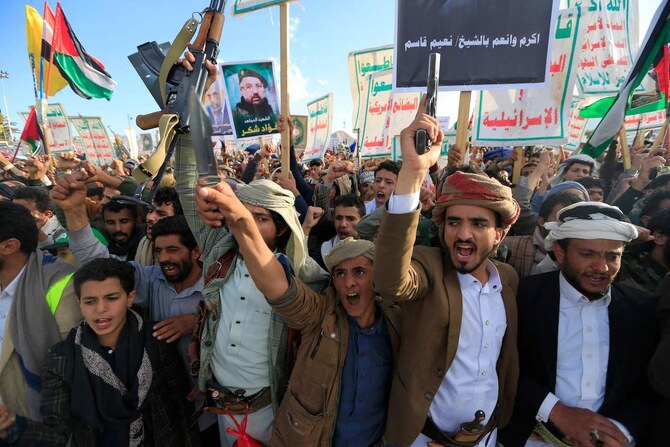

AL-MUKALLA: Yemen’s Houthi militia has armed Al-Qaeda militants, provided them with a haven, and facilitated attacks on Yemeni government-controlled areas, UN experts said. The Houthis have also made millions of dollars through sea piracy.
Disclosing the strange partnership between the Houthis and Al-Qaeda and other terrorist groups, including Al-Shabaab in Somalia, the UN Panel of Experts on Yemen said in their report that the Houthis and Al-Qaeda agreed to put aside their differences and focus on weakening the Yemeni government by transferring weapons, coordinating attacks on Yemeni government forces, cooperating to smuggle weapons into Yemen, sharing intelligence information, and providing haven for the other’s fighters.
“That opportunistic alliance is characterized by cooperation in security and intelligence, offering safe havens for each other’s members, reinforcing their respective strongholds and coordinating efforts to target the Government’s forces,” the report said, adding that the Houthis also released incarcerated Al-Qaeda fighters convicted of terrorism and provided Al-Qaeda with drones and rockets.
“Since the beginning of 2024, the two groups have coordinated operations directly. They agreed that the Houthis would transfer four uncrewed aerial vehicles, as well as thermal rockets and explosive devices, and that the Houthis would provide training to AQAP (Al-Qaeda in the Arabian Peninsula) fighters.”
Citing deadly drone attacks by Al-Qaeda in Abyan, Yemeni military commanders have lately accused the Houthis of supplying Al-Qaeda with drones and other weapons, as well as sheltering Al-Qaeda militants who stage hit-and-run attacks on government troops.
The 537-page report, which covers the period from Sept. 1, 2023, to July 31, 2024, described Hezbollah as “one of the most important” supporters of the Houthis in Yemen, assisting them in decision-making, field military support through the use and assembly of weapons and fighting techniques, increasing their financial revenues, recruitment and brainwashing techniques, and managing Houthi media propaganda.
The Houthis have a variety of revenue sources to support their military efforts, including selling rare and valuable antiques and antiquities abroad, minting coins and printing currencies, imposing levies on telecom companies in areas under their control, confiscating assets of companies, including Yemenia airways revenues, smuggling weapons and banned pesticides, and imposing levies on oil imports to the country.
“The Houthis have been amassing substantial illegal resources through the organized smuggling of various items such as weapons, drugs, telecommunications equipment, prohibited goods such as banned pesticides, non-permissible medicines, and cultural heritage property,” the report said.
It added: “The Panel's investigations revealed that Houthi-appointed authorities collected approximately 994 billion Yemeni rials in the name of customs duties on imports of fuel through ports under their control during the period from April 1, 2022, to June 30, 2024, under the exchange rate prevailing in government-controlled areas.”
However, during the Houthi campaign against ships that the Yemeni militia claimed were in support of the Palestinian people, the Houthis have collected approximately $180 million a month from ships to allow them to sail in the Red Sea and Gulf of Aden without being attacked, and a high-ranking Houthi leader facilitated the transfer of the money from the shipping agencies to the militia’s coffers.
“The sources estimate the Houthis’ earnings from these illegal safe-transit fees to be about $180 million per month. The Panel has not been able to verify this information independently.”
The UN experts also accused the Houthis of recruiting and exploiting Ethiopian migrants — who arrive in the country by the thousands each year — to fight alongside them against the Yemeni government while also facilitating drug trafficking.
The Yemeni government, as well as local and international rights groups, have previously said that the Houthis recruited thousands of African migrants to fight the Yemeni government.
“Other sources informed the Panel that the Houthis have also recruited mercenaries from the Tigray and Oromo Ethiopian tribes, at salaries ranging from $80 to $100. The Panel has been unable to verify that information and continues to investigate,” the experts said.
The Yemeni government welcomed the findings of the UN report and urged the world to designate the Houthis as a terrorist organization and cut off their financial resources.
Yemen’s Information Minister Moammar Al-Eryani said in a post on X that the collusion between the Houthis and other terrorist organizations is intended to “weaken the Yemeni state, destabilizing security and stability in liberated areas,” thereby undermining maritime navigation security.


