

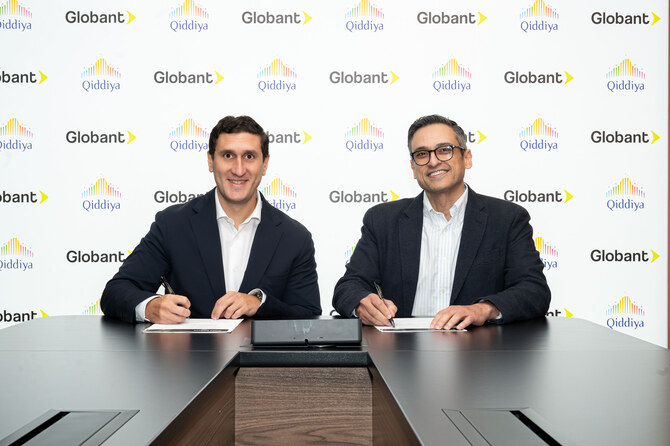
Saudi Arabia’s Qiddiya Investment Co. and Globant partner in immersive entertainment push

Developing mega projects like Qiddiya is one of the goals outlined in Saudi Arabia’s Vision 2030 program. Supplied
Short Url
Updated 03 November 2024
Follow

Saudi Arabia’s Qiddiya Investment Co. and Globant partner in immersive entertainment push

  • Globant will work with QIC to develop the Qiddiya PLAY LIFE Connected Experience
  • Deal to showcase how digital ecosystems can enhance the entertainment and cultural sectors in the Kingdom

RIYAD: Qiddiya Investment Co., wholly owned by Saudi Arabia’s Public Investment Fund, signed an agreement with tech firm Globant to turn Qiddiya City into an immersive hub.

Under the deal, Globant will work with QIC to develop the Qiddiya “PLAY LIFE Connected Experience,” a digital entertainment, sports, and culture ecosystem designed to transform how visitors and residents interact with the destination’s wide range of offerings, according to a press statement. 

Developing mega projects like Qiddiya is one of the goals outlined in Saudi Arabia’s Vision 2030 program, as the Kingdom continues to evolve as a global tourism and entertainment destination. 

“Our partnership with Globant marks a pivotal step in realizing Qiddiya’s vision as the world’s first city dedicated entirely to play. The Qiddiya PLAY LIFE Connected Experience will enhance how visitors engage with our attractions and set a new standard for digital integration in entertainment and tourism,” said Abdulrahman Al-Ali, chief technology officer at QIC. 

He added: “We are creating a destination that is both innovative and unforgettable, and this collaboration will help ensure that every visitor’s journey is personalized, seamless, and truly unique.” 

The press statement said that the PLAY LIFE Connected Experience framework will leverage advanced systems like artificial intelligence, data analytics, and cloud technology to develop an interface that will personalize and enhance every interaction at Qiddiya City. 

The platform will also allow visitors to book events, manage their itineraries, discover new adventures, and engage with the community, all through a personalized, real-time interface. 

“Partnering with Qiddiya on this program is a major milestone for Globant. We are not building a smart city but creating an immersive, digitally connected experience that brings Qiddiya to life in ways that go beyond traditional entertainment. This is the future of how cities and people will interact, and we are thrilled to lead this transformation,” said Federico Pienovi, CEO and chief business officer of new markets at Globant. 

The incorporation of technology in Qiddiya City will showcase how digital ecosystems can enhance the entertainment and cultural sectors in the Kingdom, according to the press statement.

Mamdouh Al-Doubayan, managing director for the Middle East and North Africa at Globant, said the deal will help the Saudi workforce advance in the technological sector. 

“Projects like Qiddiya provide unparalleled opportunities to transfer our expertise in digital transformation and innovation, especially in the entertainment industry, to the new generation of Saudis. As a result of creating opportunities for upskilling and reskilling, we are helping to build the future workforce and enabling the Kingdom to become a leader in digital ecosystems,” said Al-Doubayan.


Kuwait to boost Islamic finance with sukuk regulation

Updated 05 February 2026
Follow

Kuwait to boost Islamic finance with sukuk regulation

  • The move supports sustainable financing and is part of Kuwait’s efforts to diversify its oil-dependent economy

RIYADH: Kuwait is planning to introduce legislation to regulate the issuance of sukuk, or Islamic bonds, both domestically and internationally, as part of efforts to support more sustainable financing for the oil-rich Gulf nation, Prime Minister Sheikh Ahmad Abdullah Al-Ahmad Al-Sabah said on Wednesday.

Speaking at the World Governments Summit in Dubai, Al-Sabah highlighted that Kuwait is exploring a variety of debt instruments to diversify its economy. The country has been implementing fiscal reforms aimed at stimulating growth and controlling its budget deficit amid persistently low oil prices. Hydrocarbons continue to dominate Kuwait’s revenue stream, accounting for nearly 90 percent of government income in 2024.

The Gulf Cooperation Council’s debt capital market is projected to exceed $1.25 trillion by 2026, driven by project funding and government initiatives, representing a 13.6 percent expansion, according to Fitch Ratings.

The region is expected to remain one of the largest sources of US dollar-denominated debt and sukuk issuance among emerging markets. Fitch also noted that cross-sector economic diversification, refinancing needs, and deficit funding are key factors behind this growth.

“We are about to approve the first legislation regulating issuance of government sukuk locally and internationally, in accordance with Islamic laws,” Al-Sabah said.

“This enables us to deal with financial challenges flexibly and responsibly, and to plan for medium and long-term finances.”

Kuwait returned to global debt markets last year with strong results, raising $11.25 billion through a three-part bond sale — the country’s first US dollar issuance since 2017 — drawing substantial investor demand. In March, a new public debt law raised the borrowing ceiling to 30 billion dinars ($98 billion) from 10 billion dinars, enabling longer-term borrowing.

The Gulf’s debt capital markets, which totaled $1.1 trillion at the end of the third quarter of 2025, have evolved from primarily sovereign funding tools into increasingly sophisticated instruments serving governments, banks, and corporates alike. As diversification efforts accelerate and refinancing cycles intensify, regional issuers have become regular participants in global debt markets, reinforcing the GCC’s role in emerging-market capital flows.

In 2025, GCC countries accounted for 35 percent of all emerging-market US dollar debt issuance, excluding China, with growth in US dollar sukuk issuance notably outpacing conventional bonds. The region’s total outstanding debt capital markets grew more than 14 percent year on year, reaching $1.1 trillion.