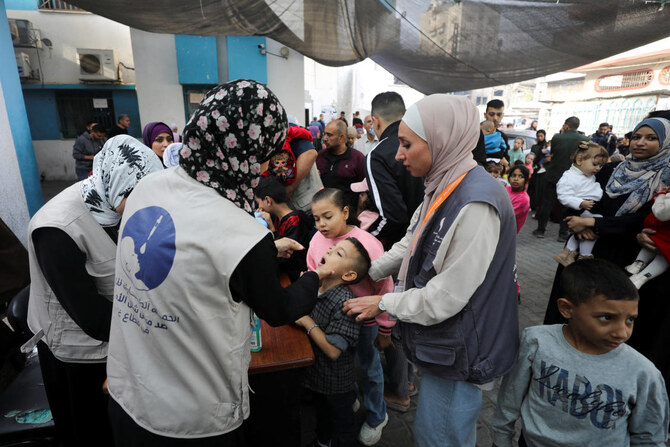
CAIRO: Palestinian officials say an Israeli drone strike on a clinic in northern Gaza where children were being vaccinated for polio wounded six people, including four children. The Israeli military denied responsibility.
The alleged strike occurred Saturday in northern Gaza, which has been encircled by Israeli forces and largely isolated for the past year. Israel has been carrying out another offensive there in recent weeks that has killed hundreds of people and displaced tens of thousands.
It was not possible to resolve the conflicting accounts. Israeli forces have repeatedly raided hospitals in Gaza over the course of the war, saying Hamas uses them for militant purposes, allegations denied by Palestinian health officials.
Dr. Munir Al-Boursh, director general of the Gaza Health Ministry, told The Associated Press that a quadcopter struck the Sheikh Radwan clinic in Gaza City early Saturday afternoon, just a few minutes after a United Nations delegation left the facility.
The World Health Organization and the UN children’s agency, known as UNICEF, which are jointly carrying out the polio vaccination campaign, expressed concern over the reported strike.
“The reports of this attack are even more disturbing as the Sheikh Radwan Clinic is one of the health points where parents can get their children vaccinated,” said Rosalia Bollen, a spokesperson for UNICEF.
“Today’s attack occurred while the humanitarian pause was still in effect, despite assurances given that the pause would be respected from 6 a.m. to 4 p.m.”
Lt. Col. Nadav Shoshani, an Israeli military spokesman, said that “contrary to the claims, an initial review determined that the (Israeli military) did not strike in the area at the specified time.”
A scaled-down campaign to administer a second dose of the polio vaccine began Saturday in parts of northern Gaza. It had been postponed from Oct. 23 due to lack of access, Israeli bombings and mass evacuation orders, and the lack of assurances for humanitarian pauses, a UN statement said.
The administration of the first dose was carried out in September across the Gaza Strip, including areas of northern Gaza that are now completely sealed off. Health officials said the campaign’s first round, and the administration of the second dose across central and southern Gaza, were successful.
At least 100,000 people have been forced to evacuate from areas of north Gaza toward Gaza City in the past few weeks, but around 15,000 children under the age of 10 remain in northern towns, including Jabaliya, Beit Lahiya and Beit Hanoun, which are inaccessible, according to the UN
The final phase of the polio vaccination campaign had aimed to reach an estimated 119,000 children in the north with a second dose of oral polio vaccine, the agencies said, but “achieving this target is now unlikely due to access constraints.”
They say 90 percent of children in every community must be vaccinated to prevent the spread of the disease.
The campaign was launched after the first polio case was reported in Gaza in 25 years — a 10-month-old boy, now paralyzed in the leg. The World Health Organization said the presence of a paralysis case indicates there could be hundreds more who have been infected but aren’t showing symptoms.
The war began on Oct. 7, 2023, when Hamas-led militants stormed into southern Israel, killing some 1,200 people, mostly civilians, and abducting another 250. Israel’s offensive has killed over 43,000 Palestinians, according to Gaza health authorities, who do not say how many were combatants but say more than half were women and children.


![]()
Palestinians say Israel struck a Gaza clinic during a polio campaign. The army denies it

Short Url
https://arab.news/n6dyv
Palestinians say Israel struck a Gaza clinic during a polio campaign. The army denies it
- The alleged strike occurred Saturday in northern Gaza, which has been encircled by Israeli forces and largely isolated for the past year
- Israel has been carrying out another offensive there in recent weeks that has killed hundreds of people and displaced tens of thousands
Latest updates


© 2026 SAUDI RESEARCH & PUBLISHING COMPANY, All Rights Reserved And subject to Terms of Use Agreement.