ISLAMABAD: Pakistan’s Privatization Ministry said on Friday the national airline’s privatization has stalled after months of efforts, as the sole bid came in “too low” compared to government expectations, which the airline employees’ union and an economist called a “major embarrassment” for the authorities.
The national flag carrier received a Rs10 billion ($36 million) bid from real estate development company Blue World City a day earlier for 60 percent Pakistan International Airlines (PIA) stakes during a televised auction, far below the minimum price of Rs85 billion ($305 million) set by the government.
The country plans to sell more than 51 percent of its stake in the loss-making national air carrier as part of economic reforms Islamabad agreed to with the International Monetary Fund (IMF) for a critical 37-month, $7 billion bailout deal approved in September.
Pakistan’s government pre-qualified six groups in June, but only the real estate development company met a Tuesday deadline to submit final documents to participate in the auction.
“The airline’s sale process has stalled for now, but the Privatization Commission Board will review the bid offer in its next meeting,” Dr. Ahsan Ishaq, a spokesperson for the Privatization Ministry, told Arab News, without specifying a date for the meeting.
“Finally, the matter will go to the federal cabinet for approval, but obviously, the bid is too low compared to government expectations,” he added. “Therefore, it may not receive formal assent.”
The state-owned Pakistan Television broadcast the bidding process live, with Blue World City as the sole bidder.
The $36 million bid was read out in front of government officials and financial advisers, which the PIA employees’ union later described as a “major embarrassment” for the authorities.
“The government should add at least twenty planes to the PIA fleet on dry lease to make it a profitable airline instead of selling it for peanuts,” said Hidayatullah, president of the PIA employees’ union, who goes by a single name, while speaking to Arab News.
“We will not allow the privatization of this national asset, and we will launch a nationwide protest if the government goes ahead with this bid,” he said.
During the bidding event, Blue World City Chairman Saad Nazir refused to match the government’s minimum price of Rs85 billion, saying, as per his company’s assessment, the offer made was “the best decision.”
The government’s initial plan was to finalize the PIA sale on the country’s Independence Day, August 14, but the plan was delayed following requests from bidders who were awaiting the airline’s latest audited accounts, aircraft lease agreements and clarity on flights to Europe, which are currently banned.
The auction was postponed twice, first to September and then to October, but neither event materialized.
Dr. Vaqar Ahmed, a senior economist, said the government had failed to “hunt potential investors” for PIA ahead of the formal auction and did not organize roadshows to market the airline’s assets to attract major investors.
“Major foreign investors have already expressed serious reservations about difficulties in repatriating their profits from investments in various sectors,” he told Arab News. “Therefore, they were apprehensive about joining the bidding process.”
“The government should have initiated measures to address the concerns of major investors and businesses ahead of formally launching the auction process for PIA to attract a fair price for the airline,” he continued.
Official data available to Arab News shows that there are 88 commercially operated state-owned enterprises in Pakistan, with collective losses amounting to Rs730.258 billion ($2.61 billion) in the fiscal year 2022.
In its five-year privatization plan ending in 2029, the government approved 24 state-owned enterprises for sale, including PIA.
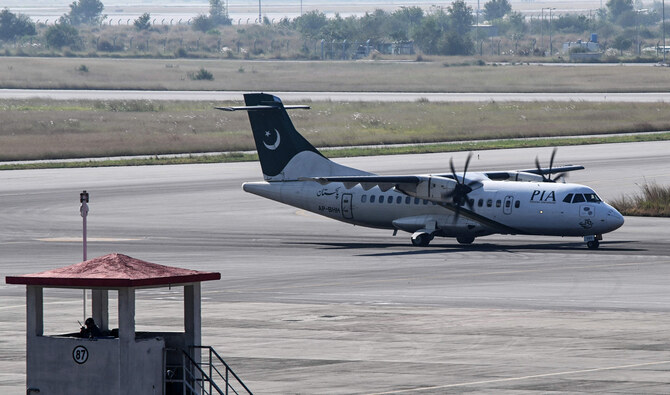
With a fleet of 34 aircraft comprising 17 Airbus A320s, 12 Boeing B777s, and 5 ATRs, PIA loses market share to Middle Eastern carriers, who dominate with 60 percent due to the absence of direct flights to key destinations.
The carrier has air service pacts with 87 countries and landing slots at significant destinations such as London Heathrow.
The reorganization plan will separate aviation-related operations from non-core components, thereby freeing the operating subsidiary from a large portion of legacy debt.


![]()

Pakistan’s national airline sale stalls as bid falls short of government expectations
Short Url
https://arab.news/gxmwb
Pakistan’s national airline sale stalls as bid falls short of government expectations
- Sole bidder Blue World City declines to meet government’s minimum price of $305 million
- PIA employees’ union labels the stalled sale an ‘embarrassment’ for Pakistani authorities
Latest updates


© 2026 SAUDI RESEARCH & PUBLISHING COMPANY, All Rights Reserved And subject to Terms of Use Agreement.