Apple beat Wall Street sales and profit expectations on Thursday for its fiscal fourth quarter, bolstered by strong early sales of iPhone 16, and forecast revenue growth of low to mid single digits for the current period.
“We expect our December quarter, total company revenue to grow low to mid single digits year over year,” CFO Luca Maestri said on a call with analysts. Analysts had expected revenue growth of 6.65 percent to $127.53 billion during the first quarter, according to LSEG data.
Shares dropped about 2 percent in extended trading. Apple said sales were $94.93 billion, ahead of Wall Street targets of $94.58 billion, according to LSEG. Earnings of $1.64 per share, excluding a massive one-time tax charge in the European Union, topped analyst expectations of $1.60 per share. Sales during the fourth quarter of Apple’s iPhone, the company’s main product, were up 5.5 percent to $46.22 billion, compared with analyst estimates of $45.47 billion. Other product lines missed expectations and the China sales total was less than Wall Street expected.
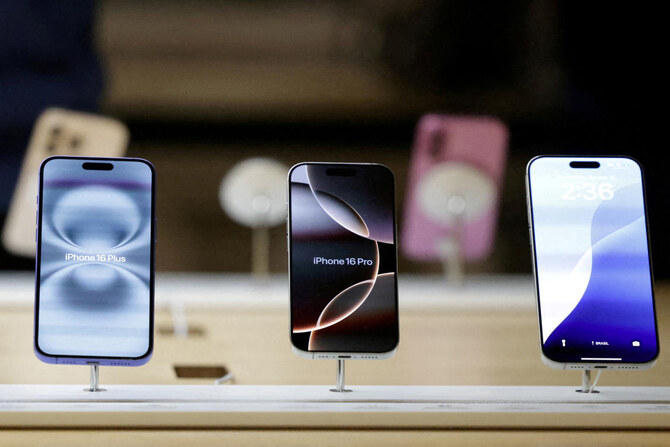
Apple’s fourth quarter ended Sept. 28, meaning it reflects only a few days of sales of its iPhone 16 series that went on sale Sept. 20. Apple Chief Executive Tim Cook told Reuters that iPhone 16 sales grew faster than iPhone 15 sales did a year earlier, with both phones on sale for the same number of days in the fourth quarter.
Cook also said Apple customers are downloading a new version of its iPhone operating system with what it calls Apple Intelligence features at twice the rate they had the year before.
“We’ve had great feedback from customers and developers already,” Cook said. “We’re off to a good start.”
Tom Forte, an analyst at Maxim Group, attributed Apple’s slight share drop to China sales coming in below expectations.
“We see the potential for sustained weakness in China as we await additional details on the earnings call regarding the potential timing of Apple Intelligence in that important country,” Forte said.
Apple’s call with analysts began at 5 p.m. ET (2100 GMT).
The rollout of Apple’s artificial-intelligence strategy, which it revealed this year, hinges on how well its new phones sell.
Rather than introduce AI in a standalone app or service, Apple has sprinkled Apple Intelligence throughout its most recent operating systems as new features, such as the ability to help re-write an email in a more professional tone. Those features will mostly be available on iPhone 16 models, which feature more powerful computing chips, although the pro versions of the iPhone 15 both work with Apple Intelligence. While some of those Apple Intelligence features arrived this week, others have been delayed, which has led some Wall Street analysts to wonder whether consumers will be slower to upgrade their devices this year while flagship software features trickle out.
The early iPhone 16 results on Thursday could allay some of those concerns. IPhone sales helped steady Apple’s fourth-quarter sales in China, which were down less than 1 percent to $15.03 billion overall. Analysts were expecting China sales of $15.78 billion on average, according to data from Visible Alpha.
Apple’s rivals Microsoft and Meta both said this week they expect continued increases in spending to support their AI strategies. Apple said payments for property and equipment — a measure of its capital expenditures — were up $2.91 billion from the previous quarter to $9.45 billion.
Apple’s lower spending comes in part because it uses third-party data centers for some AI work. Some aspects of Apple Intelligence do rely on Apple’s own data centers, but the company is using its own in-house chips to power those features.
“There would be some (financial) benefit to us by using our own silicon, obviously, but that’s not the reason we’re doing it. We’re doing it because we can provide the same standard of privacy and security that we can provide on device,” Cook said.
Sales in Apple’s services business, which includes iCloud storage and Apple Music, were $24.97 billion, compared with analyst expectations of $25.28 billion, according to LSEG. Mac and iPad sales were $7.74 billion and $6.95 billion, respectively, compared to estimates of $7.82 billion and $7.09 billion, according to LSEG data.
Sales in Apple’s home and wearables business, which includes its Apple Watch and AirPods devices, fell to $9.04 billion, compared with estimates of $9.2 billion, according to LSEG.
Earnings per share were 97 cents including the charge related to a one-time multi-billion-euro European tax payment.


![]()

Apple results top Wall Street targets on strong iPhone sales, shares drop on outlook
Short Url
https://arab.news/zw85s
Apple results top Wall Street targets on strong iPhone sales, shares drop on outlook
- Early iPhone 16 sales grew faster than iPhone 15 sales, says CEO Tim Cook
- Apple’s AI strategy includes new iPhone 16 features
Latest updates


© 2026 SAUDI RESEARCH & PUBLISHING COMPANY, All Rights Reserved And subject to Terms of Use Agreement.