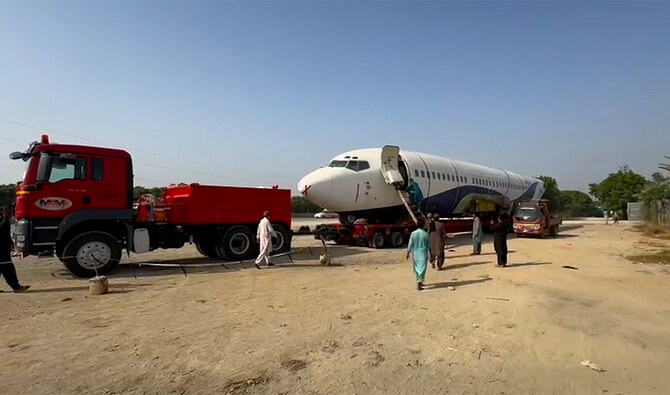
KARACHI: A private moving company is transporting a decommissioned Boeing 737 airplane between two cities in southern Pakistan by road, with video clips of the unusual journey widely shared on electronic and social media on Thursday.
The 200-seater plane took its first flight on Mar. 1, 1991 and was operated across Europe and the Middle East. It was retired in Karachi in 2014 after over 23 years in service and is now being shifted to Hyderabad for training purposes by New Babar Cargo Movers.
Although it takes around two hours to reach Hyderabad from Karachi by road, the plane’s journey is expected to take longer as the aircraft is being moved at a cautious speed. Transporting the plane on a 40-wheel trailer also required dismantling its wings, engines and wheels to enable safe intercity travel on the M-9 Motorway, the mover company said in a statement.
“The aircraft has crossed Karachi Toll Plaza and is now traveling from the M-9 Motorway toward Hyderabad,” the brief statement shared among media groups said, with local channels widely broadcasting visuals of the plane mounted on the trailer. “It will be driven at a speed of 20 to 30 kilometers an hour.”
Pakistan’s Geo TV quoted motorway police as saying the highway between the two cities would not be blocked during the transfer.
The vehicle carrying the aircraft has been instructed to drive on one side of the road, escorted by Civil Aviation Authority staff and security.
“The plane is being moved as per protocol,” the channel reported.
A notice from the National Highways and Motorway Police dated Oct. 31 said the transporter would be responsible if NHA property was damaged during the move or if any harm was caused to commuters.
“In case of any untoward incident or fatal accident during the transportation, the sole responsibility shall rest on the transporter,” the NHA said.

Media glee in Pakistan as Boeing 737 moved from Karachi to Hyderabad by road
https://arab.news/nya5d
Media glee in Pakistan as Boeing 737 moved from Karachi to Hyderabad by road
- Plane was retired in Karachi in 2014 and will be used for training purposes in Hyderabad
- Transporting plane on a 40-wheel trailer required dismantling its wings, engines and wheels
Too warm to freeze: Climate shift threatens ice hockey in Pakistan’s Hunza Valley
- Rising temperatures, falling snowfall disrupt community-run tournament dependent on natural ice
- Scientists report shorter snow seasons across Hindu Kush-Himalayan region as climate risks grow
HUNZA, Pakistan: Aleena Gul used to watch the pool beside her home in Pakistan’s Hunza Valley freeze solid each winter, transforming it into a makeshift ice hockey rink.
This year, it barely froze at all.
“If we see, there’s a big difference between 2018 and now in 2026,” said Gul, a local player whose family has hosted the community tournament for eight seasons.
“Winter used to begin in November and everything would freeze, . It’s January now and the ice still hasn’t frozen properly,” said Gul, a local player whose family has hosted the community tournament for eight seasons.
The change has disrupted a small but growing winter sports tradition in the mountainous region near the Chinese border, where residents say colder, longer winters once provided reliable natural ice.
Scientists studying the wider Hindu Kush-Himalayan region have reported fewer extreme cold events and shorter snow seasons, with snowfall increasingly failing to settle. Weather data for Hunza shows winter precipitation down by about 30 percent since the late 2010s, with some recent winters two to three degrees Celsius warmer.
That is a challenge for a region reliant on visitors, where winter tourism depends heavily on snowfall and freezing temperatures.
The community-run ice hockey tournament in Hunza depends entirely on natural ice. When Gul’s pool failed to freeze properly this year, organizers scrambled to find an alternative venue nearly two hours north, in a town close to the Chinese border.
Even there, conditions were difficult.
“I expected better ice conditions, but when I saw the rink I felt a bit sad. Many of our players fell. The surface had too many bumps and wasn’t strong,” said Yahya Karim, another player.
Of three matches scheduled on the first day, only one went ahead.
“Today, we got ready at almost around 9 o’clock. When we got called for the match, we saw that the ice was not in a good condition. So, all these things are very unexpected for us. And this is a side effect of climate change,” Gul said.
Naseer Uddin, co-founder of the youth organization SCARF, said volunteers had worked for about a week preparing the arena.
“We worked on this arena for about a week. We had planned [a match] here. Then, suddenly, when the sun came out today, so we had to switch suddenly because the ice in this arena has been spoiled,” he said.
Sadiq Saleem, president of the Altit Town Management Society, said residents were witnessing a noticeable change.
“We are witnessing a sudden shift in Hunza’s weather pattern, [both] in the snowfall and freezing [temperature] here. We are seeing a big shift in the intensity of winter here,” he said.
The girls’ match eventually went ahead, and Gul’s team emerged victorious. But the uncertainty over ice conditions has left many wondering how long the tradition can survive.
Climate change has become a growing concern for Pakistan, which contributes less than 1 percent of global greenhouse gas emissions yet is frequently ranked among the countries most vulnerable to global warming.
This week, Pakistan’s National Disaster Management Authority warned of an elevated risk of glacial lake outburst floods in the north as rising temperatures threaten to accelerate snow and glacier melt. Seasonal forecasts point to higher-than-normal temperatures and possible early heatwave conditions in Gilgit-Baltistan and upper Khyber Pakhtunkhwa, regions that include Hunza.
For now, players in the valley are making do with what winter brings. But as temperatures rise, even a simple backyard rink is no longer guaranteed.


