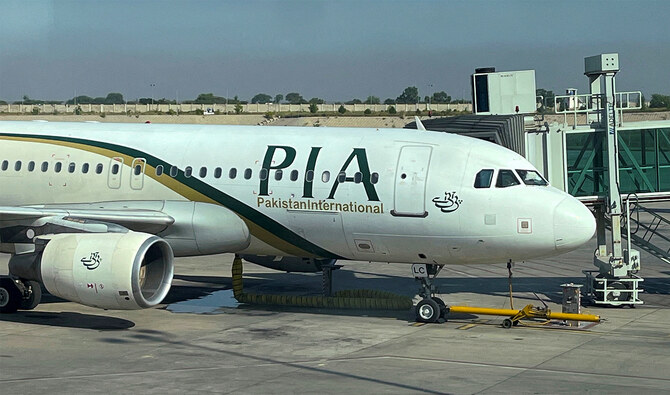
KARACHI: The bidding process for Pakistan’s national airline will open on Thursday, with just one participant in the first major privatization in over a decade.
The cash-strapped country is looking to offload a 51-100 percent stake in debt-ridden Pakistan International Airlines (PIA) to raise funds and reform bleeding state-owned enterprises as envisaged under a $7 billion International Monetary Fund (IMF) program.
The Privatization Ministry said that the process would begin at 1:30 p.m. (0830 GMT) and bids will be opened at 6:30 p.m. in Islamabad.
The government had pre-qualified six groups in June, but only one — real estate development company Blue World City — met a Tuesday deadline to submit final documents to participate in the process.
Officials from three groups that chose not to bid told Reuters on condition of anonymity that there were concerns about the government’s ability to stand by agreements made for the flag carrier in the long term.
One executive voiced concern about policy continuity once a new government came in. The government of Prime Minister Shehbaz Sharif has relied on a coalition of disparate political parties.
The disposal of PIA is a step former governments have steered away from as it has been highly unpopular given the number of layoffs that would likely result from it.
Underpinning these concerns over policy continuity and honoring contracts was the government’s termination of power purchase contracts with five private companies earlier this month, as well as the process of re-negotiating other sovereign guaranteed pacts.
Changes in Pakistan’s decade-old agreements with private Independent Power Producer (IPP) projects, largely financed by foreign lenders, to address chronic power shortages, “raises the risk of investing as well as doing business in Pakistan, even in the presence of sovereign contracts as well as guarantees,” said Sakib Sherani, an economist who heads private firm Macro Economic Insights.
Other concerns raised by potential bidders included inconsistent government communication, unattractive terms and taxes on the sector, in addition to PIA’s legacy issues and reputation.


Pakistan to hold final bidding for national airline with shortlist of one
https://arab.news/gc3my
Pakistan to hold final bidding for national airline with shortlist of one

- Groups choosing not to bid raise concerns about government’s ability to meet commitments in long term
- Pakistan previously stayed away from disposing of PIA since it is likely to involve a large number of layoffs

Pakistan rules out talks with Afghanistan, says over 330 Afghan fighters killed in clashes
- Clashes between the neighbors erupted after Pakistan’s airstrikes on Afghan territory last weekend
- US voices support for Pakistan, Information Minister Attaullah Tarar says they aim to make Pakistan safe
ISLAMABAD: Pakistan has ruled out any talks with Afghanistan until an end to “terrorism” emanating from the Afghan soil, officials said on Friday, following the killing of more than 330 Afghan fighters in cross-border clashes this week.
The latest clashes between the neighbors erupted after Pakistan’s airstrikes on Afghan territory last weekend triggered Afghan retaliatory attacks along the border on Thursday, escalating long‑simmering tensions over Pakistan’s claim that Afghanistan shelters Pakistani Taliban militants. Afghanistan denies this and argues Pakistan is deflecting blame for its own security failures.
Pakistani Information Minister Attaullah Tarar said they had killed 331 Afghan fighters, destroyed over 100 posts and targeted 37 military locations across Afghanistan. Afghan officials have said that more than 50 Pakistani soldiers have been killed and several Pakistan posts have been captured by their forces. None of the casualty figures or battlefield claims from either side could be independently verified.
Meanwhile, Mosharraf Zaidi, Prime Minister Shehbaz Sharif’s spokesperson for foreign media, ruled out any talks with Afghanistan until Kabul addresses the issue as the United States (US) expressed his support for what it called Pakistan’s “right to defend itself” against attacks from Afghanistan’s Taliban rulers.
“There won’t be any talks, there is nothing to talk about... Terrorism from Afghanistan has to end,” Zaidi told Pakistani state media, saying Islamabad would continue to target militant havens inside Afghanistan.
“Pakistan’s responsibility is to protect its citizens. If we know that there is a terrorist in point A and we know that there is a terrorist enabler at point A, we will find a weapon to land at point A and eliminate the threat.”
Zaidi said he didn’t expect Pakistan to deviate from this position and that the government had clearly conveyed what it was doing.
“We have clearly articulated what we are doing and what we plan on continuing to do and what it will take for us to stop doing what we are doing,” Zaidi said.
“And we will expect that both the international community and the regime in question, the Afghan Taliban, will come to their senses and will help reduce instability and disorder in this region.”
Pakistan is a major non-NATO ally of Washington, while the US considers the Afghan Taliban to be a “terrorist” group.
“The United States supports Pakistan’s right to defend itself against attacks from the Taliban, a Specially Designated Global Terrorist group,” Reuters quoted a State Department spokesperson as saying. US diplomat Allison Hooker said on X she spoke on Friday with Pakistan Foreign Secretary Amna Baloch.
The State Department spokesperson said Washington was aware of the escalation in tensions and “outbreak of fighting between Pakistan and the Afghan Taliban,” adding the US was “saddened by the loss of life.”
“The Taliban have consistently failed to uphold their counterterrorism commitments,” the State Department said, adding that “terrorist groups use Afghanistan as a launching pad for their heinous attacks.”
Meanwhile, Afghan Taliban spokesperson Zabihullah Mujahid called for talks to resolve the crisis.
“We have always emphasized peaceful resolution, and now too we want the issue to be resolved through dialogue,” he said on Friday afternoon.
Asked what Pakistan desired, Information Minister Tarar said: “Neutralizing the threat and ensuring that Pakistan is safe.”
“Because for us, we’ve been good neighbors, we’ve been very friendly neighbors, we’ve been very, very generous neighbors. Our generosity, unfortunately, has often been seen as our weakness,” he told state media.
“So the objective, aim is to neutralize the threat and make Pakistan safe.”
To a question about a ceasefire, Tarar said it was “too early” to comment on that as it was an evolving situation.


