

Report says crowd-sourced fact checks on X fail to address flood of US election misinformation

Short Url
Updated 31 October 2024
Follow

Report says crowd-sourced fact checks on X fail to address flood of US election misinformation

SAN FRANCISCO, California: X’s crowd-sourced fact-checking program, called Community Notes, isn’t addressing the flood of US election misinformation on Elon Musk’s social media platform, according to a report published Wednesday by a group that tracks online speech.
The nonprofit Center for Countering Digital Hate analyzed the Community Notes feature and found that accurate notes correcting false and misleading claims about the US elections were not displayed on 209 out of a sample of 283 posts deemed misleading — or 74 percent.
Misleading posts that did not display Community Notes even when they were available included false claims that the 2020 presidential election was stolen and that voting systems are unreliable, CCDH said.


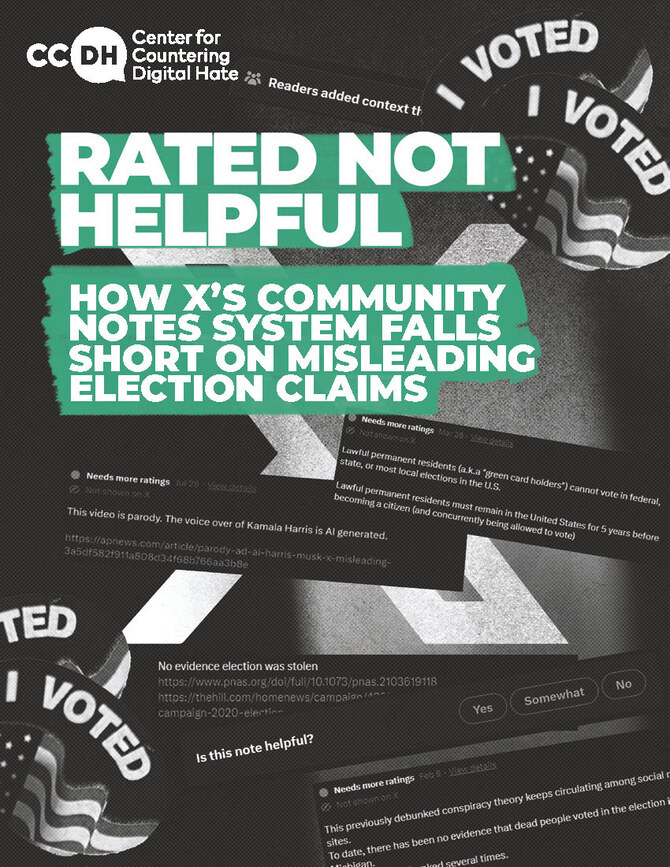
From a page of the "Rated Note Helpful" report of the Center for Countering Digital Hate

In the cases where Community Notes were displayed, the original misleading posts received 13 times more views than their accompanying notes, the group added.
Community Notes lets X users write fact checks on posts after the users are accepted as contributors to the program. The checks are then rated by other users based on their accuracy, sources, how easily they are to understand, and whether they use neutral language. The program was launched in 2021 by the previous leadership of the site — then known as Twitter — and was called Birdwatch. Musk renamed it Community Notes after he took over the site in 2022.


Formerly known as Birdwatch under the old Twitter, the program was renamed Community Notes after Elon Musk took over the popular social media platform in 2022 and renamed it X. (Image courtesy of X)

Last year, X sued CCDH, blaming the group for the loss of “tens of millions of dollars” in advertising revenue after it documented an increase in hate speech on the site. The lawsuit was dismissed by a federal judge in March.
Keith Coleman, a vice president of product at X who oversees Community Notes, said in a statement that the program “maintains a high bar to make notes effective and maintain trust across perspectives, and thousands of election and politics related notes have cleared that bar in 2024. In the last month alone, hundreds of such notes have been shown on thousands of posts and have been seen tens of millions of times. It is because of their quality that notes are so effective.”
San Francisco-based X also pointed to external academic research that has shown Community Notes to be trustworthy and effective.
Imran Ahmed, the CEO of CCDH, however, said the group’s research “suggests that X’s Community Notes are little more than a Band Aid on a torrent of hate and disinformation that undermines our democracy and further polarizes our communities.”


Meta to charge Arab advertisers extra fee for reaching European audiences

Updated 11 March 2026
Follow

Meta to charge Arab advertisers extra fee for reaching European audiences

  • US tech giant told advertisers it will add fees ranging from 2 to 5 percent on image and video ads delivered on its platforms to offset digital service taxes
  • Charges are determined by where the audience is located, not where the advertiser is based

LONDON: Meta will from July 1 impose location-based surcharges on advertisers targeting audiences in six European countries, a move that will directly affect Arab businesses that run campaigns across the continent.

The US tech giant announced it will add fees ranging from 2 to 5 percent on image and video ads delivered on its platforms, including Facebook, Instagram and WhatsApp, to offset digital service taxes imposed by individual governments.

Crucially, the charges are determined by where the audience is located, not where the advertiser is based.

That means Saudi, Emirati, Egyptian or other Arab companies paying to reach consumers in the UK, France or Italy will face the additional costs regardless of their own country’s tax arrangements with Meta.

Fees will apply at 2 percent for ads reaching UK audiences, 3 percent for France, Italy and Spain, and 5 percent for Austria and Turkiye.

“If you deliver $100 in ads to Italy, where there is a 3% location fee, you will be charged $100 (ad delivery), plus $3 (location fee), for $103 total,” the company wrote in an email to an advertiser initially reported by Bloomberg. “Note that any applicable VAT will be calculated on top of the total amount.”

The taxes have been introduced at different points, starting with France in 2019, though not the EU as a bloc.

Many tech companies report substantial sales in Europe and millions of users but pay minimal tax on profits. The goal is to claw back locally derived economic value, Bloomberg reported.

The move follows similar decisions by Google and Amazon, which have also begun passing European digital tax costs on to advertisers.

For Arab brands with growing European footprints, particularly in fashion, travel, hospitality and media, the new fees add another layer of cost to campaigns already subject to currency and targeting complexities.

Digital services taxes, levied as a percentage of revenues earned by major tech platforms in individual countries, have drawn criticism from Washington, which argues they unfairly target US companies.

Meta has been reached for comments.