

Data-driven tech helping to reduce impact of severe weather events

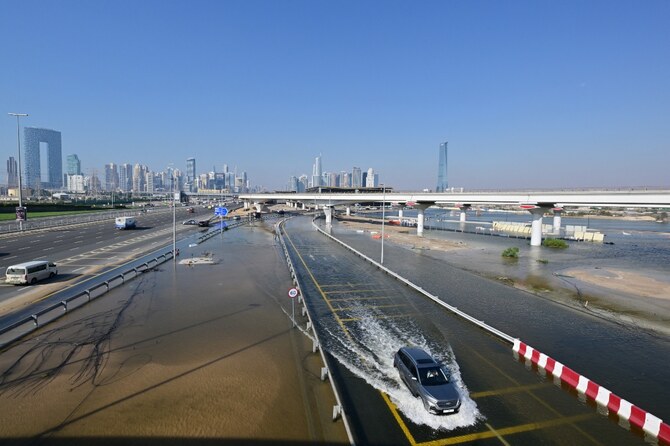
In April, 142 mm of rain fell on the UAE in 24 hours — the same amount usually over a year-and-a-half, and the heaviest in 75 years. (FILE/AFP)
Short Url
Updated 29 October 2024
Follow

Data-driven tech helping to reduce impact of severe weather events

  • Better predictions of rainfall and flooding increasingly possible
  • Data is key, says Naji Atallah, EMEA Emerging markets, Autodesk

SAN DIEGO: Severe weather events across the Middle East are becoming increasingly common, but advanced data-collection technology is now being used to mitigate these effects on cities today and hopefully in the future.

According to the website Statista.com, flooding between 2013 and 2023 resulted in economic insured losses of an estimated $98.2 billion.

The report goes on to say that 2021 was the year with the highest insured losses caused by flooding events during that decade at $24.2 billion.

The human cost alone is of concern. In 2021 the World Economic Forum reported that storms had claimed over 577,000 lives, and almost 59,000 people died in floods.

In April, 142 mm of rain fell on the UAE in 24 hours — the same amount usually over a year-and-a-half, and the heaviest in 75 years.

Five people reportedly died in the storms that also flooded homes, malls, streets and even Dubai’s busy international airport. The country was brought to a standstill as cars were submerged.

According to Naji Atallah, head of construction and manufacturing, EMEA Emerging markets at Autodesk, such weather is going to become more frequent as climate change continues.

But as more information is gathered on such events then more can be done to reduce the impact, and in some cases turn these events into an advantage.

Speaking on the sidelines of the recent Autodesk University 2024: The Design and Make Conference in San Diego, US, Atallah told Arab News that incidents such as flash floods can be prevented, or the impact at least reduced if a large amount of data is available.

“Floods, more intense rainfall, or more intense droughts are becoming more frequent,” he explained. “So a city that designed its infrastructure for a one-in-100-year storm will be capable of coping with a probability of 1 percent. for a storm of that magnitude.”

But he said there was now a greater frequency to these major weather events. So a storm that would have previously occurred once every 100 years, is now likely to occur once every 10 years, making the need for improvements much more necessary.

“At some point there will be a storm event that’s beyond the capacity of that design and then flooding will occur. So, the intention should be to make the flood events predictable and manageable.”

He said there are currently cities in the Middle East using software to help design drainage systems and prioritize areas that need intervention when flooding occurs.

Atallah said that rapid urbanization was contributing to increased flooding because it has reduced drainage areas.

Information remains key, he said.

“It is all about data,” Atallah explained. “These models are extremely rich in data, which means you can simulate different scenarios and how the water will behave, where it will go.”

In cities such as Dubai, where fleets of tankers are used for drainage, there can be better predictions of high-risk areas and therefore the deployment of these vehicles.

In addition, Atallah said scenario-mapping can help determine where to create channels and storage areas where flash floods are most likely — basically creating lakes or reservoirs.

This is especially important in areas such as the Gulf region, he said, as water is high in demand but low in supply.

He said cities in the UAE and Saudi Arabia are already working on projects to counter future weather events. This includes Jeddah, which is particularly flood-prone.

Atallah said there was still a lot to be learned.

And he hopes the advancements in technology, including artificial intelligence, would help mitigate the effects of major weather events detrimental to human habitats.


US condemns Houthi detention of embassy staff in Yemen. Guterres seeks release of all detained UN staff

Updated 22 min 25 sec ago
Follow

US condemns Houthi detention of embassy staff in Yemen. Guterres seeks release of all detained UN staff

  • US State Department says the sham proceedings only prove that the Houthis rely on the use of terror against their own people to stay in power
  • UN Secretary General says the continued Houthi detention and prosecution of UN personnel is a violation of international law

WASHINGTON/UNITED NATIONS: The US on Wednesday condemned the ongoing detention of current and former local staffers of the US embassy in Yemen by the Houthi movement.
“The United States condemns the Houthis’ ongoing unlawful detention of current and former local staff of the US Mission to Yemen,” US State Department spokesperson Tommy Pigott said in a statement.
“The Houthis’ arrests of those staff, and the sham proceedings that have been brought against them, are further evidence that the Houthis rely on the use of terror against their own people as a way to stay in power,” Pigott said.

Earlier, United Nations Secretary-General Antonio Guterres called on Houthi rebels not to prosecute detained UN personnel and to work “in good faith” to immediately release all detained staff from the UN and foreign agencies and missions.
Guterres condemned the referrals of the UN personnel to the Houthis’ special criminal court and called the detentions of UN staff a violation of international law, UN spokesman Stephane Dujarric said.
There are currently 59 UN personnel, all Yemeni nationals, detained by the Iranian-backed Houthis, in addition to dozens from nongovernmental organizations, civil society and diplomatic missions, he said.
He said a number of them have been referred to the criminal court in Yemen’s capital, Sanaa. “There were procedures going on in the court, I believe, today and all of this is very, very worrying to us,” Dujarric said.
The court in late November convicted 17 people of spying for foreign governments, part of a yearslong Houthi crackdown on Yemeni staffers working for foreign organizations.
The court said the 17 people were part of “espionage cells within a spy network affiliated with the American, Israeli and Saudi intelligence,” according to the Houthi-run SABA news agency. They were sentenced to death by firing squad in public, but a lawyer for some of them said the sentence can be appealed.
UN human rights chief Volker Türk said in a statement Tuesday that one of those referred to the court was from his office. He said the colleague, who has been detained since November 2021, was presented to the “so-called” court “on fabricated charges of espionage connected to his work.”
“This is totally unacceptable and a grave human rights violence,” Türk said.
He said detainees have been held in “intolerable conditions” and his office has received “very concerning reports of mistreatment of numerous staff.” Dujarric said some have been held incommunicado for years.
Dujarric said the UN is in constant contact with the Houthis, and the secretary-general and others have also raised the issue of the detainees with Iran, Saudi Arabia, Oman and others.
The Houthis seized Sanaa in 2014 and since then they have been engaged in a civil war with Yemen’s internationally recognized government, which is supported by a Saudi-led military coalition.
The November verdict was the latest in the Houthi crackdown in areas of Yemen under their control. They have imprisoned thousands of people during the civil war.