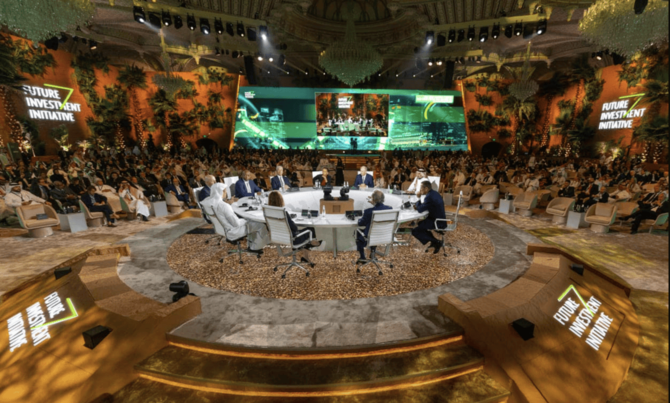

RIYADH: Whether through securing $17.9 billion in deals, or hosting the largest-ever voluntary carbon market auction, recent Future Investment Initiative forums have shifted the dial when it comes to sustainability.
With Riyadh gearing up to hold the eight edition of the event, the success of previous gatherings means that all eyes will be on the more than 7,100 expected attendees to deliver yet another headline-making forum.
Set to be held from Oct. 29-31, FII8 is already set to announce $28 billion in deals, according to FII Institute CEO Richard Attias.
That figure will be added to the over $128 billion in agreements sealed across past editions.
FII7, which took place between Oct. 24-26 2023, saw deals worth $17.9 billion signed, covering sectors such as aerospace, energy, and manufacturing, reflecting the forum’s role as a catalyst for economic growth.
Saudi Arabia’s energy ambitions were a focal point at FII7, showcasing the Kingdom’s commitment to balancing traditional hydrocarbon investments with renewable power.
Among the major agreements signed was ACWA Power’s financing deal for a wind energy project in Azerbaijan.
The FII Institute also launched its Inclusive ESG Tool, designed to drive sustainability efforts in emerging markets, providing companies and investors with clearer metrics on environmental, social, and governance performance.
Developed in collaboration with London firm ESG Book, the initiative is designed to close the $5.4 trillion investment gap in sustainable projects in developing regions.
AI dominated the discussions at FII7, with leaders exploring its transformative potential across various sectors, including finance, healthcare, and industry.
As Goldman Sachs predicted that AI investments could reach $200 billion by 2025, speakers at the forum highlighted how the technology is reshaping industries and driving productivity.
Sessions emphasized the need for robust regulatory frameworks to ensure AI benefits society while managing its risks.
Experts also pointed to the complementary relationship between AI and emerging technologies such as blockchain, which are set to revolutionize financial services.
The forum took place against the backdrop of the then upcoming COP28, with a focus on sustainability and climate justice.
A special session brought together stakeholders from the Global South to shape carbon market frameworks, positioning these countries to lead biodiversity conservation and climate action efforts.
FII7 succeeded in its mission to unite global leaders in tackling the most pressing issues of our time.
FII6
At FII6, held in Riyadh in October 2022, the Kingdom’s Public Investment Fund and the parent company of the country’s stock exchange, the Tadawul Group, led a carbon market auction, with participation from 15 leading Saudi and regional entities.
Prominent companies such as Aramco, Olayan Financing Co., and Saudi Arabian Mining Co. were among the key buyers of carbon credits, marking a significant step in regional efforts to offset carbon emissions and invest in environmentally conscious initiatives.
This edition of the forum also saw PIF announce plans to establish five companies aimed at driving investment in neighboring countries.
These companies would focus on key sectors in Bahrain, Iraq, Jordan, Oman, and Sudan.
The total planned investment amounted to $24 billion, reflecting Saudi Arabia’s broader economic strategy of fostering regional development and enhancing cross-border economic ties in alignment with its Vision 2030 goals.
The companies have been rolled out since FII6, including the establishment of Saudi-Bahraini Investment Co. in November 2022 with an investment of $5 billion, and the Saudi-Iraqi Investment Co. in May 2023 with a capital of $3 billion.
The 2022 event, themed “Investing in Humanity: Enabling a New Global Order,” also served as a platform for the announcement of significant investments by the FII Institute.
The institute revealed a $600,000 investment in Dogtooth Technologies, a UK-based startup that develops fruit-picking robots designed to reduce crop wastage and cut CO2 emissions.
A similar $600,000 investment was made in Seafood Souq, a technology company offering a digital solution for seafood traceability, further underscoring the FII Institute’s commitment to supporting innovation in industries vital to global food security and sustainability.
Another key highlight of the event was the launch of the Algoritmi Prize, an annual award established by the FII Institute in collaboration with global research publisher Springer Nature.
The prize was aimed at promoting cutting-edge research in artificial intelligence and robotics, with a focus on finding technological solutions to some of the world’s most pressing challenges.
Held at the King Abdulaziz International Conference Center in Riyadh, the event attracted a high-profile roster of global leaders from the realms of business, politics, and civil society.
Notable attendees included the President of Senegal, Macky Sall; the Prime Minister of Pakistan, Shehbaz Sharif; the Greek Minister of Development and Investments, Adonis Georgiadis; and the Finnish Minister for Development Cooperation and Foreign Trade, Ville Skinnari.