

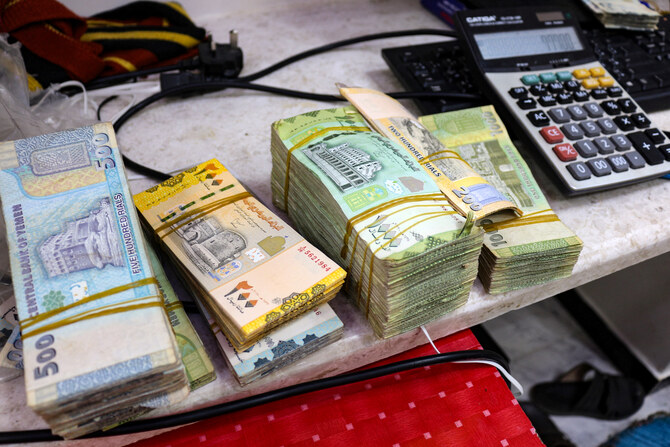

AL-MUKALLA: The Yemeni riyal fell to 2,045 against the dollar in government-controlled areas on Sunday, just days after an all-time low of 2,000.
As the Yemeni government and its financial institutions called for an international bailout, money traders and local media said the riyal was on track to break another record of 2,100 against the dollar.
The riyal traded at 215 against the dollar during the early months of the war, which began after the Houthi militia forcibly took power a decade ago.
Violent protests have erupted in Aden, the interim capital, and other cities in recent years, as the riyal’s depreciation has raised food, fuel and transportation prices.
The Aden-based central bank has shut down unlicensed exchange firms and ships, as well as those not following its monetary rules. It has ordered the relocation of banks from Houthi-controlled Sanaa to Aden, and sold dollars from its dwindling foreign currency reserves in public auctions to help local traders obtain enough to import food and other essentials.
But the measures have failed to support the riyal, which fell from around 1,200 per dollar in April 2022, following the formation of the Presidential Leadership Council, to 2,000 a week ago.
The government has blamed the Yemeni riyal’s devaluation on Houthi attacks on oil terminals in the southern provinces of Hadramout and Shabwa, which resulted in a halt in oil exports, as well as currency speculation by local money traders and exchange firms.
It comes as Ahmed Ghaleb, governor of Aden’s central bank, reiterated a governmental appeal to the international community to help contain the riyal’s depreciation and ensure it can continue meeting financial obligations such as paying salaries.
According to official Yemen news agency SABA, Ghaleb, currently in Washington DC, said during a meeting with US Yemen envoy Tim Lenderking that the Houthis’ strikes on oil facilities in late 2022, as well as their attacks on international shipping, had deprived the Yemeni government of its main source of revenue. They had also increased shipping and insurance costs, exacerbating the country’s humanitarian crisis.
Speaking last week to a gathering of central bank governors and financial ministers from the Middle East, North Africa, Afghanistan and Pakistan region, Ghaleb said Yemen had lost over $6 billion in revenue in the 30 months since its oil exports stopped. He also said Houthi attacks on ships had disrupted the flow of supplies and escalated poverty and food insecurity.
The Yemeni government has repeatedly said it cannot pay employees in areas under its control without financial aid.
Teachers, security and military personnel, and other government employees in Aden, Al-Mukalla and other government-controlled cities have complained their salaries are paid weeks late and have lost value due to the riyal’s depreciation.
“Salaries are paid late, losing value. The teacher, who previously received $320, is now paid $53. We went on strike to protest the collapse of salaries, but no one paid attention,” Abu Mohammed, a teacher from Hadramout province, told Arab News on Sunday.


