

Arab Film Festival ‘challenges stereotypes, promotes dialogue’ in the US

A still from opening film 'Life is Beautiful.' (Supplied) 
Short Url
Updated 27 October 2024
Follow

Arab Film Festival ‘challenges stereotypes, promotes dialogue’ in the US

DUBAI: The Arab Film Festival, now in its 28th year, is taking place in San Francisco — and managing director Maya Labban says it aims to “challenge stereotypes and promote dialogue.”

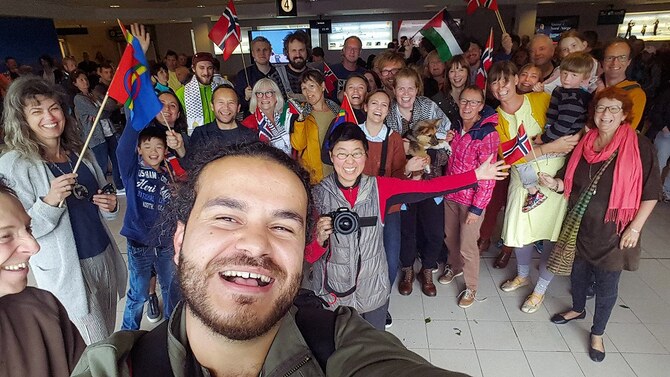
Set to run until Nov. 3, it opened with a poignant documentary by Palestinian filmmaker Mohamed Jabaly called “Life is Beautiful: A Letter to Gaza.”

The film tells the heart wrenching tale of Jabaly’s unexpected exile in Norway after Gaza’s borders were closed abruptly in 2014. Finding himself far from home, stranded and stateless, it charts Jabaly’s journey of emotional and physical separation from his family. It portrays both the warmth and hope found in new friendships in Norway and the despair, sadness and grief he feels toward his displacement and the violence in his homeland.

It was the first time the festival opened with a documentary. Labban told Arab News: “The Arab Film Festival is not only a celebration of cinema but also an essential cultural event that fosters understanding, challenges stereotypes, and promotes dialogue.

“In the current political climate, where representation matters more than ever, AFF provides a platform to amplify the voices of Arab American filmmakers and creatives. Because of the shared rage of inhumanity, we are actually starting to have great conversations with people in the movie industry.”

Established in 1996, the festival celebrates the best in contemporary Arab cinema and is the largest and oldest independent festival of Arab films outside the Arab world. Its mission is to provide authentic narratives that illuminate the complexity and richness of Arab culture. With screenings in the Bay area of California and online, AFF seeks to establish an important platform for filmmakers from the Arab world and beyond within the US.

This year, the program features more than 40 films from 26 countries, 16 of which are directed by women. It also includes filmmaker mixers, classic films, industry and community panels, talks and workshops. Select events will be streamed online. 

Other highlights include “From Ground Zero,” Palestine’s submission to the 97th Academy Awards which is a collection of 22 short films made in Gaza. Initiated by Palestinian director Rashid Masharawi, the project was born to give a voice to Gazan filmmakers and tell the untold stories of the current war.

Also in the program is “Arze,” directed by Mira Shaib from Lebanon. It tells of a struggling single mother in Beirut who supports her agoraphobic sister and teenage son, Kinan, by selling homemade pies. Meanwhile, “We Never Left,” directed by Loulwa Khoury, is a heart-wrenching depiction of life between Beirut and New York, capturing the tortured story of displaced Lebanese and a fervent ongoing love for their country.

“We are not just about entertainment, when we tell authentic Arab stories, we are reshaping perceptions and potentially the policies that are built on these perceptions,” said Labban.

“The more we diversify the narratives around Arabs, the more we can influence the broader cultural and political landscape to be more inclusive and just.”


At Jazan festival, Suad Al-Asiri paints memory, land and leadership

Updated 13 January 2026
Follow

At Jazan festival, Suad Al-Asiri paints memory, land and leadership

  • Local artist channels personal hardship into works that reflect Jazan’s identity, heritage
  • Jazan: A Nation and a Prince, places region at the heart of a composition featuring Prince Mohammed bin Abdulaziz and Prince Nasser bin Mohammed bin Abdullah bin Jalawi

RIYADH: At the Ahad Al-Masarihah pavilion at Jazan Festival 2026, Suad Al-Asiri’s paintings blend memory, place and personal history, offering visual narratives shaped by beauty and hardship. 

A novelist and visual artist, Al-Asiri has long used art as a storytelling tool. After a near-fatal car accident in March 2024, her work took on a new urgency. Bedridden for 11 months, cut off from the public world for more than a year, she describes that period as one of the most painful in her life — yet also transformative. 

“First of all, praise be to God for granting me life, as the accident was extremely severe,” she said. “By God’s grace, I was given a new life. All my thinking after the accident was about becoming an inspiration to others — about enduring pain and obstacles, and still leaving an impact.” 

Her return to public life came in 2025, when she participated in National Day celebrations with the ministry of interior. By the time she arrived at Jazan Festival, she was ready to channel that experience into her art. 

The centerpiece of her display, “Jazan: A Nation and a Prince,” places the region at the heart of a composition featuring Prince Mohammed bin Abdulaziz and Prince Nasser bin Mohammed bin Abdullah bin Jalawi, governor and deputy governor of Jazan respectively. 

Visitors linger over the details: the painting incorporates coffee beans, sesame and khudair — materials drawn from local products.

“I wanted people to recognize these products immediately,” she said. “They are part of Jazan’s daily life, and using them makes the work more tangible, more connected to everyday experience.” 

The painting sparks conversation. Visitors discuss leadership, identity, and the intimate relationship between people and their environment. 

Beyond the central piece, Al-Asiri presents individual portraits of the two princes, expanding the dialogue into a broader exploration of heritage and memory.  

Her journey into art is tied to her life as a storyteller. Early experiments with charcoal and pencil evolved into abstract art, drawn by its expressive freedom. 

From there, she explored realism, surrealism, and eventually modern art, particularly pop art, which has earned her wide recognition in artistic circles. Her novels and media work complement her visual practice, earning her the title “the comprehensive artist” from the governor.

Yet what stands out most in this exhibition is how Al-Asiri’s personal resilience flows through each piece. Her experience of surviving a devastating accident, enduring months of immobility, and returning to the public eye informs every brushstroke. 

Visitors sense not just her artistic skill, but her determination to turn life’s hardships into inspiration for others. 

Walking through the pavilion, one can see it in the way she blends heritage symbols, southern landscapes, and scenes of daily life. 

Each painting becomes both a document and a dialogue — a celebration of Jazan’s culture, a reflection on identity, and a testament to the power of human perseverance. 

At Jazan Festival 2026, Suad Al-Asiri’s art is a quiet, persistent inspiration for anyone who pauses long enough to listen.