


TBILISI: Georgia’s ruling party was on course to win a closely watched election Saturday, according to partial results that were rejected as “falsified” by pro-Western opposition parties which denounced a “constitutional coup.”
The election result would indicate a new setback to the Caucasus country’s bid to join the European Union and put it on a path of closer ties with neighboring Russia.
Brussels has harshly criticized the policies of the Georgian Dream governing party and has said the election will determine Georgia’s chances of joining the bloc.
With votes from more than 70 percent of precincts counted, the central election commission said Georgian Dream was leading with 53 percent, while the main opposition union was on 38 percent.
The result would give Georgian Dream 89 seats in the 150-member parliament — enough to govern but short of the absolute majority it wants to make sweeping constitutional changes. Final results were expected on Sunday.
“Georgian Dream has secured a solid majority,” the party’s executive secretary, Mamuka Mdinaradze, told reporters.
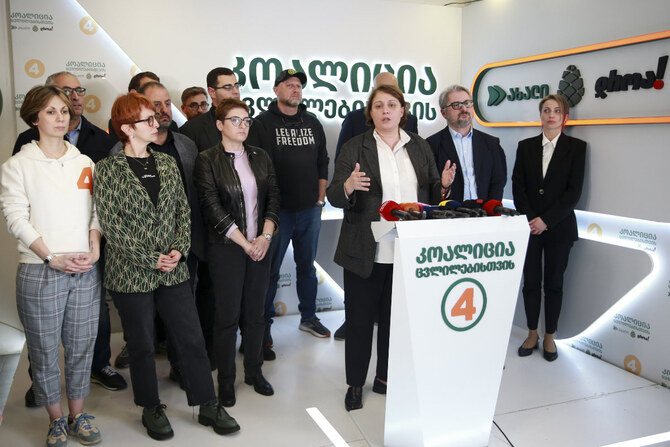
Tina Bokuchava, leader of the opposition United National Movement (UNM), said the results were “falsified” and the election “stolen.”
“This is an attempt to steal Georgia’s future,” she said.
Nika Gvaramia, leader of the Akhali party, called it a “a constitutional coup” by the government. “Georgian Dream will not stay in power,” he said.
The opposition has staged mass demonstrations in recent months against what it says are the government’s attempts to curtail democratic freedoms and steer the country of four million off its pro-Western course.
Rival exit polls published after voting ended had shown the ruling party and the opposition ahead.
Pro-opposition Georgian President Salome Zurabishvili hailed a victory for “European Georgia” despite “attempts to rig” the vote after one exit poll said the opposition won.
After another showed a win for the government, Georgian Dream’s billionaire founder Bidzina Ivanishvili hailed the party’s “success in such a difficult situation.”
“I assure you, our country will achieve great success in the next four years. We will do a lot,” he said.
Hungary’s nationalist Prime Minister Viktor Orban hailed Georgian Dream’s “overwhelming victory” on social media.
In Tbilisi, voters expressed diverging views over their country’s future direction as they cast ballots.
“Of course, I have voted for Europe. Because I want to live in Europe, not in Russia. So, I voted for change,” said Alexandre Guldani, an 18-year-old student.
But Giga Abuladze, who works in a kindergarten run by the Orthodox Patriarchate, said “We should be friends with Russia — and Europe.”
“There is an opposition and so be it but it mustn’t be disruptive. We need to help each other,” the 58-year-old said, praising Ivanishvili.
Opposition parties alleged incidents of ballot stuffing and intimidation during voting.
Zurabishvili said there had been “deeply troubling incidents of violence” at some polling stations.
A video circulated on social media showing a fight between dozens of men outside a polling station in suburban Tbilisi.
Another showed scuffles outside a campaign office in Tbilisi of the United National Movement (UNM), Georgia’s main opposition force, founded by jailed ex-president Mikheil Saakashvili.
The were also videos of an alleged ballot stuffing incident in the southeastern village of Sadakhlo.
“Global war party”
In power since 2012, the party initially pursued a liberal pro-Western policy agenda. But it has reversed course over the last two years.
Its campaign centered on a conspiracy theory about a “global war party” that controls Western institutions and is seeking to drag Georgia into the Russia-Ukraine war.
In a country scarred by Russia’s 2008 invasion, the party has offered voters bogeyman stories about an imminent threat of war, which only Georgian Dream could prevent.
In a recent TV interview, Ivanishvili painted a grotesque image of the West where “orgies are taking place right in the streets.”
Georgian Dream’s controversial “foreign influence” law this year, targeting civil society, sparked weeks of street protests and was criticized as a Kremlin-style measure to silence dissent.
The move prompted Brussels to freeze Georgia’s EU accession process, while Washington imposed sanctions on dozens of Georgian officials.
The ruling party has also mounted a campaign against sexual minorities. It has adopted measures that ban LGBTQ “propaganda,” nullify same-sex marriages conducted abroad, and outlaw gender reassignment.
The opposition coalition agreed a pro-European policy platform outlining far-reaching electoral, judicial and law enforcement reforms.
It had wanted an interim multi-party government to push through reforms before calling fresh elections.


