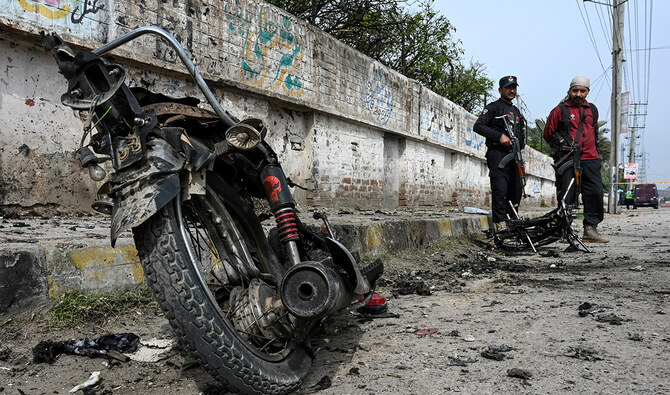
PESHAWAR: A suicide bomber detonated at a checkpoint in western Pakistan on Saturday, killing eight people and wounding five more, officials said.
The bomber set off the blast from the back of a motorbike rickshaw near the town of Mir Ali in Khyber Pakhtunkhwa province, a local police officer told AFP on condition of anonymity.
Four police officers were killed alongside two members of a state paramilitary force and two civilians in the attack near the border with Afghanistan, he said.
Pakistan has seen an increase in militancy since the Afghan Taliban returned to power in 2021, with Islamabad claiming hostile groups are now using the neighboring country for shelter.
“Among the five injured personnel, the condition of three is critical, and they have been transferred to a local military hospital,” the police officer said.
A local government official who also did not want to be named confirmed the same toll of dead and wounded.
The attack was claimed by a little-known militant group calling itself “Aswad ul-Harb.”
Another checkpost near the Afghan border was raided this week by the Pakistani Taliban, killing 10 police officers.
Last year, the country saw more suicide attacks than any year since 2014, according to the Pakistan Institute for Conflict and Security Studies.
There were 29 suicide attacks registered, killing 329 people in Pakistan’s deadliest year in a decade.


Police say eight killed in western Pakistan suicide bombing
https://arab.news/99ske
Police say eight killed in western Pakistan suicide bombing

- Incident happed near the town of Mir Ali in Khyber Pakhtunkhwa province
- An official says among the five injured people, three are in critical condition

Pakistan military says 13 militants killed in counterterror operations across northwest
- Military says counterterror operations launched in Bajaur, Bannu, Dera Ismail Khan, Khyber and South Waziristan districts
- The counterterror operations take place as Afghanistan and Pakistan remain locked in conflict since late last month
ISLAMABAD: Pakistani security forces this week killed 13 militants in five separate counterterror operations in the northwestern Khyber Pakhtunkhwa (KP) province, the military’s media wing said on Sunday, vowing to eliminate militancy from the country.
The counterterror operations were conducted on Mar. 6-7, with Pakistani troops killing five militants in the northwestern Bajaur district in the first operation. In two other encounters in Bannu and Dera Ismail Khan district, security forces killed three militants belonging to the Tehreek-e-Taliban Pakistan (TTP) militants, the Inter-Services Public Relations (ISPR) said.
Meanwhile, five other militants were killed in two separate counterterror operations in Khyber and South Waziristan districts in which five more militants were slain.
“Weapons and ammunition were also recovered from Indian-sponsored killed khwarij, who remained actively involved in numerous terrorist activities in the area,” ISPR said in a statement.
Pakistan’s military frequently uses the term “Fitna al Khwarij” to describe TTP militants. The militant outfit has carried out some of the deadliest attacks against Pakistani civilians and security forces since 2007 in a bid to impose their strict brand of Islamic law across the country.
Islamabad accuses Afghanistan of sheltering the TTP and facilitating their attacks against Pakistan, a charge Kabul has denied. Pakistan also accuses India of supporting these militant groups, which New Delhi has repeatedly rejected.
The counterterror operations take place as Pakistan remains locked in conflict with Afghanistan since late February.
The worst fighting between the two sides began late last month when Afghan forces launched a surprise attack on Pakistani military installations along their shared border. Afghanistan said the assault was in retaliation for Pakistan’s earlier airstrikes in February on what Islamabad described as militant camps inside Afghanistan.
Pakistan’s Information Minister Attaullah Tarar said on Saturday that Islamabad has killed 527 Afghan Taliban fighters and injured more than 755 since clashes began.
Afghanistan has also claimed attacking multiple Pakistani military bases and killing several Pakistani soldiers. Arab News has not independently verified the claims by both sides.
Pakistan has ruled out talks with Afghanistan and said it will continue its military operations in the country till it withdraws support for militant groups that Islamabad says operate from Afghanistan.


